
The Museo Universitario de Arte Contemporáneo presents a retrospective by Peruvian artist Fernando Bryce (Lima, 1965), who has been internationally recognized for his work since the 1990s.
The exhibition was curated by Natalia Majluf and Tatiana Cuevas, curators at the Museo de Arte de Lima, and at the Museo Universitario de Arte Contemporáneo, respectively. They joined forces to research and complete the curatorship for the largest exhibition ever dedicated to this artist since the 2005 anthological exhibition organized in Barcelona by the Fundació Antoni Tàpies. The exhibition includes 24 works—consisting of a total of 2,000 pieces—produced between 1997 and 2011, from public and private collections in Germany, Spain, the US, Peru, and Switzerland.
The work by Fernando Bryce is characterized by revealing the ideology behind the images. He tirelessly searches across a diversity of archives to find official documents, press material, dissident publications, political propaganda, or advertisements that he carefully selects and reproduces. He then presents these in a new format—drawing—to generate new interpretations. Bryce has developed his own method of systemizing his work. He relies on mimetic analysis to question—with his copies of originals—the visual sources and the relationships of power these reveal, as he reflects on the manner in which they are presented in the mass media. The artist creates a new message based on the interpretation of mass media images from periodicals and movie posters. The result is a reflection on the presentation and reception of certain ideologies, on history as a paradigm.
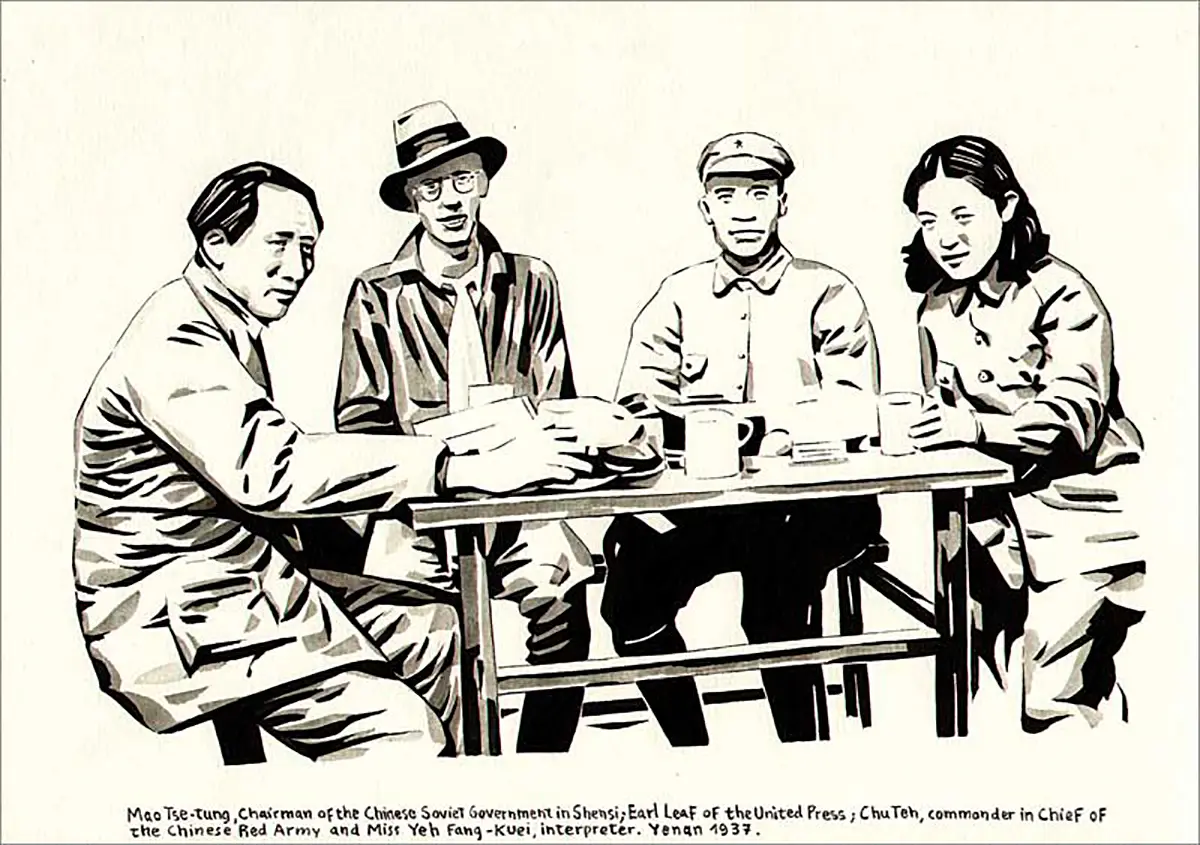
Bryce questions the official discourse and the manner in which these are presented in order to establish an institutional message that is more often than not biased. Through representation—literally understood as "presenting again"—he generates new discourses that tell a new story.
According to the curators, the compilation of several references into the same place reminds them of a system of thought capable of articulating the vision of specific moments through sources that can be dissonant.
Natalia Majluf mentions that Bryce is a self-proclaimed parahistorian who works outside the discipline. That which he produces as historic accounts is actually the combination of history, unofficial popular culture, and cultural studies, which is the critical element. But most important of all is the visual aspect of the work.
By re-signifying images of historical events—like the Spanish Civil War, fascism, or the colonial invasions—Bryce generates parodic and ironic instances to reveal the true nature of official discourses and prejudices, while also portraying in a global manner all the elements of a specific period in our collective memory.
One of Bryce’s most notable series, Vision of Western Painting, includes 39 reproductions of paintings and 96 copies of documents that attest to his conceptualization process and to the beginning of a museum of “universal art” reproductions in Peru. The selection of documents showcase the thought process of the staff members from this museum: namely, that European art from a certain period is the only type of art that has any value—along with all the rhetoric that surrounds this idea. The intention of this piece is clearly parodic while it also addresses the notion of reproduction as appropriation.
According to philosopher Walter Benjamin, the invention of photography, film and other mechanical tools that allowed the reproduction of images, offered the revolutionary possibility of ending the abyss that separated us from art; the aura that it once had begun to disappear since then, along with the “unrepeatable” quality is also used to possess.
Benjamin affirms that mass reproduction favors the reproduction of the masses. In giant and festive parades, monstrous gatherings, massive sports celebrations, and, why not, in war—today reproduced precisely to be projected and disseminated—the mass sees itself face to face. Bryce’s reproductions allow this to occur and also permit us to reflect on the manner in which we understand those things being represented and the manner in which we construct our discourses and memory.
The work by Benjamin opened a door for reflection on the value of the original and its copy in art. Likewise, the work by Fernando Bryce opens doors to new forms of reproduction and perception about historical memory and its importance.
ISAURA RUIZ