
Flávia Ribeiro is one of those artists whose career has taken place away from the foci of the artistic scene. In contrast to the eagerness of young artists of the 1980s towards having their work exhibited, Ribeiro presented her first solo show only in 1988, at the age of 34. This is not a coincidence: the quiet character of her career is expressed in the work itself, an art whose sensible aspect leans on matters like delicateness, flexibility, and lightness.
In Atravessamentos (Penetrations), an exhibition recently at Millán Gallery in São Paulo, the artist remained faithful, once again, to her intuition of exploring the limits of conventional languages, carrying to its extreme the possibilities of the relationship between aesthetic enjoyment and sensibility. Mixing techniques such as drawing, engraving, and sculpture, these works end up being hybrids that provoke and stimulate the viewer’s cognition.
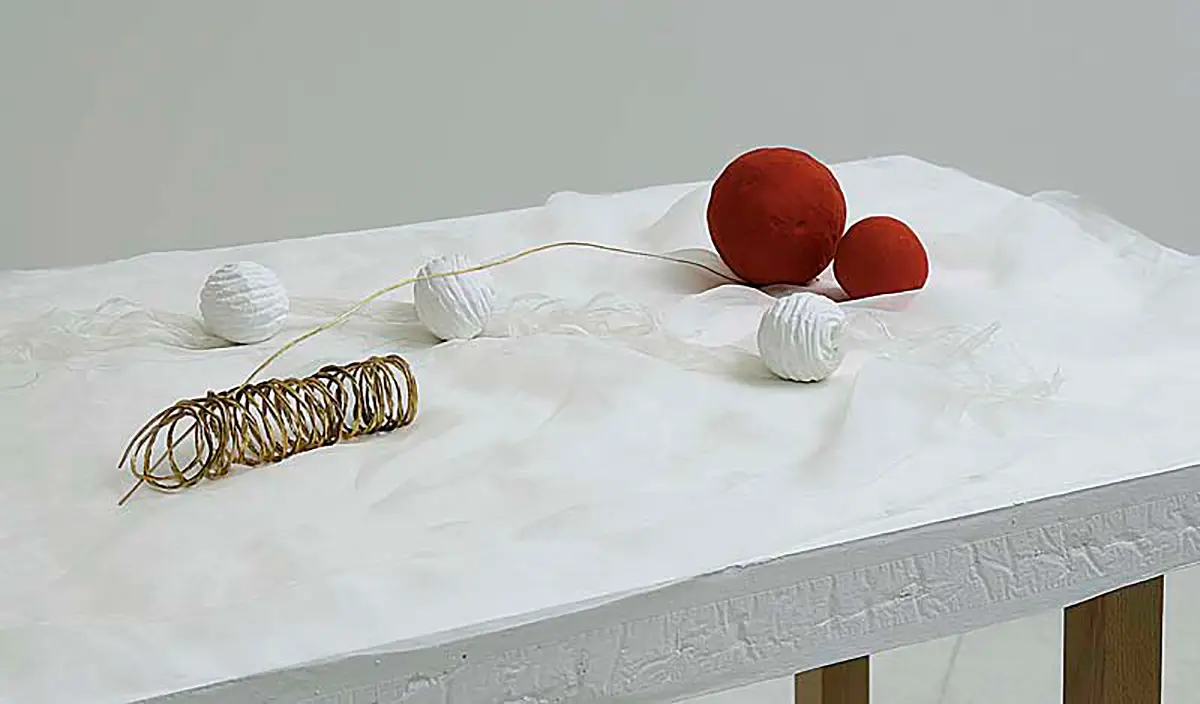
These works investigate dichotomies such as light/darkness and lightness/weight. Materials like metal, wood, gesso, organza, and paper suggest topics like delicateness and de-materialization. The effect of immateriality prods us to go beyond our own notions of the physical in the work of art and points to an idea of perception as primarily poetic.
The concept of “penetration” was elaborated by Gilles Deleuze, a philosopher Ribeiro holds in great esteem. Some of the titles of her works included in this exhibition are also derived from Deleuze, as in Dobra (fold) and Campos e acontecimientos e aproximaçoes (“Fields of events and approximations”). “For Deleuze, we are multiple, inhabited by tribes. He says, for example, that a conversation only truly takes place when the two people involved allow themselves to be penetrated by each other, creating a third site,” Ribeiro notes. If her interest is to augment the viewer’s perceptual capacity, the artist achieves her goal of “penetrating” her audience with her work and promoting Deleuze’s “third site.”
Ribeiro does this by the directly connecting the body and man. The evidence of the presence and motion of bodies can be in her series Cuerpos Associados, works built using white-silk organza fabric that moves thanks to the air being displaced by people walking by. This effect is also appreciated in another recent work by the artist, the panel titled Mecánica, exhibited at São Paulo’s Museu de Arte Moderna (MAM)’s Wall Project, where sheets of paper covered with bronze dust and attached at two points in their upper section are projected in space through the presence of people.
Human bodies are not directly present in Ribeiro’s work. They appear through their interaction with her viewers. Physical data such as the weight, temperature, and texture of objects refer us to an old state of remembrances. They are signs of the impermanence of the things of the world. One of Ribeiro’s techniques is emblematic in this context: when the artist places flowers and branches on the press in order to create a natural drawing. In other words, Ribeiro rejects her own mediation and retains the image in its pure state.
A look at Ribeiro’s previous works reveals the great coherence of the shifts in her work overtime. There are breaks, albeit soft, that establishes a continuous movement forward where “pre-existing concerns are expanded and new interests and topics emerge, as in a broth that slowly becomes denser and more refined,” the artist says.
Her drawings floating in the air are related to sculptures of soft shapes, like those “line sculptures” made of pewter. To destabilize the conventional modalities of artistic practice, Ribeiro reuses procedures that come from the art of printmaking to create works that oscillate between that genre’s own conventional concepts, painting, and object-art. One of her techniques, for instance, is to substitute wax blocks for the engraving plaque. She pours liquid latex on the wax’s cracks in order to generate shapes.
Ribeiro always mistrusted institutional art learning in Brazil. She frequented a college class for barely two months, yet she accumulated significant experiences, such as her acceptance, at the age of 16, into the Brazil School, her two years as student-assistant in Dudi María Rosa’ workshop, and her acceptance to the prestigious Slade University College in London.
Above all, Ribeiro is interested in the sensorial aspects of art. She likes lines because they direct our gaze. Spheres, for their continuous motion. Materials, for their potential for change. Irregular shapes, because they are unpredictable. And, as an artist, she is interested in acting as an artisan who produces atravessamentos between real and unreal elements, thus promoting encounters and frictions. In fact, it is common for her to create works and only then draw, photograph, or print them. As she confessed once, she is an artist of the hand, not an artist of projects.
ALESSANDRA SIMÕES