
Flavio Garciandía’s thirteen paintings on view at the Couturier Gallery in Los Angeles reveal the Cuban artist’s experimentation with new media in the continued exploration of what he has wittily termed “New Tropical Abstraction.” The use of acrylic on aluminum sheets and canvas is a shift from his more commonly utilized oil on canvas, yet the brushwork and color palette are reminiscent of his recent investigations of abstract tendencies.
With a keen knowledge of the history of art and especially post-war abstraction, Garciandía cites the brushwork of noted abstractionists such as Willem de Kooning, Barnett Newman, and Cy Twombly. In the thirteen works exhibited, the paint is often sheer, exposing layers of varied brushstrokes and the aluminum or canvas support. Garciandía gives a nod to the Caribbean by using both striking and acerbic colors inspired by the island and sea—the oranges of mamey fruit and papaya and the pink of guava mixed with aqua and seafoam green.
The colors recall the color palette he has been working in for the past decade, including those he selected for the work Pinnacle or Decline of Cuban Art created at the 2006 Havana Biennial. For this collaborative project, Garciandía invited more than 150 Cuban artists residing in Cuba or abroad to select one of thirty-one colors to be used to fill in a flat color band on a 1.5 x 20-meter canvas. This collective painting project acknowledged Cuba’s great artists and the impact of emigration on the Cuban art community; Garciandía himself has resided in Mexico since the early 1990s. Although he moved from Cuba, his legacy as an artist and esteemed instructor at the Instituto Superior del Arte (Cuba’s only art college) maintains his presence on the island.
In his current work, Garciandía self-consciously reflects on his appropriation of the techniques and methods of other artists (both from the past and present) as evidenced by his cheeky titles, which are assigned after the paintings are completed. ¿Dónde Esta John Baldessari? features layers of aqua and glimmering guava pink paint with white Twombly-esque scribbles and dabs of gold glitter. While the painting itself does not reference any particular work by Baldassari, the great conceptualist has been an important influence on Garciandía, both as a painter and pedagogue. In fact, Garciandía’s last exhibition in Los Angeles, also at the Couturier Gallery (2004), was titled I Insulted John Baldessari In Havana, and featured abstract paintings that quoted from the brushwork of other painters.
Through the citation of others’ works Garciandía corrupts notions of the individual artistic genius. Furthermore, he ruptures the artificial dichotomies of fine and vernacular art by incorporating shimmering paint and glitter. The use of these materials references the homespun carnival aesthetic of his hometown Caibarién and found throughout the Caribbean. However, removed from its use in a float or costume, it shares more with Andy Warhol and the pop artists’ elevation of this popular material to the realm of high art.
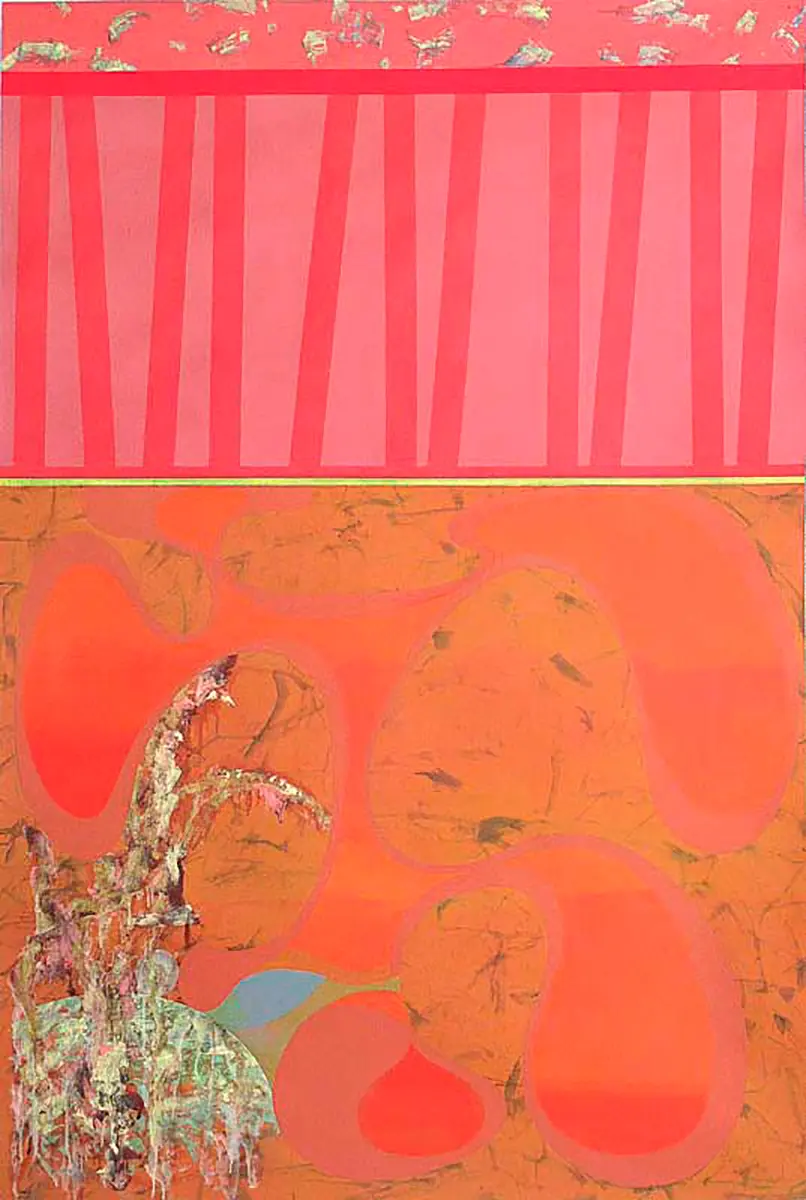
Yapan (paisaje e insolencia) [Japan (landscape and insolence)] is a rather large canvas (roughly 6’ x 4’) divided into horizontal segments, not unlike Newman’s work, in which Garciandía contrasts painting styles. The lower half of the work contains a background of oranges and pinks with biomorphic forms contoured in pink and filled with orange and gray markings. The bottom left corner features a cascade of bright pale yellow, pink, green, and gray choppy brushstrokes, somewhat like that of de Kooning, alongside periwinkle, peach, and green rounded forms. A bright yellow line divides the registers and the upper segment is much more linear with alternating angular sections of flat coral and pink paint applied with precision and capped with a bright pink band. Above, a narrow row of guava pink paints peppered with brush marks containing light yellow, blue, and gray paint. Here the juxtaposition of color and brushwork draws attention to the tools and methods of the painter.
Various colors, forms, and brushstrokes are repeated throughout the works on view. Garciandía not only cites the work of others but his own work as well. A very similar application of light yellow, blue, and gray daubs of paint on a pink background seen in the top register of Yapan (paisaje y insolencia) appears in both panels of his diptych The Gay Life (L.A. mon amour). The two panels are differentiated by the background colors—one pink and the other more coral.
Collectively the paintings reveal Garciandía’s meditation on the act of painting, the materials of painting, and the work of other painters. They display his understanding of art history and also his resistance to taking himself or the discipline too seriously.
BETH ROSENBLUM