
What is the connection between what an artist wants to say and the materials he or she uses to say it? The work of Gloria Ortiz Hernández, a Colombian artist who recently arrived from New York after residing there for 50 years, was on exhibit last March and April at Casas Riegner Gallery. After a period of vibrant, highly emotional paintings and of works that focused on social awareness issues, 1 Ortiz came to Casas Riegner with Dibujos y Estructuras, a compilation of extremely sober works, with features of geometric abstraction, demonstrating on several occasions and in unique ways the emotional and creative capacities of basic, everyday materials.
Starting with Continuum (2000) and ending with Sequitur V (2005)—both series comprised of 5 drawings each, with the circles in Sequitur made with pigment and pencil on Fabrian paper and the squares in Continuum with pencil on the same type of paper—we notice the mastery and control that Ortiz seeks to achieve through her technique. The visibility of the repetitive, meditative, well-ordered motion of her hand as it traces line after line reveals the discipline and dedication demanded by her work. Additionally, in the two series—and around her entire oeuvre—we find a unifying thread: the importance of the surface supporting the work and the evidence of the movement that flows through it. Ortiz’s rhythmic, precise handling of her pencil results in a smooth surface, devoid of distracting elements, and in this way it opens up the possibility of uninterrupted perception.
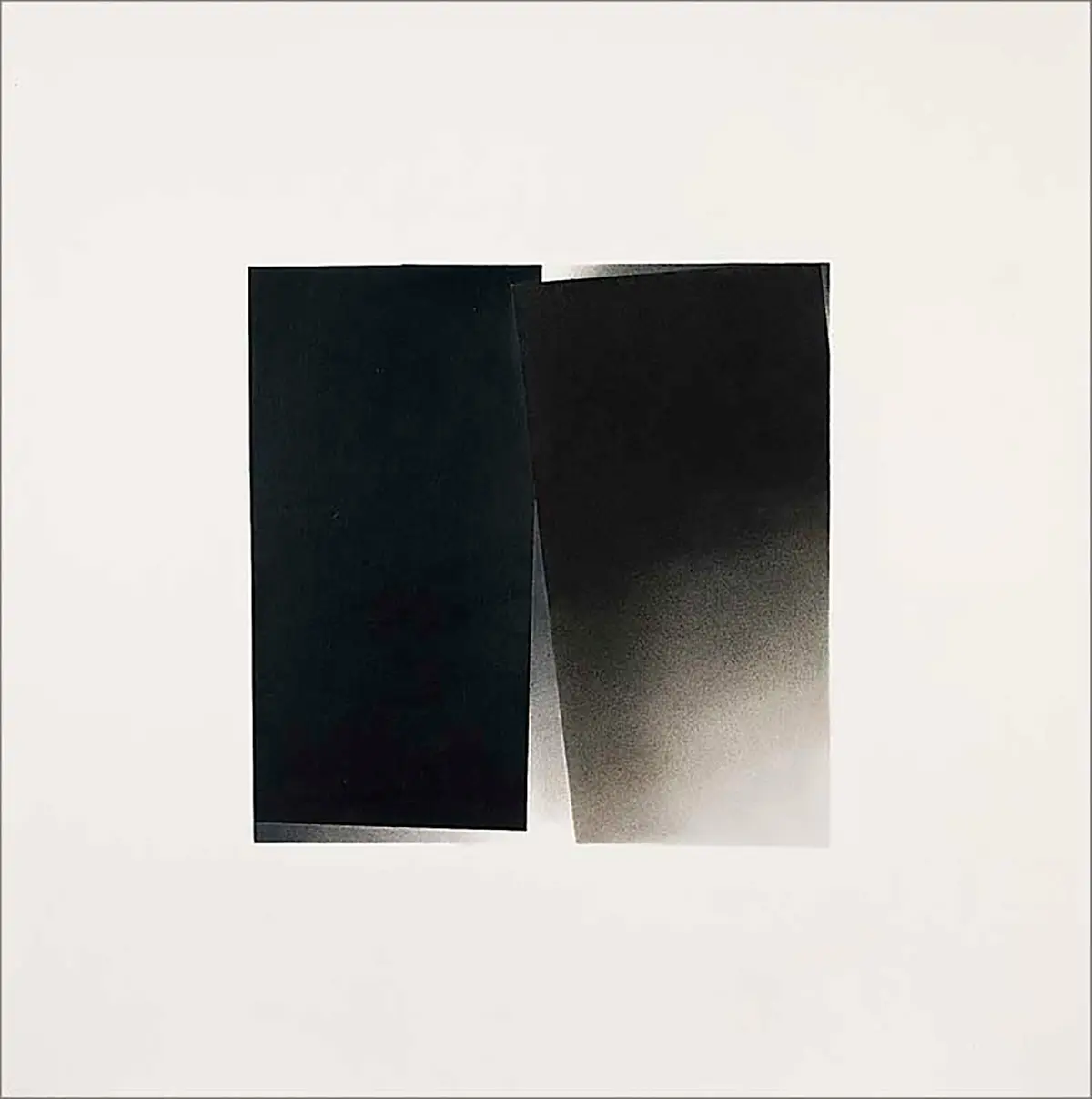
Permeability is a key and poetic topic for the artist, and it is also in evidence in Sequitur V and Continuum. Between dark circles and light squares, all her figures are porous. For Ortiz, there isn’t such as thing as an impermeable, closed figure… that is not the nature of being. The skin of her figures dissolves little by little, to the point of being submerged between the paper fibers, because the shift in the solidity of the line, in the softness of the image’s aura, is achieved only after the subtlety of Ortiz’s hand motions. From the texture, we move on to motion. The artist takes from filled circles or squares to others that are gray, almost ethereal. This gradual oscillation between light and darkness not only makes Ortiz’s works appear like a dance but also demonstrates equilibrium’s clear dependence on binary polarities.
As we move forward through Dibujos y Estructuras, we come to understand the artist’s search for denser textures. For example, works like Sin título (Día/Noche) #4 (2008) or Por partes #1 (Step by Step) (2011-12), continue with the use of basic geometric shapes, while revealing color—primary ones such as black, white, blue, or red—and weight—by means of charcoal, pigments, and oil pastels. 2 In Sin Título we see layers of a rectangle containing several smaller ones within. The way in which they are differentiated is through their different densities and color shifts; we move from a creamy ebony hue to a gleaming white. Yet between the two extremes there are gray hues that can only be achieved through true mastery of oil pastels and charcoals. In Por partes, also rectangular and populated with varieties of whites and blacks, the artist intercepts the general figure with vertical and horizontal color lines. Some may think that these lines imply a personal or narrative logic, but the opposite is rather the case. Through her work, Ortiz attempts to reach as close as possible to perfection—to universality, to the intangible-yet-present—and the decisions made at the moment of interacting with a given artwork are made to the tune of intensely active consciousness. Ortiz’s sensibility for her materials allows one of the most sincere human qualities—one that I often ignored—to express itself through the artist: intuition.
Finally, the sculptures included in Dibujos y Estructuras also remain faithful to basic geometry and to the use of materials in their most “naked” and transparent mode. In the iron sculpture Dos Inclinaciones (2007-2008), the entire frame is a rectangle, vertical in orientation, that has been divided in two and presents molded depths in each half, which creates two triangular platforms. As in the drawings, the surface here is smooth and highly worked-over, with a uniform texture. But the most characteristic feature in this structure is that it is just as permeable, just as susceptible to the outside world, as the drawings were. Ortiz explains that she doesn’t apply the usual patina layer to her sculptures since what she is after is for them to reveal stories in motion, pieces in constant shift. The artist does not intend to impose stability; she seeks to give her materials a voice and to let them tell the story of their environment and of their physical and chemical functioning. Ortiz gives her creations the possibility of embracing that perfect imperfection that arrives by means of the universal laws of constant change.
Learning to draw has always been—and will be—one key task for any artist. Tracing motion or figures on paper is a way of translating the subjectivity of an individual’s understanding of the world to an objective, tangible, visible medium. The surface on which one draws and the different materials used are part of the intended message; depending on the formal decisions made by the artist, different emotions and sensations can be generated. Her deep knowledge of her materials and the way in which she allows them to find a voice through her action are key to understanding Gloria Ortiz-Hernández’s work.
This process is the result of many years of practice, patience, listening, subtlety, awareness, and acute attention to her intuition. To understand the conceptual element in Ortiz’s art we need to wait, not anticipate, and to let ourselves be enveloped by her knowledge of the intangible and of the human in each one of us; to allow ourselves, precisely, to be permeated.
NOTES
1. Ortiz-Hernández studied and later worked in New York at the peak of the feminist movement in the US. A good part of her work in the 1980s focused on the emerging topics of female struggle during that period.
2. It is important to note that the inclusion of heavier materials with gleaming textures in Ortiz-Hernández’s work requires very specific curatorial approaches, where the illumination of the space plays an essential role for the works to be appropriately appreciated.
VANESSA ADATTO