Doubt is the first solo exhibition in Madrid by Gustavo Acosta, a Cuban artist that has evolved into a master painter and drawer. His shrewd and lustful approach to these two artistic disciplines has become an inspiration for many and a target of the underhanded anger of others. His work pays homage to the right way of doing things. Acosta articulates a discourse based on eloquence and the complete mastery of the artistic discipline. Everything appears to originate from illusions, from the concerted confabulation of madness, the accident of memory, assisted by delirious fragments or by an eroticism pursued through unruly objects; but not so. Acosta’s endeavor is almost like an exercise in pictorial epistemology; it recognizes the flexible nature of language as much as the virtue of becoming a rhetorical distraction or narrative. Each piece tells stories as if it were recapitulated archaeology.
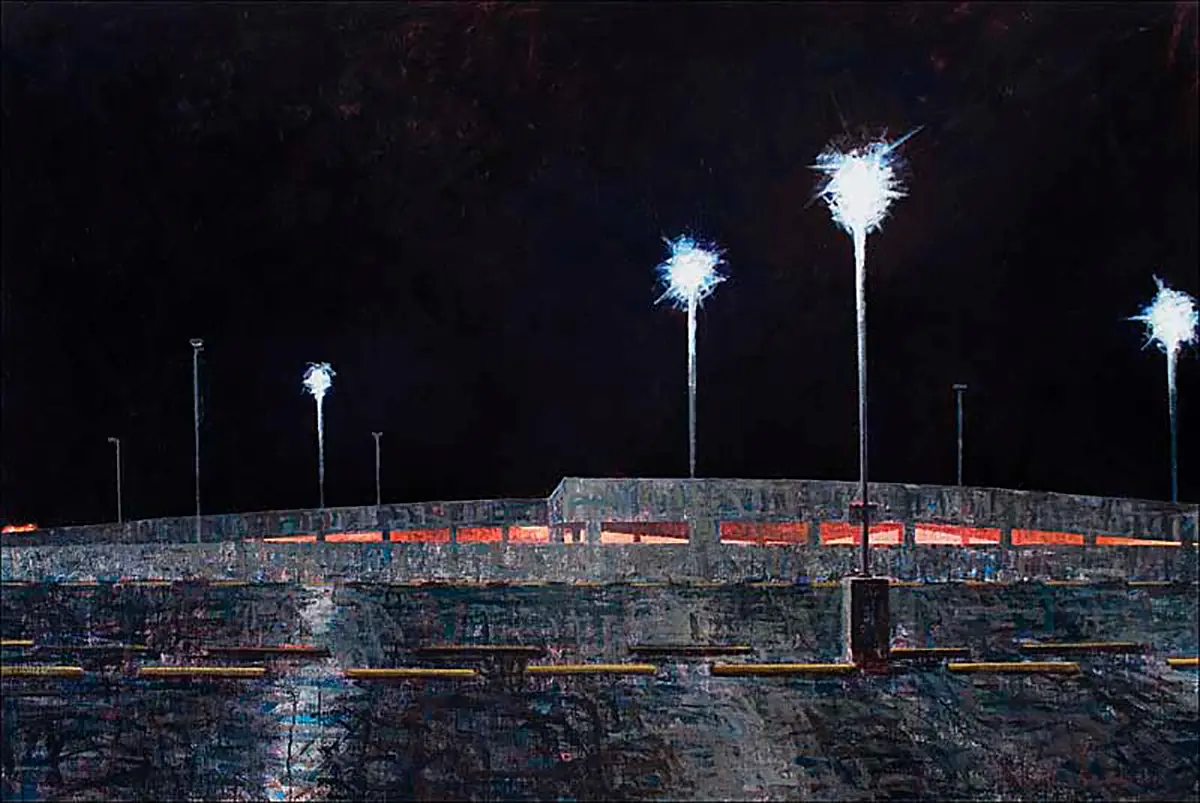
Doubt includes large impressionistic canvases and drawings that rival the reality offered by mirrors, as Acosta tests the mimicking ability of art and its tropological density. The modulations of the urban plane, increasingly more abstract through the years, offer an intimate—promiscuous—code used to convey memories, nostalgia, and the inherent emotions in his work; as it often occurs with many artists of his generation who once interjected traveling as life’s final destination: isolation, longing, alienation, fear, hope, and fantasy. The spaces are carefully outlined to be rendered completely credible. But somehow they are not altogether correct, as they are an exercise in storytelling/disjunction aimed at generating an ambiguity that takes advantage of the viewers’ own subjectivity. He draws and paints with exactitude so as to—in almost voyeuristic fashion—allow us to observe the streets and the coastline from above as if we had the power as viewers to manipulate the occurrences below without intrusive participation that alters the almost literal stillness of each scene. We do not see people, as there is an absence of characters because space plays such a compelling role that it replaces any need for a human presence. No clues are offered about the identity of the places observed; no surface that gives away any specific details that help with their identification, as the viewer’s gaze searches for something to hold on, for any inkling in which to place the original mark. We are not sure whether it is day or night, nor are we sure about the exact location. Nonetheless, there is a certainty about the place, the hunch, or suspicion that it was once known to us at one time. “Are we perhaps looking at ourselves, our lives, and the history of our existence? Is this the mirror we question together with Acosta? Through painting, he brings the grid back to real life and transforms engineering and architectural wonders into the artist’s canvas. He then covers the grid with anonymity that gives us a sense of fascination and loss.”
This feeling of loss has a lot to do with Cuba, with memories, and with the nostalgia caused by the loss of motherland that Acosta left in 1991 to go to Mexico, then Spain, and finally Miami, where he lives to this day. It is possible that Cuba is the place of his maps, notwithstanding the lack of a precise cartographic discourse focused on the accident of the loss, or on a recovery that at the end becomes anxious and frustrating. Even when Acosta represents other places, like the cities where he has lived outside of Cuba—and where he has shared vital experiences that define his legacy as a human being—the island was there from the beginning and is the place where he began his journey toward the exploration of new—real and imaginary—urban landscapes and seas, as he transforms painting into a narrative of approximation and madness, ecstasy and reconciliation, with the memory expanded by the trip. Like many of his contemporaries, Acosta constantly refers back to Cuba in order to capture and preserve his history and the memories that he fixes in this complex weave that ceases to be axiological to become personal and humane. After many images of landscapes and seascapes, this artist has been able to venture into the speculation of other places that are now a more important part of his life, and that is channeled through the carnival of an essay of memories and superimpositions. In his works, we recognize Havana and Miami, as well as fragments of other places that could very well be somewhere else or nowhere. It is important to take into account that Acosta’s work is playful; it enjoys the construction and narrative processes as resources that expose his own logic reinterpreted into new scenes of cities that have a place in real or imaginary maps. Sketchy, compelling, boisterous, predictable—in its stance—and a melting pot of unfounded ideals; the urban environment becomes a theatre, a potential stage for certain types of relationships that occur and evolve before our gaze without intimacy we cannot possibly ascertain from far above.
We do not know what happens behind these scenes; the stories or riddles that are weaved at the very center of these insinuating representations that gallop before our eyes like in a movie. Nonetheless, we can sense, guess that something is about to happen or that has already happened; something that may closely affect and paralyze us. The interiors and exteriors merge into this complex existential drama in which we could suddenly occupy the place of the marionette without even noticing that we have become the object of intelligent and shrewd manipulation. And this is precisely the theme of Doubt. The very title of the exhibition announces the main purpose of the works that are part of it.
ANDRÉS ISAAC SANTANA