
Madrid pays homage to an Argentine designer and visual artist Juan Gatti, who celebrates his 30-year artistic career in this city with a retrospective exhibition that is as ambitious as it is well executed. Although Gatti has had his share of recognition in Spain—the 2004 National Design Award, and the 2010 Visual Arts Gold Medal of Merit in Visual Arts—this new retrospective exhibition titled Contraluz (Backlight) represents an opportunity to survey the polyhedral career of this artist, but most importantly, it is an excellent excuse to properly showcase Gatti’s most recent personal project.
Gatti moves to Madrid during the 1980s, at a particularly interesting time in the Spanish capital. Since then, Gatti has been involved in the construction of the identity of La Movida Madrileña (The Madrilenian Scene) and other manifestations that emerged during the years that followed Franco’s repressive regime. Gatti demonstrated to have the ability to correctly interpret the social and cultural mood of that time in Madrid, an artistic scene associated with musicians and performers like Mecano, Miguel Bosé, Alaska y Dinarama, among many others. It was also a time of visual proposals that eventually became highly popular iconographic references, among these the visual style of most of Pedro Almodóvar’s movies.
Curator Rafael Doctor accurately arranges the monumental container that houses an exhibition divided into two sections. The first level reflects three decades of Gatti’s career: 280 images and posters, as well as design objects developed around fashion photography, still advertisement, editorial photography, graphic design, design applied to objects, as well as the design of film credits and posters for movies directed by Fernando Trueba, Alec de la Iglesia, and Pedro Almodóvar.
Our obsession to control speed, light, and time, represents the origin of some of the most important technological advances achieved during the last century. A technology that resulted in movie theaters; territories colonized by an overwhelming empire of images. Based on this visual and synthetic language, Juan Gatti is able to underscore and maximize his talent, as he stimulates this anxiety to assimilate the greatest possible amount of visual information from the entertainment world, Pop culture, psychedelia, and the avalanche of fluoride icons that emerged from an increasingly vigorous industry that invaded the streets with posters, disk covers, and signs. According to Gatti: “Argentines see themselves so far removed from the rest of the world that they are always up to date with what goes on in the rest of the world.”
Juan Gatti leaves Argentina to stay in New York for some time. He eventually arrives in Spain in the 1980s. There he finds a very receptive public that is hungry for all the information that had been censored during a long and repressive period. It is my opinion that Spain could not have asked for a better translator of visual trends than Juan Gatti.
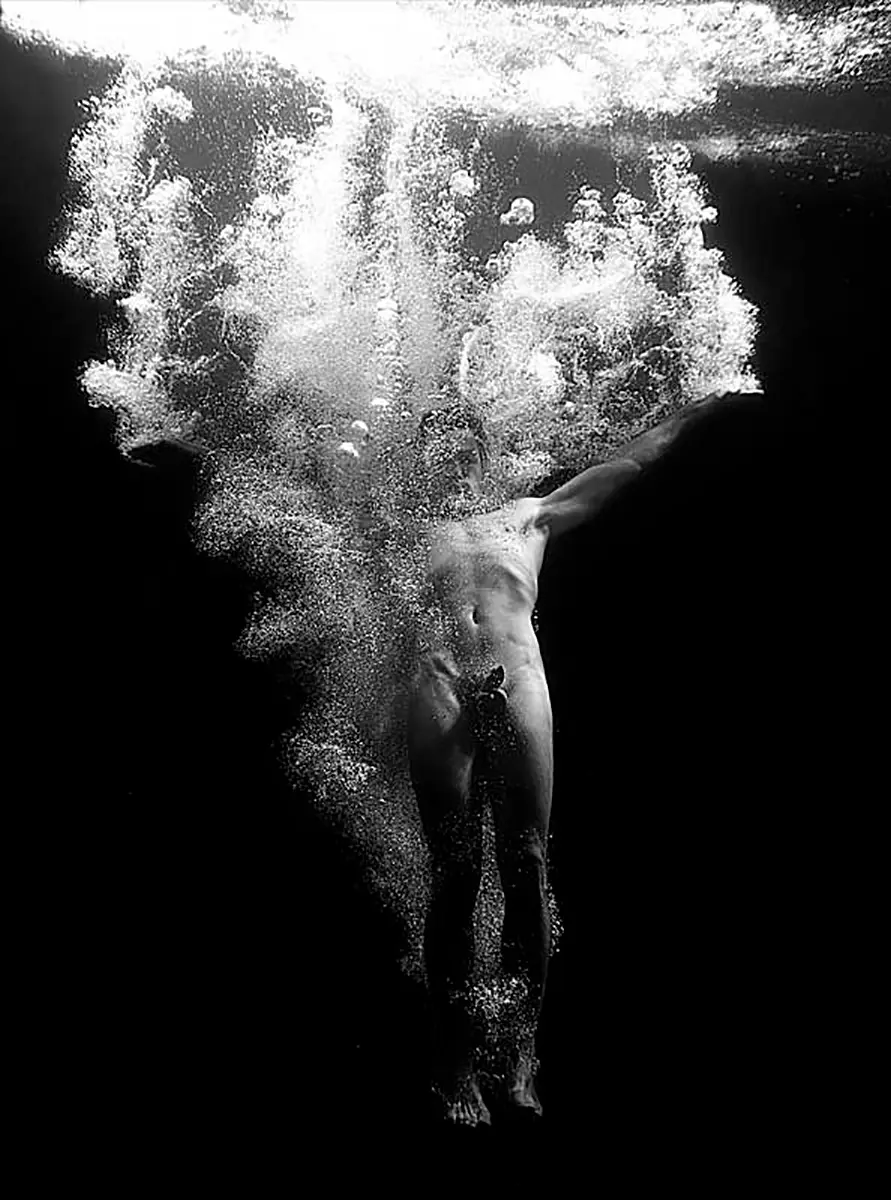
The second part of the exhibition spreads across the rest of the exhibition space and centers on the Contraluz series that is also the title of the exhibition. It includes 40 large-format black and white photographs from Gatti’s most recent personal work—for the first time conceived as a corpus that is independent of other media and that does not involve any collaborations.
Contraluz represents the never-before-shown counterpart of a vast career associated with the public realm in Spain. It permeates all the way into the marrow of Gatti’s most intimate—and not because of it less spectacular—universe.
Contraluz is the impressive result of the visual maturity of an artist who does not see himself as a photographer, but rather as a creator of images. This project stems from another titled Ciencias Naturales (Natural Sciences), which he based on the poster La Piel que Habito (The Skin I Live In), the latest film by Pedro Almodóvar.
While Ciencias Naturales pays homage to that first Nineteenth Century obsession to uncover all the things that stay invisible under our skin and to conceive a truly visceral taxonomy for all living beings, Contraluz succeeds in subtly infiltrating that latent living germ, without the need to tear the skin in order to reveal it.
Gatti extracts light and life from anything that attracts his attention. Like a cathode ray, his discerning gaze pierces through the essence of those living organisms and uncovers their most ethereal condition. This artist makes anything that is seemingly immaterial palpable by touching it with light, through a process that surveys the sensual silhouette of smoke, the effervescence of the air contained in the bubbles, the fragile structure of insects, the velvety texture of flowers, the sparkling manes from a white horse; as well as the tail produced by a bird’s flight or the dance movements of his own Loïe Fuller before the shutter of his camera.
The ascending walk through the cylindrical exhibition space received the echoes of music and nourished our expectations as it leads us to another level. The fluorescent essence of these images becomes cobalt blue as it shines intensely to further enhance the visual impact on viewers, just as some living organisms, and medusas, in particular, emanate their incandescence through the depths of the ocean.
Not sufficiently satisfied with this, the exhibition ends by taking away from us that which we still hold as our own: it immerses us into a 360-degree screening in which Gatti’s imaginary truly becomes mobile and where we literally end up immersed in the weightless liquid of a shared vital drive.
ELISA RODRÍGUEZ CAMPO