Although it was no more than a sample of his extensive oeuvre, the recent retrospective of Julio Zachrisson’s graphic work at Allegro Gallery was a valuable experience, both historically and esthetically. It included prints created by him over a period of four decades, which offered ample evidence of the breadth and depth of his knowledge of printmaking. For his established admirers, it offered an interesting overview, and for younger viewers, it was an impressive introduction to the surrealist and magical world of one of Panama’s great artists.
As always, Zachrisson’s works confirmed his mastery as a draftsman not only in the traditional Beaux-Arts sense but also in terms of the autonomy and freedom with which he handles lines and shadows. The exhibition also illustrated his remarkable ability as a graphic artist, whose repertory includes works in linoleum cuts, drypoint, etching, aquatint, chine collé, and lithography, used individually or in combination with the sort of ease that can only be achieved through knowledge and years of tireless practice. Although black predominated, there were silkscreen prints and lithographs that incorporated color, reminding us of his paintings, as well as metal etchings in which the colors were achieved through the use of multiple plates, by hand painting the finished print, or by incorporating colored paper in the printing process.
This collection of works on paper again confirms that, throughout his oeuvre, Zachrisson has created a world of his own, one that is both unique and recognizable. Some of his characters look like old acquaintances, like prototypes from the collective unconscious, figures towards which—at times—one might even feel a sense of brotherhood. Other figures are monstrous, a cross between humans and objects, or humans and animals, that stare out at us, as if challenging us, from their distorted portraits. We perceive a dark sensuality, black humor, and often get the feeling that we stand before representations of Freudian ideas related to the human condition, violence, and sexuality. With his typical mischievousness, Zachrisson mocks human arrogance, social hypocrisy, and the foolishness of many of our political realities.
The oldest series in the exhibition is Comejen (Termite), a group of linocuts in which human figures are devoured by gigantic versions of those awful little creatures that are hated for the eagerness with which they eat away our tropical constructions. Among the metal etchings, the series Circo (Circus) from 1970 stood out, with four dramatic compositions populated by apocryphal animals, unusual birds, half-naked acrobats, mask-covered faces or buttocks, and peeping toms. For Zachrisson, the circus works as a metaphor for humanity, and the precarious balance it can only achieve through bizarre acrobatics.
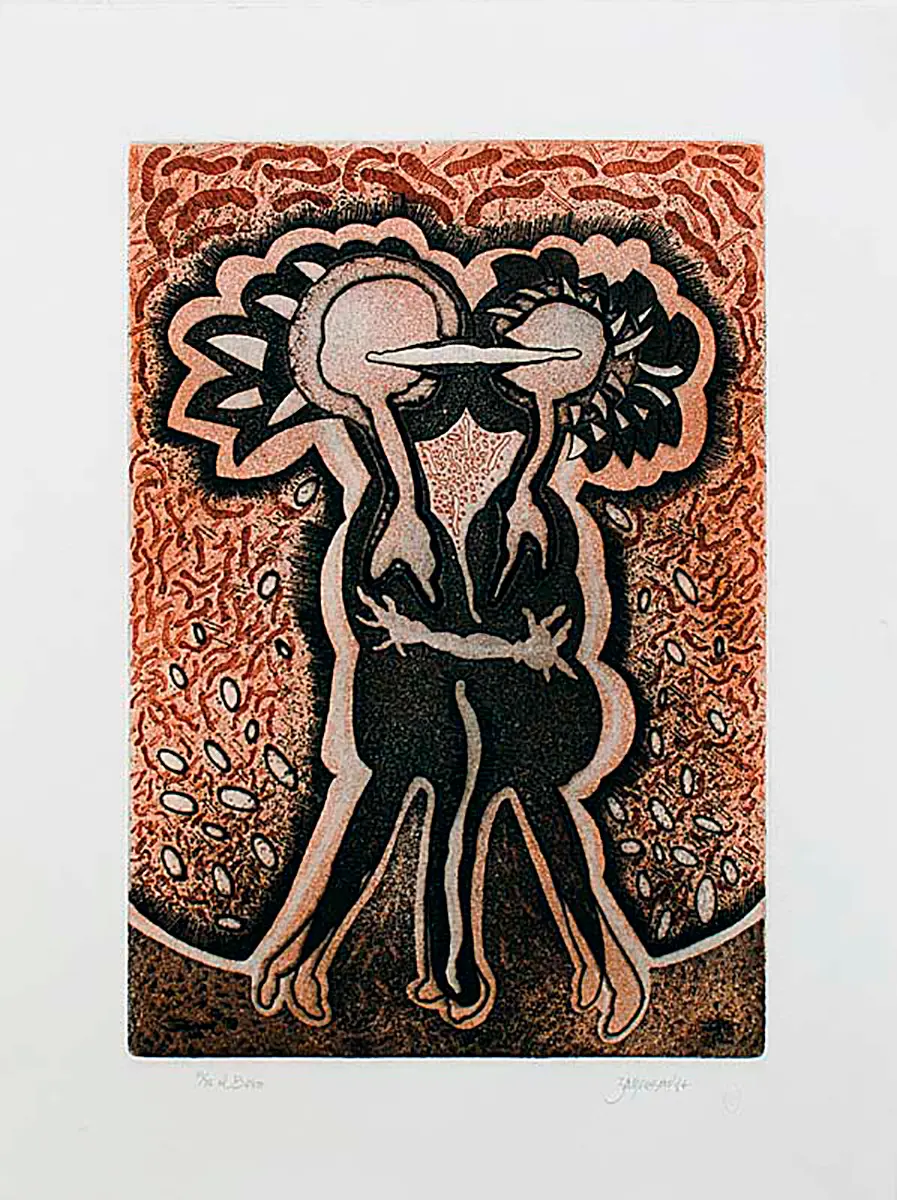
In the works from the eighties and nineties, there are larger figures which, alone or in twosomes, fill the compositional space. Surrounded by a sort of “aura” or lines that repeat their silhouettes, they remind us of how Panama’s Kuna Indians create the figures and designs in their “molas.” In El beso (The Kiss), two figures, joined by one tongue, are surrounded not only by their encircling auras but also by playful shapes that resemble sperms or ova in the space around them.
Zachrisson is very aware not only of Panama’s indigenous and pre-Columbian traditions, but also its folklore and urban legends, as well as world literature and mythology. Although he has lived in Spain since 1961, his earlier studies in Mexico together with a deep connection to his origins imbue his artwork with a Latin American feeling, one that he has combined with ideas drawn from Spanish artistic and literary traditions. We know he admires Goya, that engraver par excellence, who reproduced and criticized the realities of his time. In this exhibition, the etching Panamá, 20 de diciembre 1989 stood out as a sui generis—albeit somewhat literal— representation of the U.S. invasion. Filling the bottom left and right of the composition are large triangular masses of people, mostly soldiers from each of the two countries. In the center, against an optimistic white background, three figures (like a family unit) rise away from the chaos towards a better future.
In his most recent work, the series Bacanal Salvaje (Wild Bacchanal) is particularly noteworthy. In it, Zachrisson tells a macabre story in a mysterious four-part sequence. Its protagonists are hybrid creatures, men with animal heads, and beasts that are carrying out an erotic ritual in a dark, wooded landscape. Another surprising series from 2005 is titled Mono Loco (Crazy Monkey) and consists of prints created with drypoint and aquatint that are later printed on a delicate colored paper in the process known as chine collé. In each one of them, a man or a woman is so similar to the primate that the line between the two seems lost and, as the artist, stated: “one doesn’t know which of the two is more of a monkey.”
To a certain extent, this historical mini-exhibition of prints contributes towards lightening a debt that Panama owes both this artist and the public. Although Zachrisson is a world-renown artist, who has been decorated by the governments of Spain and his own country, and whose works have appeared in countless shows and publications, the great retrospective exhibition that his artistic career merits have yet to be organized in Panama. The exhibition at Allegro Gallery gave us a small foretaste of how important that all-encompassing view of his oeuvre would be.
MONICA E. KUPFER