
A Latin Spring in Spain. Or a Hispanic one. Ibero-American, or however one wants to call it; at any rate, centered on the Latin American art and artists that preceded the actual spring season in Spain and brightened it upon their arrival with a formidable offering of first-rate, highly varied events and exhibitions. Madrid was where most of this took place, but not the sole location. In Vitoria, in the northern region, part of the Basque Country, the Atrium contemporary art museum hosted an excellent anthology of works by Guatemalan artist Regina José Galindo, and across the country Sevilla’s Centro de Arte Andaluz Contemporáneo presented La idea de América Latina, a collective including works by Joaquín Torres García, Juan Downey, Marta Minujín, Ana Bella Geiger, Alfredo Jaar, Leandro Katz, Miguel Ángel Rojas, Minerva Cuevas, and Milena Bonilla, among others. Berta Sichel and Juan Antonio Álvarez Reyes, the curators, borrowed the title from a book by Walter Mignolo, the Argentine theoretician who has explored the concept of coloniality, first coined by Aníbal Quijano to express the notion that the Modern project was from the start a colonial project, and that it remains so in its contemporary consequences. As, in fact, Regina Galindo’s work proves, where the body is used in radical ways to reveal the fact that patriarchal structures, as well as racism and other devices forged in colonial Guatemala for the subordination of the original peoples and ethnic groups, retain to this day a significant degree of effectiveness. Or as the collective exhibition Proyecto Juárez, curated by Mariana David and presented last fall at the contemporary art space Matadero de Madrid, with works by Mexican artists Carlos Amorales, Gustavo Artigas, Artemio, and Yoshua Okón alongside Mexican-Spaniard Santiago Sierra, attempted to show. All of them sought to interrogate both the facets and the conditions of possibility of genocide, or, more precisely, of the slow-motion feminicide taking place in Ciudad Juárez since the beginning of the new century, with atrocities that ominously foreshadowed those currently shaking the entire Mexican Republic as a consequence of the “narco wars.”
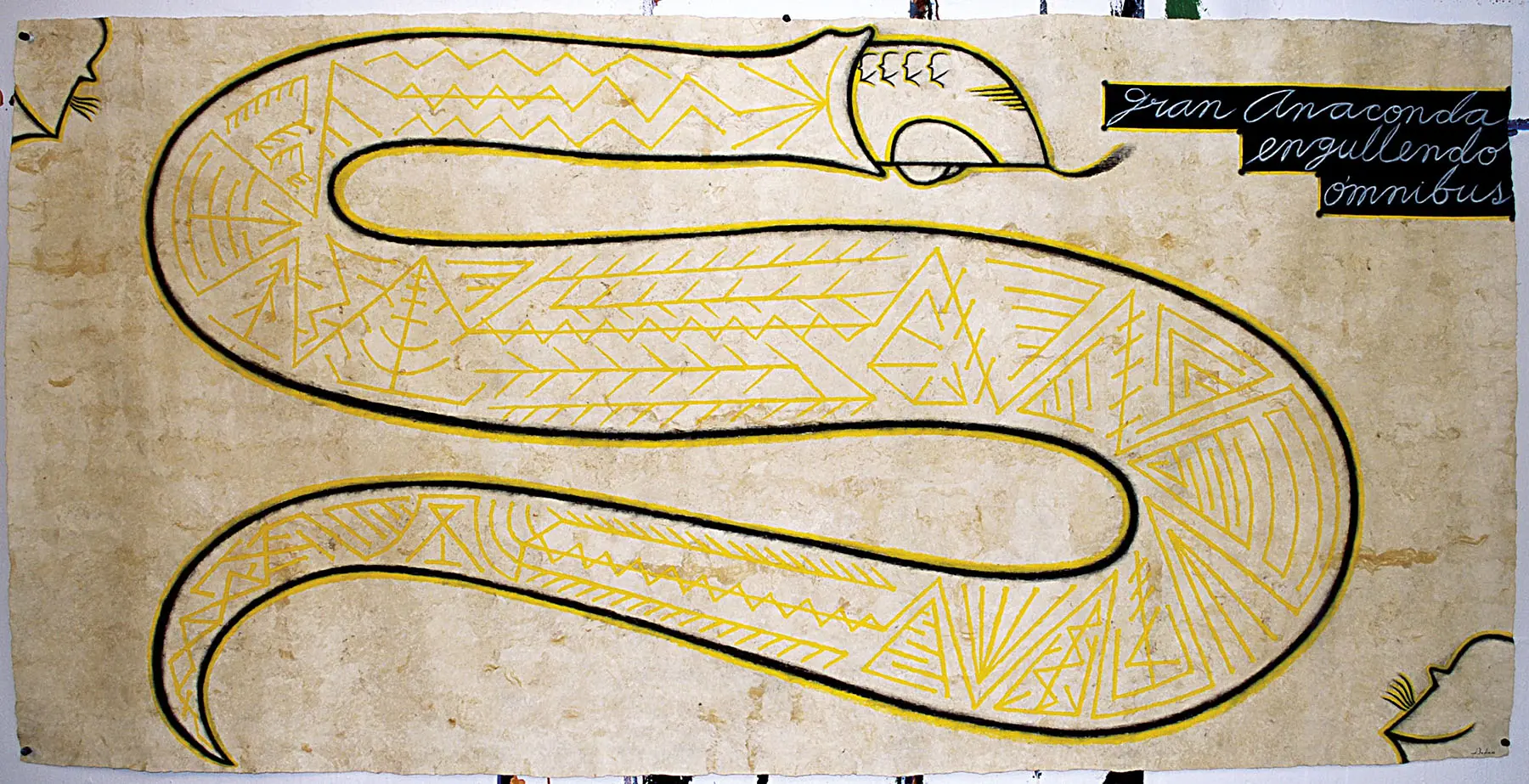
José Bedia’s exhibition Entre dos mundos, presented at Casa de América in Madrid between January and March, was not devoid of this critical perspective, although it is true that the works on exhibit there were free of the pathos or the anthropological, semiotic, or sociological emphases that so noticeably bias some of the works mentioned before. Bedia is an artist who refuses to set aside allegory, symbolism, the free play of imagination, and virtuosity. But perhaps for those very reasons his ability to represent that which in Latin America—and not only there—is a source of aggression, predation, and violence, is more highly revealing and effective than what happens with artists who simply tend to illustrate anthropological or sociological interpretations of those sources and conflicts. In Bedia’s world—which is not ours, although it is subordinate to ours—men, animals, and gods, the living and the dead, are joined to a degree that is incomprehensible to us, but that nevertheless offers a fertile starting point, a medium, and a path to capture and represent critically a world like the one we inhabit, in permanent war with itself. In fact, draftsmanship, which plays a key compositional role both in his paintings and in his installations, combines and intertwines the scenes from his personal world and its heterogeneous denizens, suggesting with surprising effectiveness their continuous metamorphosis into one another. But Bedia is not alone in his efforts. He defiantly claims his belonging to the afro-Cuban tradition and has for many years visited places that still belong to “badly misnamed primitive cultures,” as he puts it, in the US and Mexico as well as in Angola, Botswana, Kenya, Tanzania, and South Africa. Only that his extended contact with such “primitives” does not follow the strategies of the ethnographer, as Bedia doesn’t treat them as objects of study and research but as his equals, possessors of wisdom that enriches his own who communicate important information about the lives they lead today and their contemporary suffering. Mythical thinking, let’s not forget, allows for a constant reformulation of a cosmological and ritual corpus established in illo tempore as a function of shifts and transformations experienced by the community at each new juncture. And its specific knowledge resides precisely in such a reformulation.
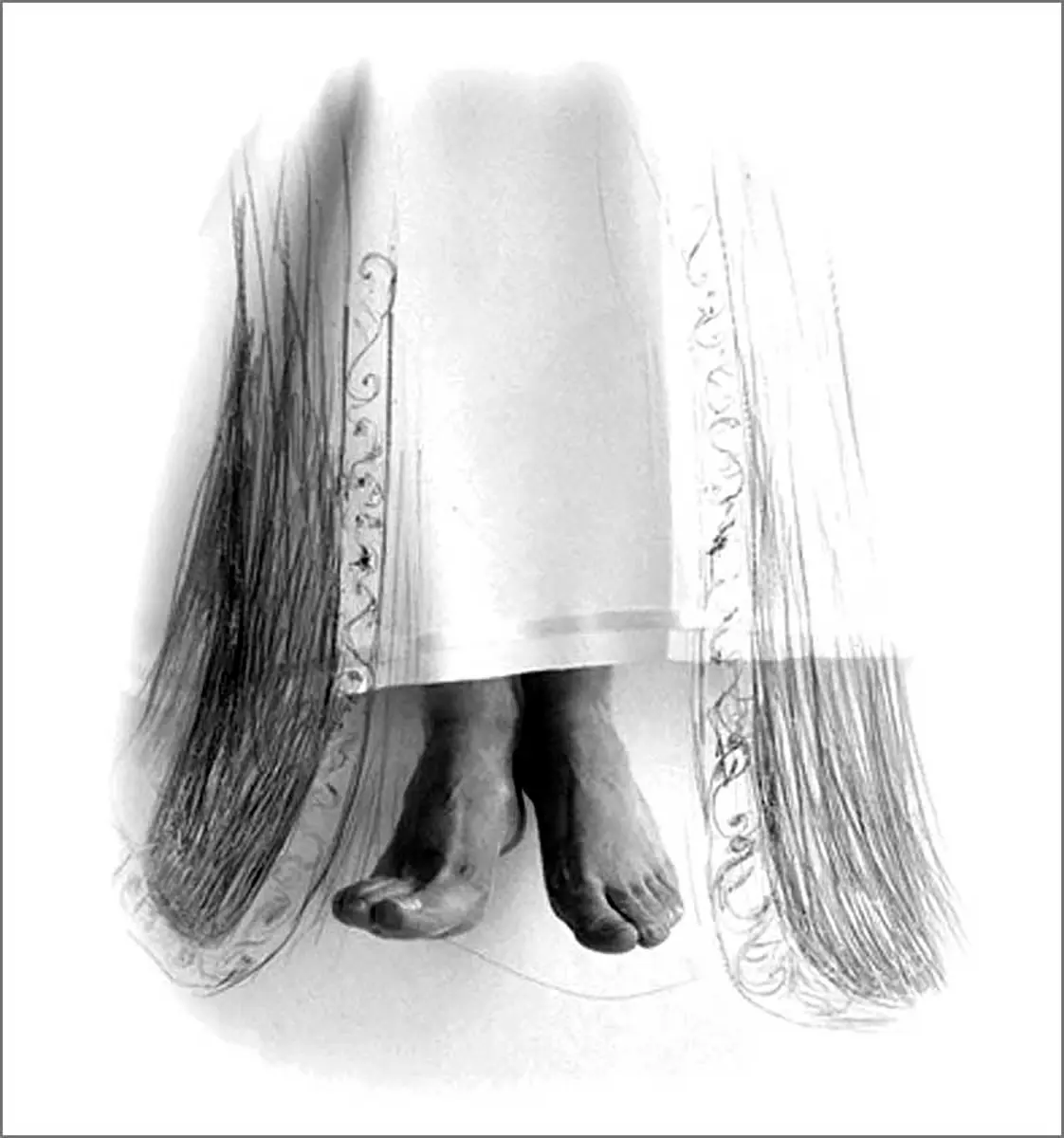
And Bedia wasn’t alone, either, in the context of this unexpected Latin American Spring. Marta María Pérez-Bravo, also from Cuba, accompanied him with a splendid solo exhibition at Fernando Pradilla Gallery in Madrid, between February and April, part of the first Festival Miradas de Mujeres. A show of recent photographs in black and white and a variety of formats, along with a few sculptures, with the artist as model and protagonist as in so many of her works. This time, though, her photographs deliberately emphasized the phantasmagoric character that is inherent to photography itself, with the evident purpose of disembodying, even more, the image of Pérez-Bravo’s body, as if such an extreme dematerialization were the aptest resource for the graphic representation of the incorporeal deities that populate the Santeria pantheon. Deities she adheres to, if we go by the preeminence of amulets, emblems, and sacred objects from that religion in her work, as well as by the fact that in these photographs she appears clad in a white ritual tunic.
Within this Latin American wave, the exhibition of works by Brazilian artist Marlon de Azambuja was a marked point of departure. It was presented in November and December of 2011 and established, in fact, a nexus between the current juncture in contemporary art and Brazil’s own constructivist tradition, well represented both by América fría. La abstracción en América Latina, a show at Madrid’s March Foundation last winter, and by the Museo Reina Sofía’s large Lygia Pape retrospective that summer, which highlighted the artist’s neo-concrete period. Azambuja feels close to this tradition and has attempted to renew it through two strategies that, while distinct, are clearly connected. The first strategy he has described as an exploration or exploitation of the “sculptural potential” of the empty spaces that exist in urban furniture, as well as in staircases, doorways, or the intervals between columns in a building. The artist transforms these empty areas into solid-seeming volumes by covering them with adhesive tape in flat, industrial colors. The second strategy essentially leans on draftsmanship and produces series of paintings such as those Azambuja exhibited at Max Estrella Gallery under the title of Gran fachada, where the façades and the volumes of museums and contemporary art centers like the Guggenheim in New York, the MASP in São Paulo, the Pompidou in Paris, or the Tate Modern in London are reduced to a seductive composition of clean lines on shiny black backgrounds.
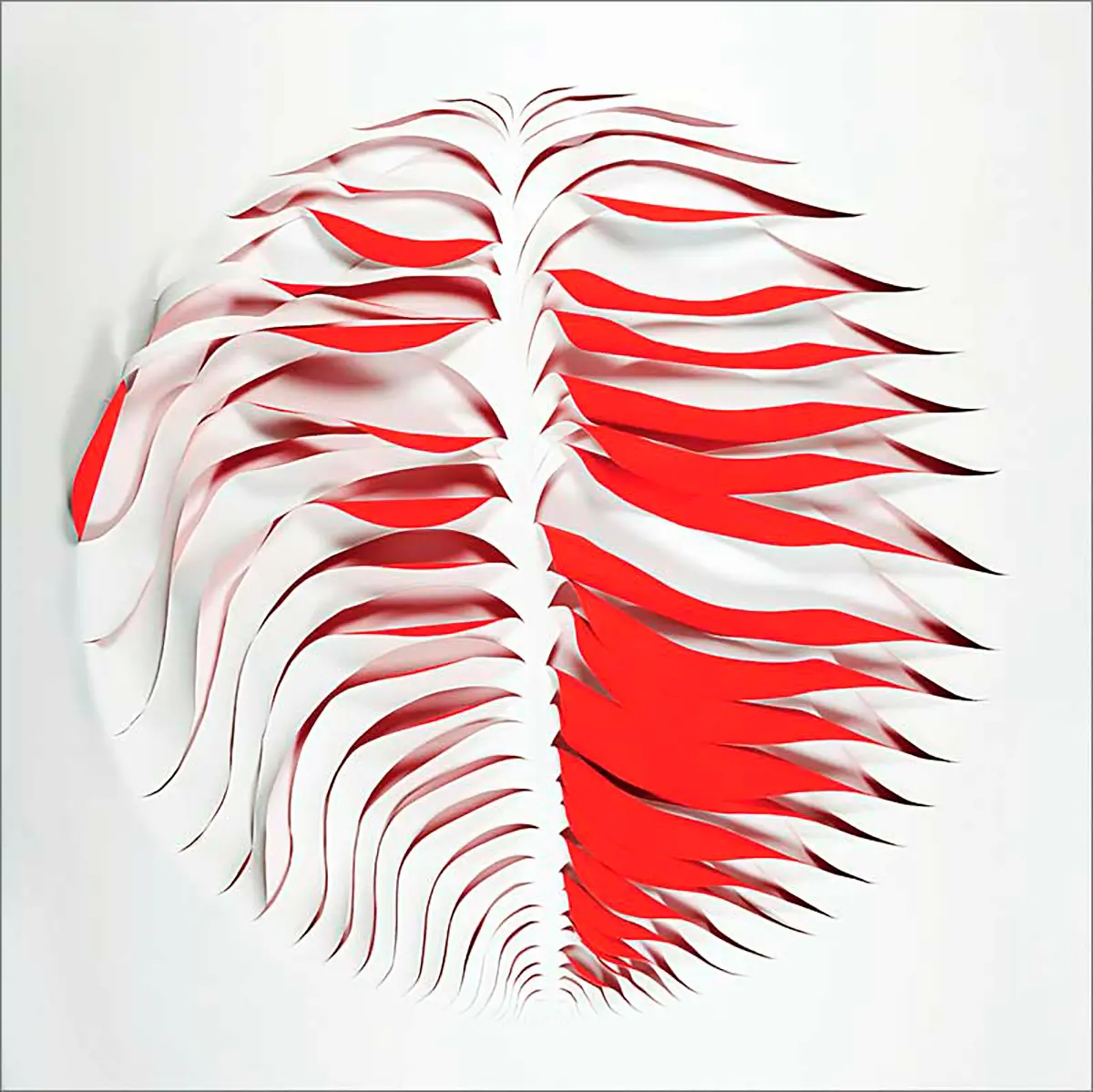
The work of Venezuelan artist Emilia Azcarate also partakes of the modern tradition, as confirmed by the outstanding show of recent works she presented between December and February at Distrito 4 gallery, in Madrid. Here, the kinetic art of Cruz-Díez and Jesús Soto proved the starting point for an original reformulation of the most orthodox version of that very modernity.
I will close this letter with a reference to two relevant theory events, both connected to the theory and history of Latin American art. The first event was held in March at the Museo Reina Sofía and was titled Repensar los modernismos latinoamericanos. Flujos y debordamientos, and it responded to its organizer’s explicit desire to offer “a critical substratum for thinking about the upcoming exhibition of the Patricia Phelps de Cisneros Modern Art Collection (CPPC, in its Spanish acronym), scheduled at the Museo Reina Sofía for 2013.” The task of rethinking a set of “modernisms” that are now taken as plural was given to a roster of critics and researchers that included Alexander Alberro, Mónica Amor, Guy Brett, Luís Camnitzer, Estrella de Diego, Cristina Freire, Andrea Giunta, Lisette Lagnado, and Ariel Jiménez, all of whom had highly professional interventions. I was, however, seduced by the way in which Luis Pérez-Oramas, who is preparing a large Lygia Clark retrospective for MoMA, offered an exuberant and at times fantasy-laden presentation of Clark’s art, punctuated by erudite quotations that ranged from Pliny and Marcus Aurelius to Duchamp. In the course of his presentation, Pérez-Oramas attempted to obliterate the distinction between the two great periods in the work of the Brazilian artist, a distinction he deems “a Modernist myth” that blurs or omits what was always at play: the body. I disagree with the notion that the dividing line between these periods in Clark’s oeuvre is nothing but a myth, but was so fascinated by Pérez-Oramas’ speech that, reflecting on what he had said, I concluded that si non vero e ben trovato.
The second important theory event in this diffuse, imaginary spring was the international colloquium Historia sin pasado. Contraimágenes de la colonialidad. España/América Latina, held on April 20th and 21st at the Centro 2 de Mayo in Móstoles, a city neighboring Madrid. As was the case with the show La idea de América Latina, the title refers to Quijano’s and Mignolo’s concept of coloniality, but in truth the colloquium expounded on a set of topics encompassing such variegated topics as an analysis of Bicentennial celebrations in some Latin American countries (Argentina, Colombia, Mexico); the reception of modern and contemporary art in Spain and the United Kingdom; the study of certain de-colonizing experiences in the art field such as Haiti’s Ghetto Biennale; and a number of valuable critical re-readings of the narrative of the colonization of the America’s that remains hegemonic in Spain. The event was organized by Yayo Aznar and María Iñigo Clavo, who invited Helena Chávez, Giuseppe Cocco, Loreto Garín and Federico Zukerfeld (Grupo Etcétera), Olga Fernández, Esther Gabara, Leah Gordon, Jaime Iregui, Jorge Luís Marzo, Eduardo Subirats, and Jaime Vindel. To conclude, I will highlight the lecture given by Giuseppe Cocco, a professor at Rio de Janeiro’s Federal University, who presented his idea that Brazil can confront the challenges implicit in its rise to the first stage of the world scene if it goes through a Nietzschean trans-valuation of all its values, supported by the legacy of the symbolic cannibalism propounded by the De Andrade brothers, the poetic vindication of the bodies of the poor carried out by filmmaker Glauber Rocha, and the recuperation and revaluation of the life attitudes of Amerindian cultures towards nature explored by anthropologist Eduardo Viveiros in works like Mètaphysiques Cannibales. This heterogeneous mélange is articulated, according to Cocco, by the notion of the body, critical in this period of cognitive, immaterial capitalism. And not anybody, but a poor body, a Brazil body, a corpobrasil.
CARLOS JIMÉNEZ
Art critic and University professor. Author of the book Los rostros de la Medusa. Studies about rhetoric photography.