
Located in the Wynwood Art District in Miami, the Ascaso Gallery presents a superb retrospective exhibition titled Tomasello: Visible Structure and Reflected Color that centers on the work of Argentine Lumino-Kinetic master Luis Tomasello.
Curated by Art Historian and Emeritus Professor at the Sorbonne, Serge Lemoine, the exhibition includes fifty of the most important works by Tomasello, and offers an in-depth survey of the artistic production of this pioneer of kinetic art from 1975 to this day.
Luis Tomasello was born in La Plata, Argentina, in 1915. He visited Europe for the first time in 1951 and was captivated by two elements that eventually became central components of his entire artistic production: on the one hand, the structural notion that the universe of Mondrian revealed to him; and, on the other, the plenitude of light he observed in the immersive bath of colored light flooding through the stained glass windows of the Chartres Cathedral.
A year later, Tomasello completely abandoned figuration and, in 1958—just one year after having settled down in Paris for good—he incorporated relief in his work. It becomes the ludic element that catches, domesticates, and redirects the light through space.
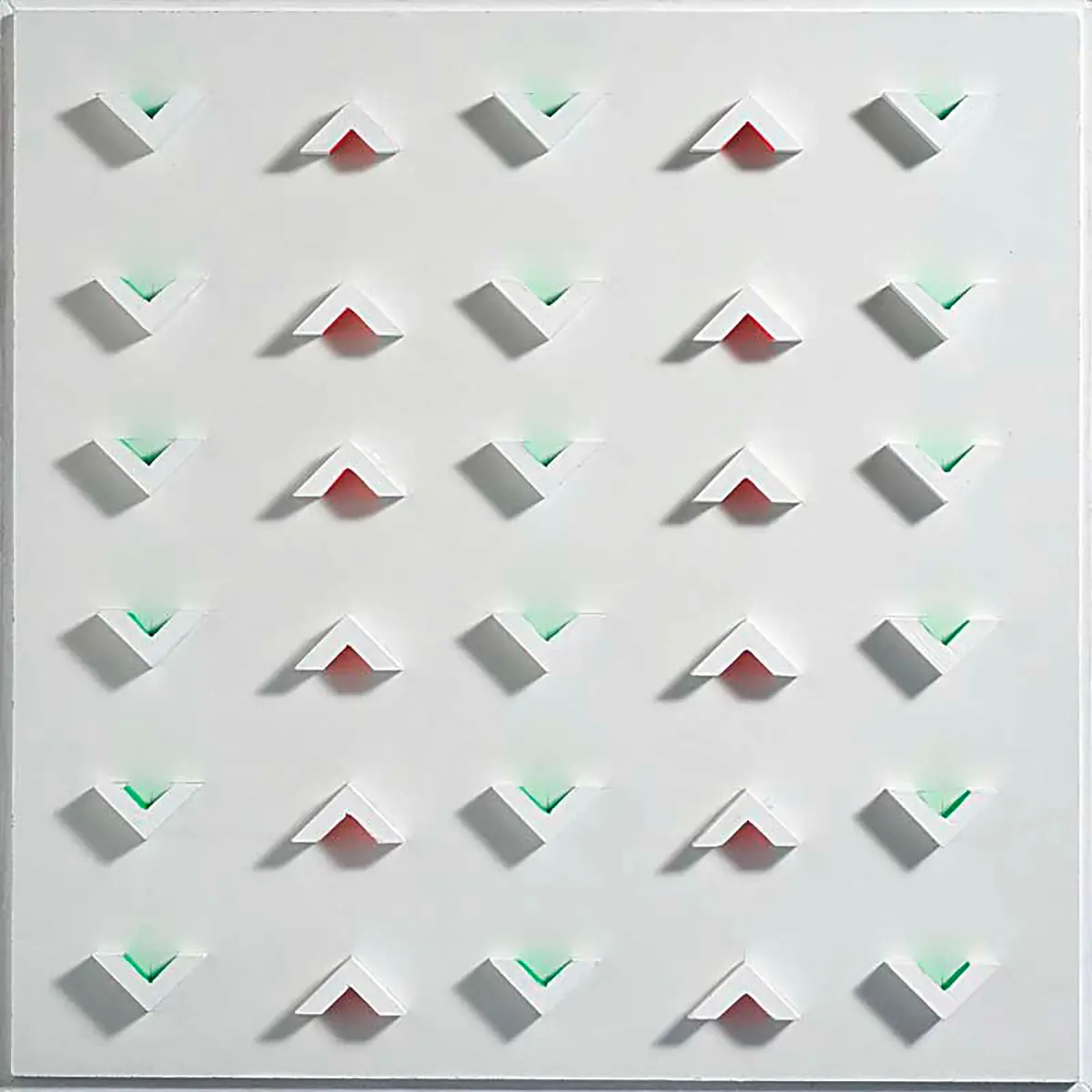
Tomasello’s work is always based on the Cartesian support of a two-dimensional structure on which the artist places a serial three-dimensional modular element. This element—always geometric—is attached to the plane support at one of its angles. In turn, the support is evenly distributed with progressive variations of angles, sizes, or colors that generate that central rhythmic-tensional effect that characterizes the work by Tomasello.
The interaction between these elements, light, and the viewer’s movement, generates this singular experience that characterizes his work and where the ludic element plays a central role.
In this sense, Atmosphères Chromoplastiques series are magnificent examples of such interaction. This exhibition includes several great pieces from this series, like Atmosphère Chromoplastique No. 852 and Atmosphère Chromoplastique No. 868 (2006 and 2007 respectively).
Atmosphère Chromoplastique No. 868 consists of 100 rhombohedrons evenly distributed on the plane. Each rhombohedron is attached to the plane at one of its angles. They reveal some inclination that confers their dynamism. Painted with orange, the posterior faces irradiate light on the plane to generate a lumino-chromatic experience.
In Atmosphères Chromoplastique No. 852 Tomasello superimposes a grid and places orange and blue color planes on it that are projected over the other faces of the grid to create a very peculiar chromatic experience.
Tomasello’s Objects Plastiques is different from his Atmosphères Chromoplastiques in that the color is applied on the frontal faces of the serial elements instead. Two examples of this are Object Plastique No. 854 and Object Plastique No. 935 (2006 and 2009, respectively). Both works are included in this current exhibition. In other instances, such as in the case of Object Plastique No. 861 (2007) the work is entirely monochromatic. So the interaction occurs somewhere else: between the serial elements and the changes of natural light with the passing of time throughout the day; these are the central components that animate this work.
Another group of works belongs to the Lumière Noire series. We are presented with matt surfaces that are mostly painted black—thus its name, although there are also working in white and indigo. Divested of any elements that can be projected over the plane, this group of works attempts to penetrate the plane through narrow slots that delve into the depths of each piece. Two works that are representative of this series are Lumière Noire No. 737 and Lumière Bleue No. 944 (1994 and 2010, respectively).
While it is true that Tomasello’s work is born out of a creative process marked by mathematical rigor, the perception of the resulting artifact invites viewers to a casual ludic experience in which the public, free from any referential tyranny, surrenders to the pure enjoyment of the forms themselves. Therefore, the masterful utilization of light and color—that create dynamic elements through their interaction with the public—is essential.
The same interest he demonstrated in his inquiries about the space helped Tomasello to make the initial leap from two-dimensional works to relief, and would eventually lead him to explore the architectural space.
The first of these interventions occurred in 1971, with the creation of a “chromoplastic mural” for the San Pedro building in Guadalajara, Mexico. Monumental works by Tomasello can also be found in Argentina, France, Mexico, Morocco, and more recently, in the US, where last year the artist created another chromoplastic intervention at the Nelson-Atkins Museum of Art, in Kansas, Missouri.
As an indicator of the important group of works included in this retrospective of Tomasello organized by the Ascaso Gallery, the exhibition includes a mockup for a marble pond and fountain, where the artist’s interest in light and color contribute to the interaction with the reflections generated by the water and the sun rays.
To complement this desire to explore the space, the exhibition also showcases a selection of jewels that Tomasello created in a collaborative effort with Catalonian goldsmith and designer Chus Burés, known for using his talent in projects for various visual artists. The sophisticated, iconic jewels represent a great way to encapsulate Tomasello’s artistic proposal, for they become, as Serge Lemoine well said, “the expression of the infinitely large embodied in the infinitely small.”
JANET BATET