
Figuration/abstraction; memory/oblivion; image/text; private/shared; life/grief. The recent work of Magali Lara (1956) emerges from the small angles activated and deactivated by the turn of a hinge. It operates not at the point of intersection, but in the new spatial articulation that the hinge generates. Animaciones brings together this work and presents an autobiographical story through the digital animation created by Luis Ordóñez with Lara’s paintings and drawings. In this way, the artist explores new tropes and pathways for the language with which she has been working.
This language is none other than that of natural shapes. Lara’s compositions often give the impression of the dynamism that characterizes life cycles. As she puts it, there is nothing older than a sense of belonging, and she would seem to be carrying this to its ultimate expression in her artistic practice. The first interstitial coordinate happens between framework and microcosm: universe/nature/person. Glaciares (2008-2009), a digital animation of drawings on a pencil with blue gouache, is an emotional, subjective landscape destined to die (glaciers melt.) These vistas of Argentina’s Patagonia region transliterate and synthesize landscapes from the artist’s own life: her widowhood and motherhood, as well as the passing of her father and siblings. By digitally “animating” these drawings, the characteristic principle of the landscape gene, that of “congealing” or “capturing” natural scenes in order to slow them down, is subverted. In the animation, the different shapes and compositions seem to move as they are presented to us in a sequence and in shots that turn and are juxtaposed, while Ana Lara’s music provides the rhythm for the emulation of motion.
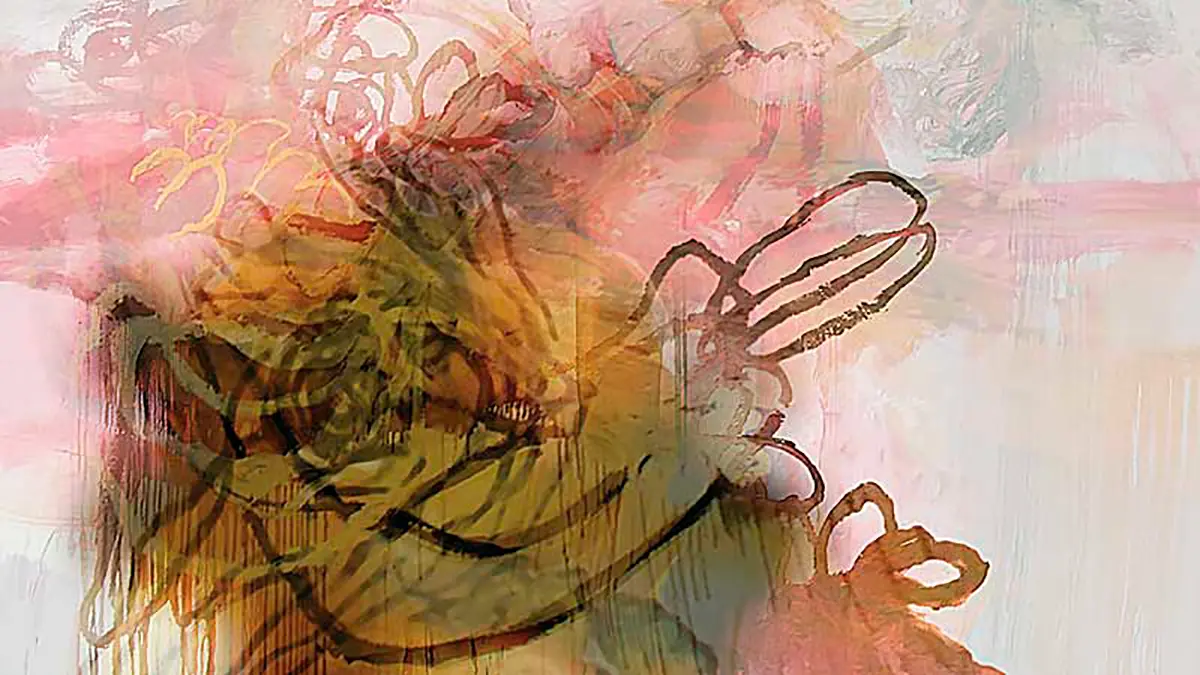
Después de la Lluvia (2011) translates digitally a large-format painting divided by the artist into three canvases but comprising a single unit, not a triptych. Lara admits that it was conceived on the new visual platform of the computer screen, where there are always several open windows, and that she opted for that presentation. It is interesting that it is as a digital animation that the work can be appreciated as a unit. The intersection between the two supports is what rounds out the work, and, in turn, allows us a better approach to its counterpart. The digital version makes us aware of the material, tactile nature of the pictorial version, as in the former those attributes are not perceived. On the other hand, on the screen and governed by music (Stephan Micus) and motion, the different parts of the painting are not seen as discrete entities, as is the case when we look at the three canvases “physically.”
No Me Acuerdo (2008), an animation of the photographs Magali Lara made of herself as she drew, is inspired by the Alzheimer’s her mother suffered through for six years. Two issues need to be highlighted with regards to the topic of memory and oblivion: first, how it makes evident the performative character of drawing; and, second, how at a given point in the animation the action “runs backward”, so that lines are erased. Not coincidentally, those lines form a spiral, metaphor for “the long journey into a wordless world.” Lara tells that her mother was able to recognize her on sight, but lacked the words to name her; once, before all her words were lost, she called her “cousin”. In this journey, the artist says, there are brief moments when the patient remembers who he or she is. (There is nothing older than the sense of belonging.) The repetitive sounds in Satisfaction of Oscillation (Yao-Dajuín) complete the parable and close it.
Un Posible Día (2011) is the story of a woman who literally lives inside her own head. The music in the animation (Javier Torres Maldonado) and the voice-over (a script by Ana Cándida de Carvalho) present the internal voices of a female character engaged in an activity as banal as leaving work and returning home. Lara says that she became a feminist thanks to her mother, and painted flowers because her mother and grandmother did that together; her desire in this show, she adds, is to tell stories not so much from the platform of the female body, but from the experience of a body that has seen and wants to materialize emotion. Tying loose ends I discover that there are many bodies in this show: not present, but alluded to. In Magali Lara’s work, what prevails is an organic element that derives not on explosive vitality, but on a kind of contentious calm. It is an exercise on a deep understanding of and participation in the mechanisms and principles of nature, rather than an attempt to represent them. Periodic and rhythmic, the body lives through small-scale manifestations of the large cycles of the universe it doesn’t narrate because it is its very diegesis.
DIANA CUÉLLAR LEDEZMA