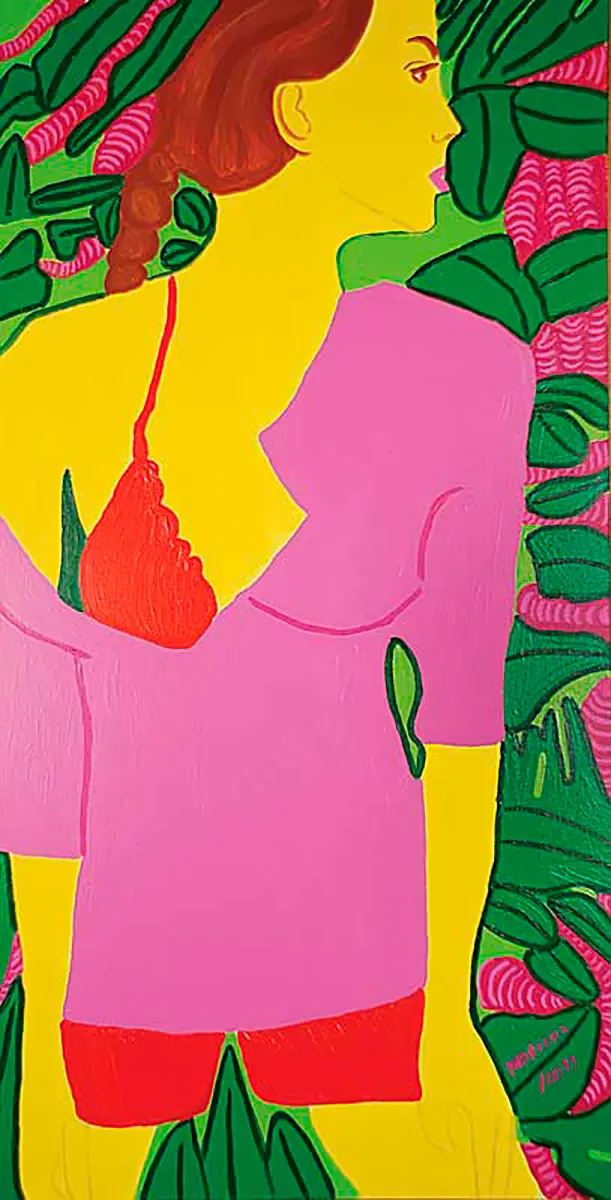
Maripaz Jaramillo’s paintings depict, this time around, a series of women posing as models amidst some rather contrived landscapes that blur into the colors and textures of their garments. Typical modeling poses where the gaze, faraway or hidden behind shaded lenses, reflects a certain halo of emptiness and melancholy. Other women in the artist’s repertoire, alone and presenting themselves to our eyes with seductive intent, offering the camera their best angles, are there awaiting the final click. This is how Jaramillo painted them.
Truncated figures, silhouetted by Jaramillo’s characteristic lines, appear flavorless one next to the other, with deadened expressions despite the bright colors typically used by the artist. More and more colors, overlapping layers of acrylic, give shape to female figures that are almost caricaturesque. Nothing new at the technical level if we review Jaramillo’s previous work, which from the beginning challenged the rules of painting and was devoted to representing in a critical vein scene from Colombian society. Challenges that forged a visual language located within the framework of Pop and Expressionism.
Ellas (the show’s title) is a recent production, yet it harks back to Jaramillo’s own beginnings (1970-1980) and in that way generates a degree of disturbance, as those earlier works represented not women enveloped in such undertones of frivolity but vibrant characters that remained themselves in particular situations. Definitely, the women represented in Ellas are of a different ilk, no longer those who struggled through desperate kisses and embraces or in night-dance scenes in the company or men, nor those seen in Jaramillo’s dramatic prints from the 1970s, which so masterfully demonstrated her expressionist affiliation. The artist has come back to thinking about the woman-as-object that she has so often referred to in her vast oeuvre.
In the story of the Colombian art of recent decades, Maripaz Jaramillo is an outstanding figure. Her earliest successes, lauded by critics, took place in the 1970s, as an intense period of experimentation with artistic language—to be consolidated in the following decade—was getting underway in the local context. These transformations were influenced by developments in the international art scene, and during this time Andy Warhol was a key point of reference for Jaramillo. However, she was able to understand what this influence truly meant and decided to focus on her own surroundings, observing everyday realities in contrast with the ostentatious pageantry of society, and in that interplay, she encountered characters and situations that revealed the popular behaviors characteristic of her region and her country. With these discoveries in hand, Jaramillo was able to launch a decisive proposal that certainly enriched the local art scene of the period. Her understanding of graphic-art principles and of course her experience as a printmaker have provided Jaramillo’s pictorial work a characteristic that remains central to her creations, Mariapaz Jaramillo has challenged painting with her graphic ideas; her works tell us something about photography and its codes, and also contain a kind of drawing within those deformed configurations created on the basis of imprecise lines.
Ellas (2011) is a series of works that emerged after a 2009 exhibition celebrating, with the series Besos y abrazos and Agua y paz, 30 years of artistic career. Critics often highlight Jaramillo’s early work; the periods when her interests have emphasized ecology or the landscape have been underappreciated as if the disappearance of human figures took away from the meaning of her art.
The almost thirty paintings created by Jaramillo for this Bogotá show come across like photographs ready for publication in a fashion magazine. Here, sophisticated women rest against exotic landscapes that at times bring to mind the fauvist school. The largest painting in the set hung on the central wall, commands the gaze of visitors to the gallery. It depicts a yellow-skinned woman clad in red, against a purple background. The waving lines of her hair play with the lines that give texture to her dress, and her pose is as artificial as she is—the perfect touch to reinforce the aura of falseness that dominates the images here on display.
ERIKA MARTÍNEZ CUERVO