After studying in Buenos Aires, his native city, Miguel Rothschild (1963) decided to continue his education in Berlin. He has remained there since 1991, moved by a frank affinity for an emotional constant—the Romantic spirit that dominates representation in German culture.
If in his previous show at Ruth Benzacar Gallery highlighted the idea of melancholy developed in Romantic aesthetics—with a reference to Dürer’s famous engraving Melencolia I—now the focus is on the ideas of aura and the sublime, as found both in religious architecture and iconography, such as ever-expanding skies—star-covered or stormy—and in the traditional concept of art.
The show begins with a series of glass boxes that, under the title of Absolución, shed an ironic light on the issues of guilt, punishment, and expiation. The boxes contain photographs of confessional walls; perforated, the photographs reproduce the varied design of the original orifices. In his way, Rothschild transforms the sacred into the profane: we no longer kneel to confess our sins; now the proposal is to play, putting our skills to the test. That is the issue: the artist invites us to take in our own hands each one of the boxes and to put those steel balls into the holes interrupting the flat surface.
Let us note that the confessional’s opening allows for the exchange of voices, but not faces. Only one of the parties, the confessor, can see the other one behind the panel. The faithful are left in darkness. But, is seeing really that important?
Felices los que creen sin haber visto (“Happy those who believe without having seen”), says the title of one of the works on exhibit, which brings to mind St. Thomas’ famous dictum: “If I don’t see in his Hands the mark of the nails and put my finger in the holes, and put my hand through the wound on his side, I will not believe.” In a parody of Thomas’ concern, Rothschild touches and perforates, penetrating the interior of photographs that depict the stained-glass panels of a Gothic cathedral. He hollows it out and leaves the trace of his exploratory gesture. It is thus that, as a result of those perforations, thousands of small color papers flurry down to the base of the work, which, separated from the wall, project shadows that shift as the viewer moves.
Why is Rothschild, in his “extended photographs”, so obsessively intent on perforating, hollowing out, using what he extracts, and at the same time giving a central place to the role of the viewer? Perhaps so that the tragedy where Nietzsche’s hard truth explodes—“God is dead. God remains dead. And we have killed him”—can be transformed, softened, into a kind of comedy.
Traversed by fishing lines that shine under the light and project a cold aura into the space, the wound on the body of Christ is attenuated. At the same time, the immense sky suffers the aggression of pointed elements (nails and pins) and works as a metaphor for pain, just like in Los silencios de Sor Juana.
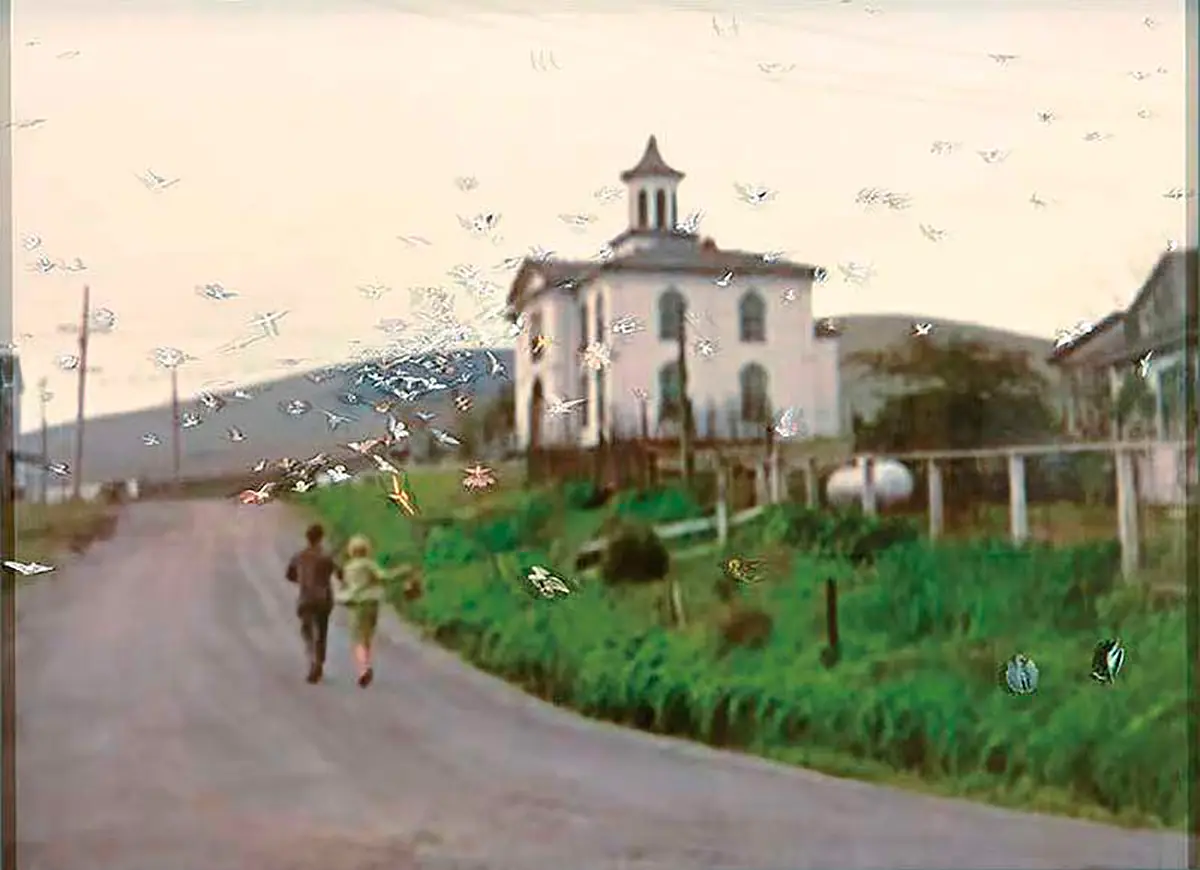
Representations of the Holy Spirit taken from paintings are also pricked—tortured—with pins in an out-of-focus photogram from Alfred Hitchcock’s film The Birds. These are rhetorical deviations that, in various ways, allow us to take some distance and thus see the emptiness that perforates everyday existence.
To show, to perforate, to cover. All is valid when it comes to selecting nontraditional materials: nails, pins, thread, fishing lines, drinking straws, steel balls are all metaphors for content alongside the perforations on the flat surface and the almost decorative use of the resulting paper circles, precarious pieces of a contrived feast that place us at the antipodes of the sacred.
By covering the surface, the small balls and color paper pieces operate as the counterpart to the transparence of Melancolía A. D. (2007-2008), previously exhibited in the same gallery and made using thousands of drinking straws in different colors that allowed viewers to see through. This work was conceived in contrast to the heavy polyhedral body that blocks our view of the horizon in Dürer’s Melencolia I.
It is evident that Rothschild’s work is organized dialectically around a play of opposites. “I like to reach viewers through an easy, lightweight, direct approach, only to have that lightness revert on second look to become its opposite,” he says.
In a godless time, a time emptied of transcendent content, the importance of art’s mission is underscored. If art didn’t exist, our loss would be twofold: a loss of the sacred, which is no more, and a loss of the memory of what it once was. De-auralization is the path chosen by Rothschild to access that memory.
ELENA OLIVERAS