
Under the directorship of newly appointed Paola Santoscoy, the Museo Experimental El Eco inaugurated two solo exhibitions to jumpstart its new events program. Pablo Vargas-Lugo (1968) and Miguel Monroy (1975) are two Mexican artists who offer proposals that somehow address—each in their respective ways—the processual nature of the work of art. This and the fact that El Eco commissioned works by them to be shown at the same time, lead viewers to wonder about the possible conceptual and formal relationships that the two exhibitions may share.
In the main space of this “habitable sculpture” designed by Mathias Goertiz, Pablo Vargas-Lugo presents with lucid sensibility his first exhibition after his return to Mexico, from living in Lima, Peru, for three years. The work titled Intemperie (In the Open) centers on a sequence of mandala pieces in which the artist uses a meditative-aesthetic technique borrowed from Buddhism that consists of drawing with sand; similar techniques were practiced in Mesoamerican cultures but instead of sand, used grains, seeds, and petals. His first mandala (OPA, Guadalajara, 2007) revealed a recent epistemological passion for formal configurations—the result of the struggle between forces during the evolution of the species—engraved in the wings of butterflies. In this site-specific installation, Vargas-Lugo expanded over his (de)materialization the visual record of a butterfly’s wing that looks like a gigantic—it measures 11 x 9 meters—and fragile evolutionary bio-map whose persistence, and finiteness could remain inscribed in the consistency and state of its own materiality.
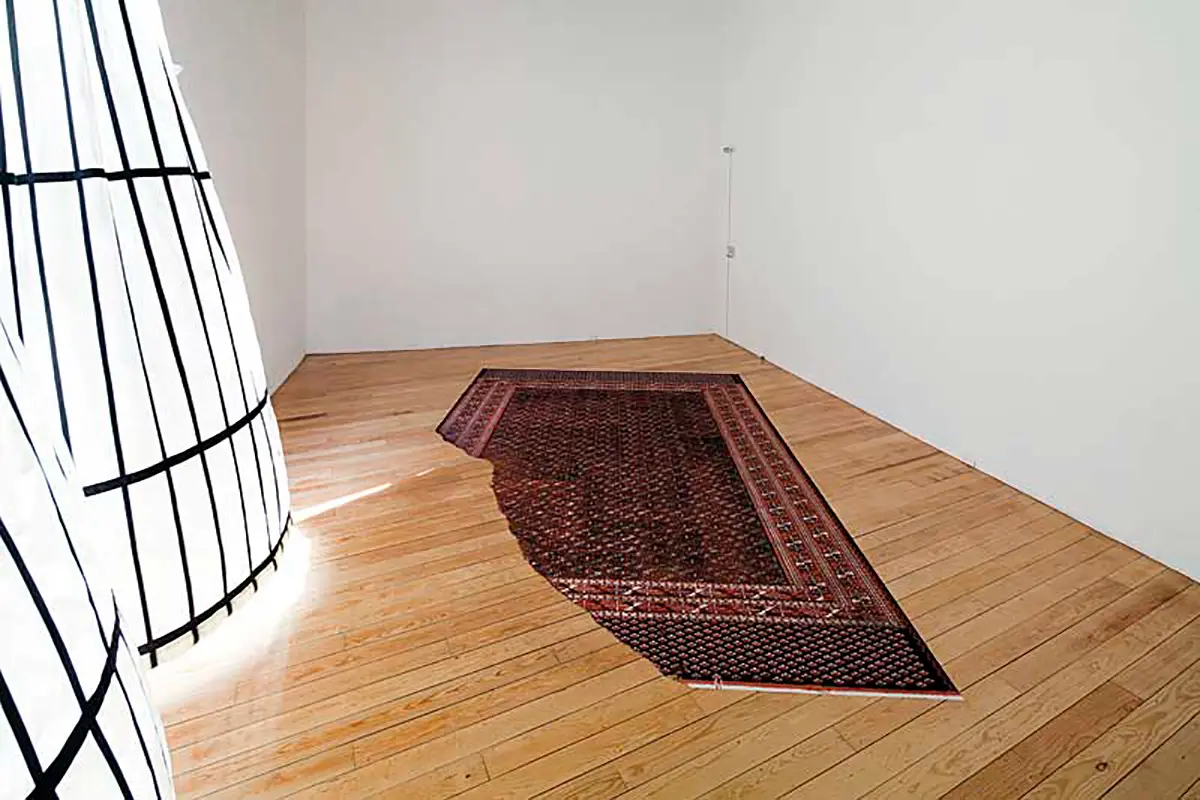
In this new in situ intervention created for El Eco—in which the artist relies for the third time on the seductive visual texture and suggestive temporality of the mandala—Vargas-Lugo rightly decides to transfer the practice of drawing with sand, in order to create a sort of “incomplete mandala.” To do so, he invokes a rug designed with patterns that refer to an imaginary from the Middle East. Thus, the artist replicates motifs from ancestral rugs that in their places of origin would outline the living quarters of the nomad dwelling, or the gathering area and living sections in a home. Luxury objects that were voraciously sought after and imported during the height of the European fervor of the Nineteenth Century for all things oriental are still kept to this day in upper-class homes as indicators of social status, and in Vargas-Lugo they serve as remnants of the succinctly narrated imaginary that this artist captures by selecting this piece as the sole work that occupies the main exhibition space in the museum.
As we get close to the piece, we realize not only that one of the corners of the rug has been “drawn”, but also that the rug is under a gradual process of effacement due to the—subtle but insistent—action of the wind that caresses it laterally. Then we realized that—interacting with the architectural space of the museum in a decidedly more active manner—Vargas-Lugo has removed the large stained glass window that connects the central space with the interior patio, and that he has replaced it with a white curtain decorated with a lattice of black lines—a literal reference to a work titled Senza Titolo (Untitled, 1980) by Italian artist Gino Dominicis—that modulates the action of the wind on the piece as a relentless witness of its disappearance.
Gradually unable to fulfill its original purpose as an object intended for hospitality in a dwelling or home, Intemperie becomes a work that delicately penetrates and uncovers contemporary humanitarian socio-political issues that are in urgent need of being solved; whether it is the nationalist insinuations in the face of the obligatory exiles; or the remnants of hospitality that is no more and does not wait for those who are not coming back; or the residues of habitability in the (de)territorialization of contemporary reality.
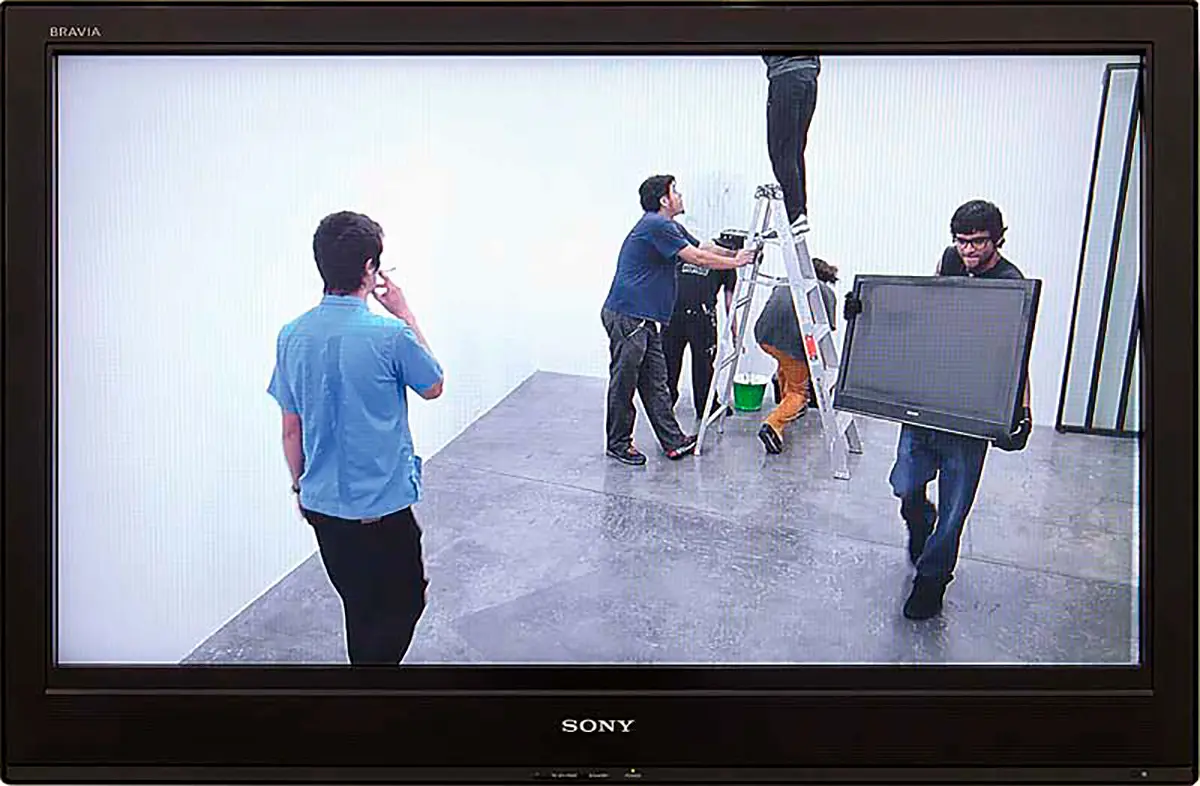
The work titled Canon by artist Miguel Monroy is presented in the exhibition space located on the second floor of the museum. It offers a video account of his in situ intervention; a serial film of actions that resort to the idea of the eternal return—a mythical-philosophical-metaphorical concept that advocates the existence of a non-linear cyclical time for the future history of humanity.
Physically, the piece by Monroy is constructed by a past offered as an illusion that is identical to itself. Now it is contained in the small surface of a screen almost at the back of the room. It works as a spectral record of a series of actions that used to cohabit what we now occupy.
By revealing the uses, negotiations, and common traffic patterns of the exhibition space, the video by Monroy exercises the illusion of the revisited plot, as if it were visually superimposed in relation to the cyclical workings of time and the everyday occurrences in the life of people whose actions are apparently inconsequential. The choreographic intervals that Monroy achieves from his actors—who stereotype a wide range of typical museum visitors—intervene the very space that we now occupy as automatons with memories, saturated of events that could have never happened within an imprecise temporality than, nonetheless, could be reinitiated at any time and immediately made us part of its alienating dynamic.
Monroy has left on the wall opposite to the screen a dirtied trace—by the gestures in the story—as the sole physically verifiable (tangible) indicator of multiple actions that shaped the past of this present we observe without ever having actually seen it. There is the stain that stands as a record of what is perhaps the first intervention painted and repainted to Infinitum on that other wall that now observes un, baring its own erosion in exchange for ours.
MARCELA QUIROZ