
Rosario Guillermo is an artist focused on the creation of ceramic sculptures. The exhibition at the Museo de la Secretaría de Hacienda y Crédito Público—Museo de la SHCP, formerly Antiguo Palacio del Arzobispado—in Mexico City, presents Guillermo’s most recent work—from 2010 to 2012—in addition to one piece from 2008. Guillermo has been working with this medium even when she was a student. Her work has experienced thematic, figurative, and abstract changes over the years. One other constant besides the exploration of the same medium is her emphasis on the monumentality of her pieces—regardless of the theme or actual dimensions. The exhibition titled Burning Earth is consistent with the two referents of her production previously mentioned. On this occasion, Guillermo explores geometrical-organic abstraction as she sublimates her relationship with figuration.
Abducción (Abduction) and Corteza Esencia (Bark Essence) are two of the sculptures presented in this exhibition. They are unarguably baroque, as are all works by this artist. Abducción is full of superimpositions crowned with dual conclusions; it is the prototype of several works in this exhibition—its characteristics include inverted positions, so the bulkier part rests on top of the thinner lower part of the piece. On the other hand, Corteza Esencia focuses on another observable characteristic: the coexistence between ceramic and wood in several of her works. The work by Rosario Guillermo involves baroque sculptures characterized by asymmetric tensions, contrasting materials, and the opposition of weight and volumes; all of these, important components of certain works like Tectaria. Pre-Columbian influences permeate some of her works. Rendered in green and brick red tones Espiral Escalonada I y II (Layered Spiral I and II) is one of the few sculptures in the exhibition that does not use the white slip as do most of the other sculptures.
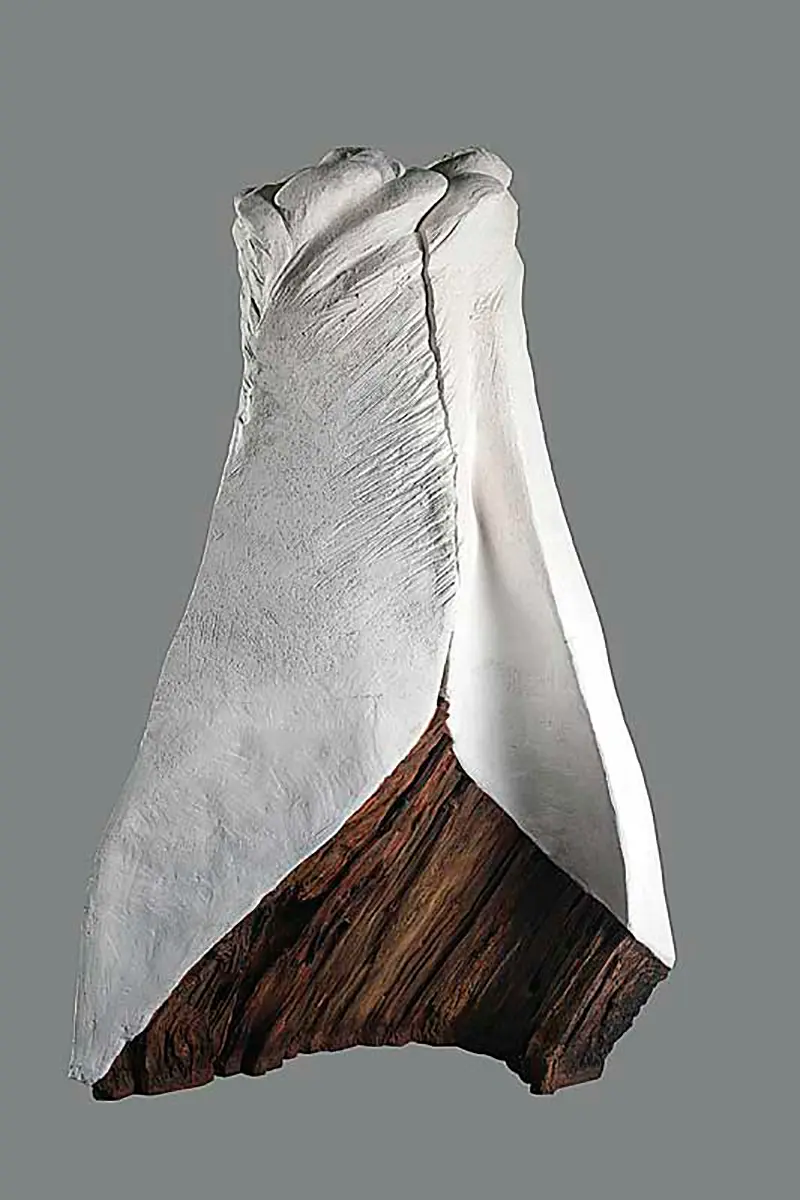
To a certain extent, these sculptures offer enchanted realizations that stemmed from the author’s efforts to control mass, weight, and fire. Rosario Guillermo exacerbates the perception of ascending and gyroscopic movements. Some forms are more recurrent than others, while others are more playful. There are the overlapped pieces constructed from a relationship with wood, like Tectónica (Tectonic), Dinamición, and in the already mentioned Corteza Esencia (Bark Essence). Tornastructura is a piece that also combines ceramic and wood. Guillermo has resolved the interaction with the pairing of these two materials in a notable and diverse manner. This is her most important achievement. And these are the important works that cannot be missing in the lists when we specialists write about the most important works of a particular period and discipline. Some of the titles of Guillermo’s work make reference to nature. They project movements that are something we could call the opposite densities of the material (ceramic) and the “immaterial (wind).” The naturally occurring phenomenon of the wind is harnessed by the artist to create spiral forms as in Huracanado (Hurricane-Force) or Spirada. References to the chalice, the capital of a column, and to the handling of ascending piped matter are presented in the exhibition in works as noteworthy as Terra Mather Estía I y II. Sumptuous and deconstructive elements are intertwined in several pieces. Viewers find in De Babel I, II, y III (Of Babel I, II, and II) a series of ascending forms that pay homage to the Monument to the Third International by Vladimir Tatlin.
The museography proposed discontinuous and continuous gravitation toward the group that allowed viewers to appreciate some sculptures individually, collectively, or through comparisons. Because baroque does not care about straight lines or uniformity, the arrangement of the works set the proper concentration of pieces to be in groups while others were isolated in emptier spaces. Rosario Guillermo developed twelve predominantly elongated “wall sculptures” that are expectedly baroque, voluptuous, and linguo-phallic; among these, the pieces Lenguawave and Lenguarizo. She also evokes the wave, the volute, and the equilibrium between opposing forces, expressed in works like Oscilante (Oscillating), Orbital, and El Origen de las Especies IV (The Origin of the Species IV). Just as she did with the large size sculptures, Guillermo treated most of the wall sculptures with off-white slips; only a few works received other applications of colors and even gold-leaf like Oscilante (Oscillating) y Orbital, while red was used in the piece Lengualava. These reliefs, which reach a maximum dimension of 84 × 41 × 18 cm (33 × 16 × 7 inches), were exhibited as a group in an exhibition room-chapel.
While the larger pieces could not be regarded as monumental in other circumstances, the fact that they are ceramic pieces gives them the right to be called that way. Creating ceramic pieces in the size produced by Guillermo is quite remarkable for this type of sculpture. At 2.25 meters (7.38 feet) high; the work Metamorfa is one example of this. Because the process of ceramic sculpture requires that each part of the piece be fired separately, most artists working with this medium experience limitations when it comes to the size of the works. The complexity involved in the movements that are needed to complete the work, not only has to do with size but also with the weight of a material that must be settled in one place, to let it dry, and then moved again to be fired. The only artists that can create larger pieces are those who work outdoors and built their ovens around the piece. I remember that Jorge Luis Borges once said that he defined baroque as “that style that deliberately exhausts (or tries to exhaust) its own possibilities, and that borders on self-caricature,” and that is precisely what permits it to exist.
GRACIELA KARTOFEL