
Artist Sandra Gamarra (1972) presents her 24th solo exhibition. Titled Self-Portrait, this most recent show by the Peruvian artist was given this title “because the exhibition uses all the elements that I would use if I were to create a self-portrait.”1 “Then, the self-portrait is an exercise in the exploration of the other, where coincidences are temporal and the affinities are established by the observer.”2
Gamarra has represented Peru at the 2009 Venice Biennale and at the 2010 São Paulo Biennial. Her works are part of the collections in the Tate Modern, MoMA, four museums in Spain, Brazil, and three museums in Peru. In July of 2011, she presented a solo exhibition at the Bass Museum in Miami. Gamarra received a Ph.D. in Visual Arts and Research from the Universidad de Cuenca in Spain. She has received three scholarships in Spain and several awards in Spain and Peru.
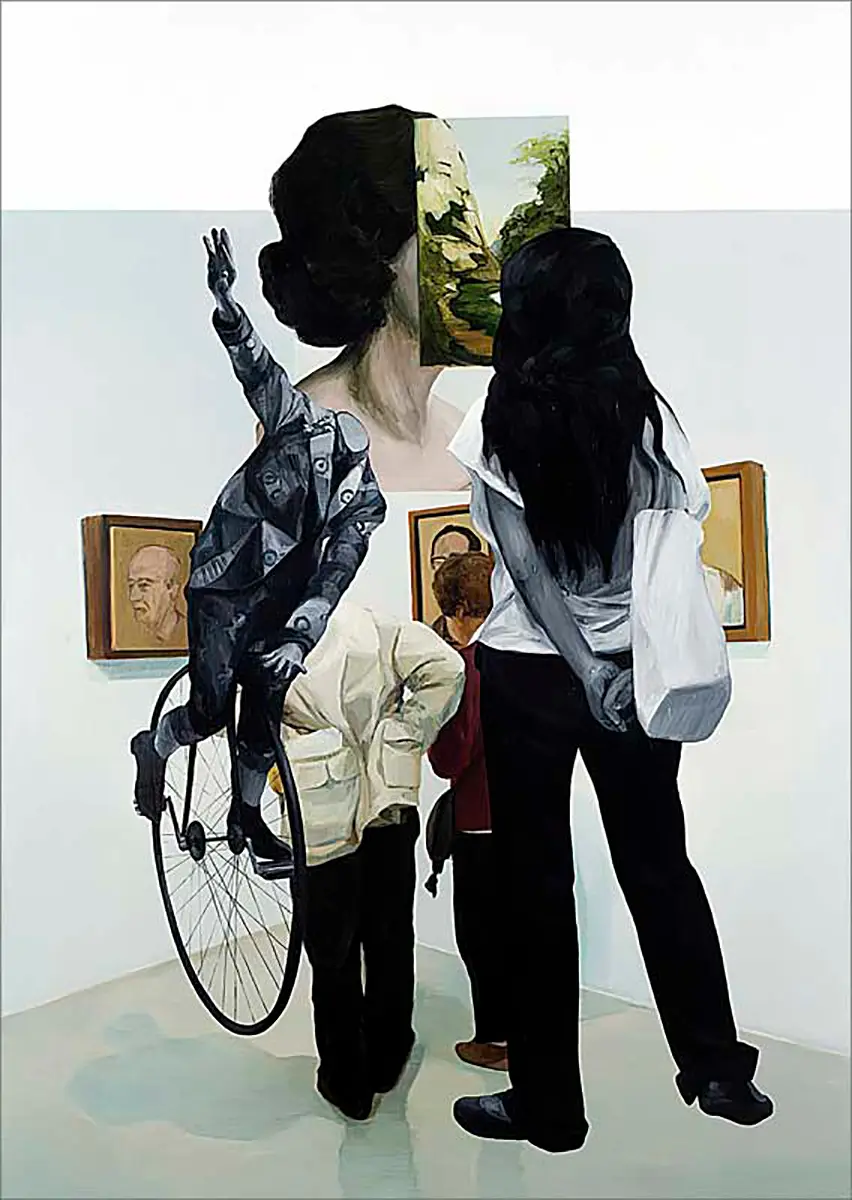
For this exhibition, Gamarra presents 17 oils, 14 on canvas, and 3 installations, each with 12 oils on paper. There is also a 12-minute video titled Que Tu Mano Izquierda no Sepa lo que Hace tu Mano Derecha (May Your Left Hand Not Know What Your Right Hand is Doing). Gamarra, who specializes in turning works into spaces, and museums and galleries into objects, enjoy using the objects as fetishes. On some occasions, Gamarra would even include viewers in this transformation.
For this exhibition, she relies on the visual style of the museum. She also employs another style in which she uses works of art by other artists—something she calls the new readymade—either parts of the works or the entire works. She then superimposes these works by several artists to create a completely new piece. The work Orden de Aparición III (Order of Appearance III) depicts a man with his back to the viewer looking at an empty wall. This image was taken from a photograph by Thomas Struth. The man is supposedly observing a work of art. There is a bookcase behind him with two portraits taken from an installation by Carol Bove titled At Home in the Universe. Likewise, there is a mirror hanging from a long metal stick and somewhere else along stick-like those created by Rebecca Horn. The bookcase is suspended in the air. This image is unreal and meaningless, but the subject and each object in this piece were taken from other works of art. The man stares at the empty wall while all the art is behind him. Here Gamarra proposes that museums are not the only place to view art, as it can also be accessed through computers, books, magazines, and many other resources around us.
In this exhibition, Gamarra included three display cases, each containing 12 oils on paper, six on each side. It resembles a museum’s display of manuscripts, jewels, or small artifacts from earlier cultures. In one of the installations, titled Autoretrato II (Self-Portrait II), the display case contains mundane objects like gas tanks painted like Greek pottery. Likewise, there is a painted hanging mobile by Alexander Calder. In another display case, there is the image of Venus of the Rags by Michelangelo Pistoletto. This is something Sandra Gamarra calls the new readymade, as it is a found image that has not been created by the artist, just presented. In yet another display case, we can observe a reproduction of a sculpture by artist Rachel Whiteread. This reproduction of works by other artists is known as appropriation and it is a resource that Gamarra has been employing throughout her career, by using objects from past civilizations or from other artists. The manner in which the display case is presented is very much in line with a museum’s way of exhibiting works; so Gamarra uses this style to redirect our attention to the visual aspect of the museum.
The installation titled Vitrinas Huacos I (Display Cases Pottery I) also proposes a display that looks much like one of ceramics in a museum: a framed window display case that protects the pieces. Gamarra painted 9 huacos—a name given in Peru to earthen vessels and pottery artworks—from the various Inca and Chimú cultures. They are painted in a realistic manner. Gamarra plays with the representation of pottery in galleries and museums, as other works by her have demonstrated.
The work Señalando (Pointing) consists of a group of three paintings of different sizes, each containing a hand that points at something. In the first image, we observe the arm of somebody pointing at a monolith from the ruins of the Quenco archaeological complex, near Cusco. Another painting depicts someone—the heads of seven other people also appear in the image—pointing at the Coricancha Temple (Incan temple of the sun). The participation of other persons witnessing something historic is important in Gamarra’s work. The third and last painting is an image inside the museum. Once again there is someone who this time points at an anthropomorphic stone sculpture. This individual is surrounded by Incan pottery and the type of didactic images used in museums. These types of pieces have become recurrent in Gamarra’s production; namely, a representation of ancient cultures and their presentation in a museum.
With this exhibition, Gamarra demonstrates the reason why she is an avant-garde artist, as she helps explain the success behind her achievements. While showcasing an original style, she is always proposing something different: this time the new readymade. She tells us that while she does not have a visual language of her own, she does have two personal styles. On the other hand, she has demonstrated that she proposes something that is very important to museums: originality with a style of her own.
NOTES
1. Interview with Sandra Gamarra, April 2012.
2. Press release was written by Sandra Gamarra.
AUGUSTINO CHIMPEN