
With great displays of talent and daring, artist and architect Tomás Saraceno (Tucumán, Argentina, 1973) dreams and produces on the largest scale. As he builds a chimera-chasing body of work, both the general public and the critics that widely celebrate him are left fascinated and seduced in his wake. In his ambition to delete psychological and psychological boundaries, be it imaginary or really existing, Saraceno posits transformative intentions in order to inhabit and to live. He proposes territories that rise up and defy gravity, blazing a path towards different dimensions. These are cities and airports that sweep aside all national borders; he creates “realizable utopias”. Yet, Saraceno’s ascendant path in the international art scene is not devoid of signs of danger, related to specific aspects of his work.
A Return to the Sources
Saraceno formulates networks that presumably course through space and postulates museums that move with the wind. He designs galaxies fueled by solar energy, gardens that sway to the breeze, and clouds that are perhaps inhabitable. These works are created alongside a multidisciplinary team (Studio Saraceno) and installed in biennials, international forums, and museums in Europe, Korea, Japan, Brazil, and Colombia.
In the abundant literature devoted to his work, Saraceno names among his sources the visionary engineer and inventor Richard Buckminster “Bucky” Fuller (Massachusetts, US, 1895-1983), who in 1949 created the geodesic dome (a structure “able to support its own weight without limitation”) and devoted his efforts to answer the following question: “Can humanity survive finally and successfully on the Earth, and if so, how?” as noted in Wikipedia, the Argentinean artist’s preferred encyclopedia. But in truth, Saraceno is not comfortable with this partiality. He believes that a moment will come when the notion of “country” will lose its reason for being and defines himself as belonging to Planet Earth.
Saraceno also mentions French architect Yona Friedman (Budapest, 1923) and Argentinean artist and theorist Gyula Kosice (born in today’s Slovakia, 1924). Indeed, from a Latin American perspective, the first point of reference that comes to mind when seeing Saraceno’s work, by virtue of its utopian and ethereal proposals, is Kosice, whom the younger artist frequented as an architecture student. Already in the mid-1940s, Kosice asserted that “Man will not end up on Earth”, creating in 1948 drawings and plans in support of his proposal La ciudad Hidroespacial (exhibited in 1971 and recently acquired by The Museum of Fine Arts, Houston), and a promise that would free mankind from “earthly weights and sins” and drive it to inhabit interactive technological structures well beyond anything now known.
But unlike Kosice’s works, which result in models (some even in very large dimensions), Saraceno creates surprising life-size structures that viewers— provided they are in good physical shape—can enter. Light-weight, some of them inflatable, these structures aspire to be human dwellings able to fly and to contain many individuals. Saraceno is not just a fantasist; he says he works because he wants to continue “actualizing his dreams,” today and always. He is an optimist who seems to be gazing at the stars and believing that (almost) everything is possible. He thinks in terms of the future, “of many futures.”
The directors of the museums and institutions that show his work must be deeply grateful: his shows are guaranteed success. They attract large numbers of viewers of all ages, who feel compelled and involved, even at the physical level.
Back and Forth
Saraceno was barely a year old when his parents went into exile in 1974, still under the democratically elected Peronist government, with the country gripped by profound turmoil due to the hardening of guerilla fighting and the activities of a death squad known as the Triple AAA (Argentina’s last military dictatorship began in 1976 and lasted through 1983.) Thus, the artist spent his childhood in Italy and only returned to his native country in the mid-1980s, when they settled in San Luis province after the return of democracy.
Currently, Saraceno lives in Frankfurt, where he arrived in 2001 after obtaining his architecture degree from the Universidad de Buenos Aires and attending one of the city’s art schools (Ernesto de la Cárcova). Before emigrating, he participated in a couple of group exhibitions, in a “reflection experience” convoked by Catherine David and organized by the Goethe Institute and the Proa Foundation. City Editing was an international colloquium accompanied by projects, around the present and the future of the city and its conflicts.
After a second and definitive trip to Europe, for graduate studies in art and architecture at the Staatliche Hochschule für Bildende Künste Städelsdchule, in Frankfurt, he acquired an excellent network of contacts—critics, biennial directors, colleagues, professors—something that in the current art scene is of crucial importance. Contacts have always been central to the arts field, but today’s instant communications help them work with greater speed and efficacy. Saraceno decided to remain in Germany; after all, a crisis had erupted in Argentina, devouring four presidents in less than a month, dissolving the country’s currency, manufacturing millions of newly poor citizens, and spreading an unending sense of hopelessness.
In Germany, Saraceno found important teachers, such as Peter Cook—one of the main members of the avant-garde architecture group Archigram, established in the 1970s—who surely stimulated the Argentinean artist’s interest in atmospheres and utopian constructions. Perhaps it was from them that he learned to use lightweight materials and the latest technology in the development of his work. Another teacher was Daniel Birnbaum, the youngest curator in the history of the Venice Biennale in 2009. Birnbaum invited Saraceno to participate in Making Worlds, his curatorship for the event’s 53rd edition. At the IUAV, the University of Venice, he was also a student of the influential critic and curator Hans Ulrich Obrist and of artist Olafur Eliasson, celebrated for his impressive and poetic large-scale installations. But even before his appearance in Venice—the exceptional platform that helped his forceful oeuvre achieve global, definitive recognition—Saraceno had already compiled an impressive resume after his arrival in Europe.
Art and Science
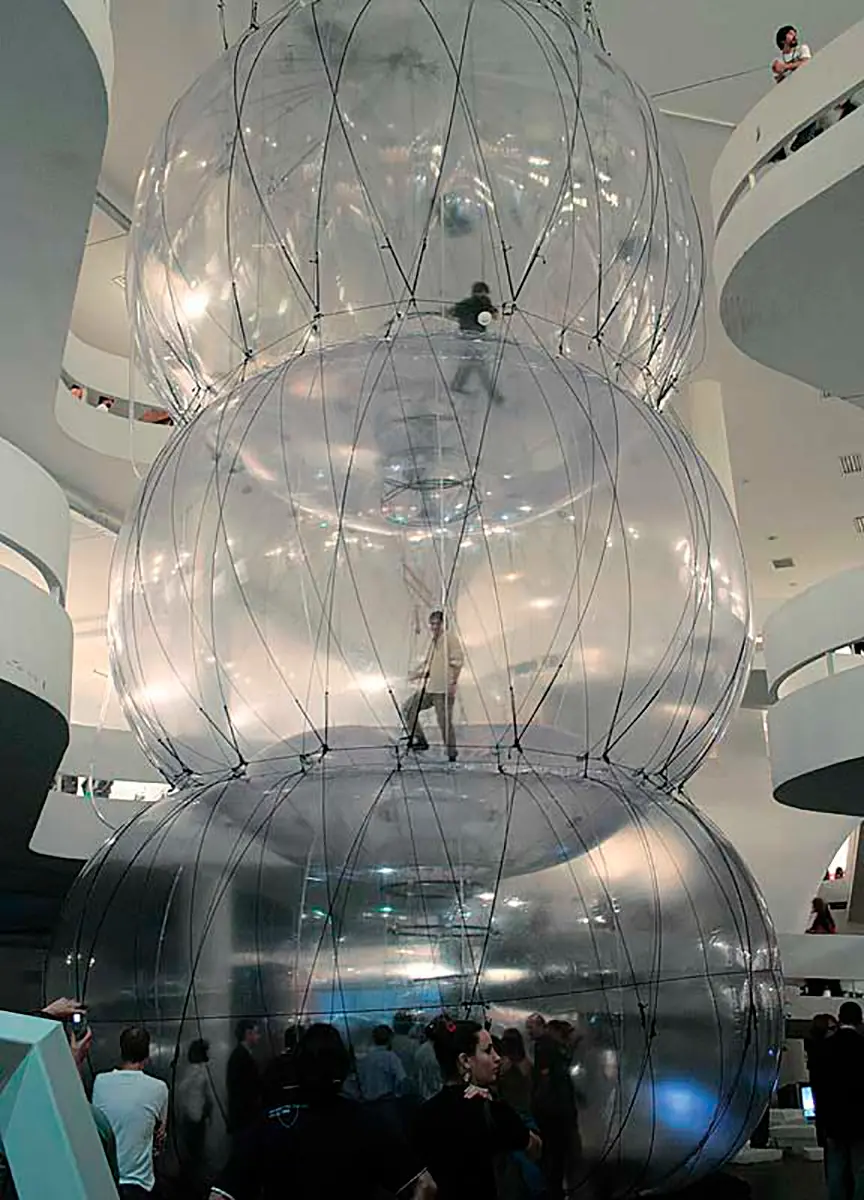
How to Live Together was the conceptual framework for the 27th International São Paulo Biennial (2006), which proposed the integration of art and life, suggested the idea of community, and posited questions that were aesthetic but also philosophical and historical in nature. Generating as many opinions as it had visitors, that Biennial satisfied many (this writer among them) who found it less striking but more substantive and intimate than previous editions, and disappointed those who judged it grandiloquent and failed in its attempt to capture the complexity of what it means to “live together.” Nevertheless, the positive assessment of Saraceno’s installation was almost unanimous. In 2006 his work was not yet as well known (at least in the south of the South), even though he had already presented his first Jardín volante, to mention one of his works with inhabitable cells, translucent metal spheres similar to those seen in São Paulo.
Saraceno likes to think about the possibility of living up in the air. Three stories tall, the structure comprised of inflatable modules (at a walkable scale) was one of the event’s outstanding presentations. It invited interaction and the establishment of relationships between the viewers themselves, even if only for a few moments. In the process of going up and down those soft, piled-up spheres, one had to speak with other visitors in order to make way and move forward, and all had to accommodate together. Thus, Saraceno’s suggestive architectural project also contributed to promoting a game of conviviality and a reflection about survival.
Art and science share a passion for processes, the allure of the unknown, and a search for knowledge. More than ever in this new millennium, art and technology flow through converging pathways, and Saraceno’s work enact the possibility of creative collaboration for the articulation of new ideas. As Irish physicist Michael John Gorman—director of Dublin’s Science Gallery and a researcher of the interaction between art and science in Galileo’s time—has put it: “When art and science moved apart, our loss was great.”
Saraceno demonstrates that once again aesthetic and scientific curiosity come together repeatedly as they move forward. He even participated in NASA’s International Space Studies Program, in Silicon Valley. In the early Twentieth Century, the arrival of new machines and their promise of a future of progress was celebrated by some intellectuals, by the Russian Constructivists, by the Italian Futurists. Kinetic art and the telecommunication experiences generated since the 1960s are born from a romance with technology.
But rather than providing an overview of the ways in which technological developments influence, be it negatively or positively, everyday life, Saraceno uses art and science (and their environs) to investigate origins and interdependences, as in his galaxies in Venice, and to study the possibility of reinventing the relationship between architecture and sustainable life, as in Cloud Cities.
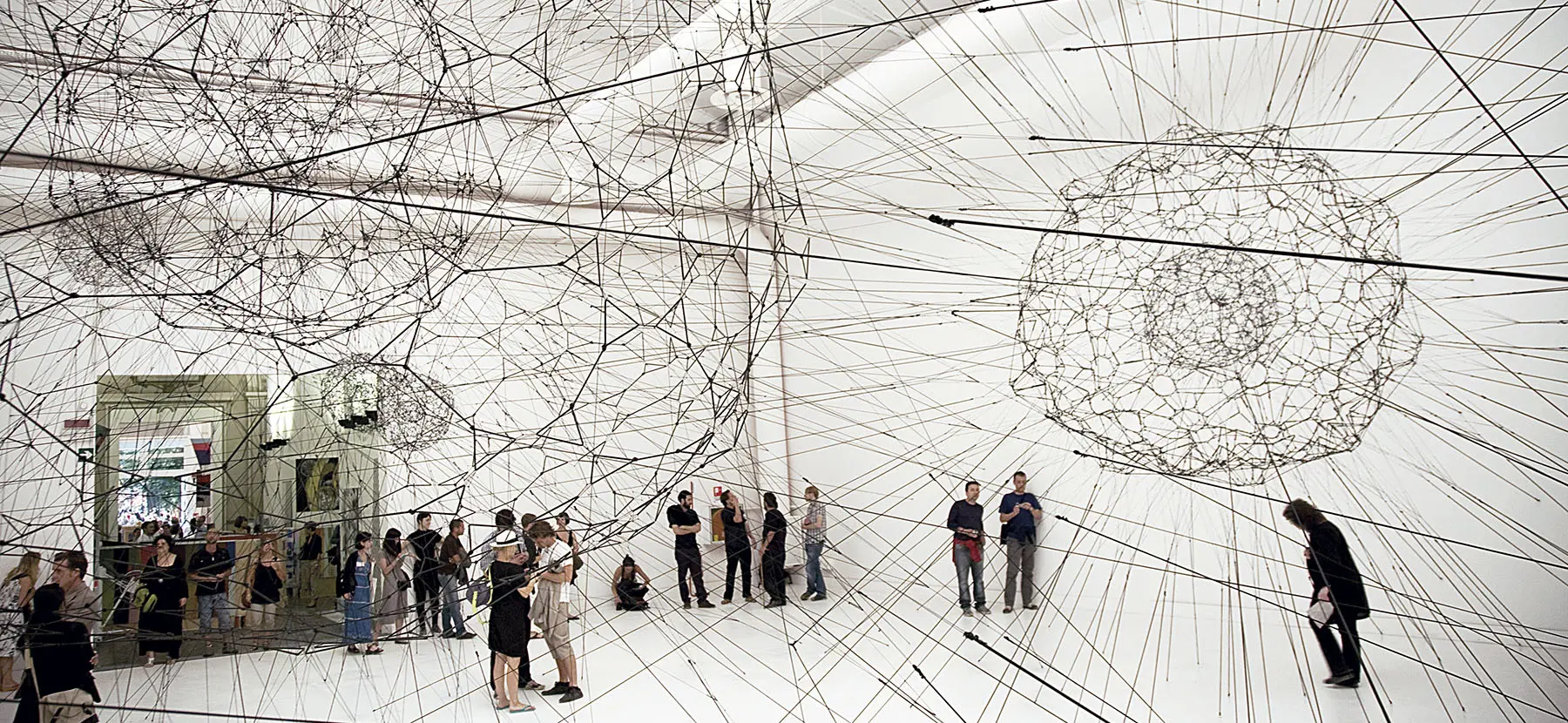
Play and chance are present in Saraceno’s discoveries and in his monumental installations, despite the serious planning effort suggested in his deployment of scientific procedures ad mathematical equations. Among the 90 artists included in Making Worlds, at the 53rd edition of the Venice Biennale (2009), Saraceno stood out with his walkable galaxy outlined in space with tensed black ropes. The artist “made worlds” on the basis of that work, Galaxias formadas por filamentos como gotas de agua en una telaraña (2008). The investigation was sparked by his interest in nature, specifically a spider web, but it ended up involving an unusual contraption and a number of specialists interested in exploring more deeply the analogies between the origin of the universe and the spider web. Saraceno not only put some spiders to work on a model of the space where his construction was to be erected, but, in order to capture the image of the animal’s comings and goings and other details of his drawings in 3-D, he also involved biologists, astrophysicists, and specialists in various fields; attempted to scan the movements, and used lasers and photography. The labyrinth of filaments was later installed in the Italy Pavilion; it used elastic ropes anchored to the floor and the ceiling to create solid yet fragile structures that traced a certain geometry of the universe and captured everybody’s attention.
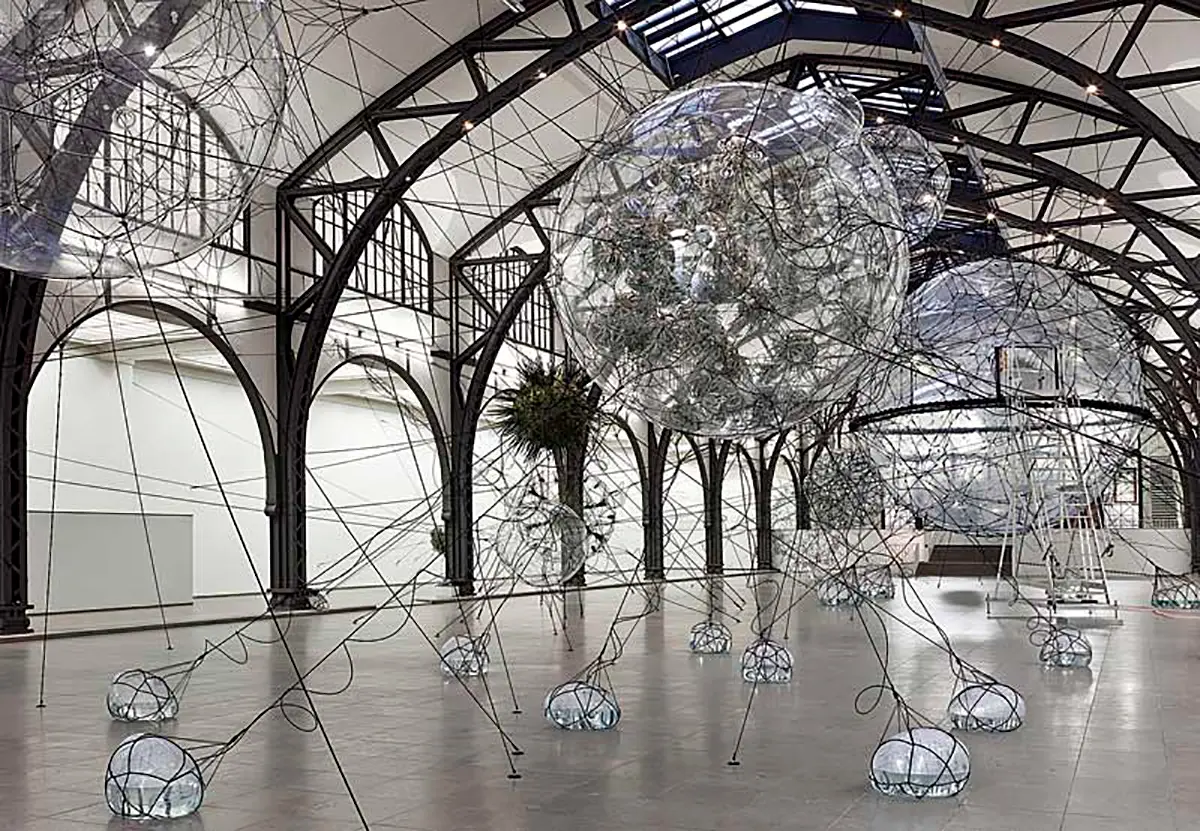
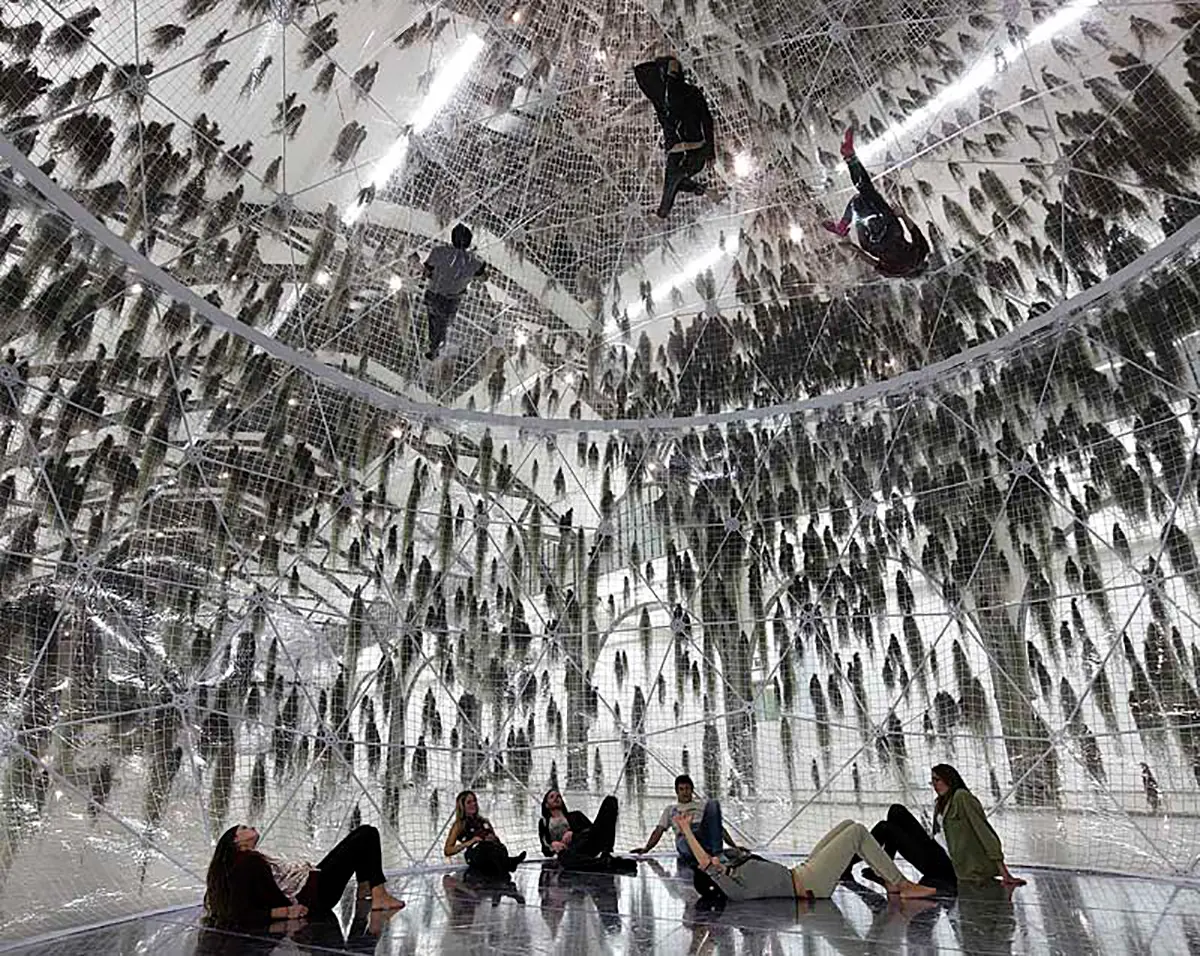
The giant transparent spheres of Saraceno’s Cloud Cities were on display through February 2012 at Berlin’s old railroad station, Hamburger Bahnhof, the site of the city’s relatively new Contemporary Art Museum. In these and other works, Saraceno further expanded Fuller’s proposals in Cloud Nine, his floating aerial habitat built on the basis of geodesic spheres. Like giant water droplets immobilized—again, the spider web—by nets, and with some biospheres holding rootles plants, these twenty spheres were mostly walkable. In this way, they offered viewers the opportunity to interact with the art, be it by entering the domes or resting in them, stepping up and feeling the softness of the air-filled plastic material.
Some Reflections
Alongside the enthusiasm generated by Saraceno’s widely celebrated work, some questions do arise. Specifically, the repeated use of plastic materials in the construction of many of his impressive structures seems to contradict some of the artist’s positions with regard to ecology. What does Saraceno do with the plastic used for his spheres after months of touch by visitors? Does he reuse it? What does he do with the ropes, which at least are easy to transport and occupy little space? Perhaps aware of the reiterated use in his oeuvre of materials that are not easily assimilated by the planet, Saraceno likes to comment on Felix Guattari’s concept of “the three ecologies” and the unbreakable connection the French philosopher and psychoanalyst establish between social, mental, and environmental ecologies. “When we speak of climate change,” Saraceno says, “we should perhaps consider ecology in its broadest aspect,” perhaps as a way to compensate for the fact that—while he appears devoted to thinking about humanity’s greater well-being—he certainly uses uncomfortable oil derivates and more.
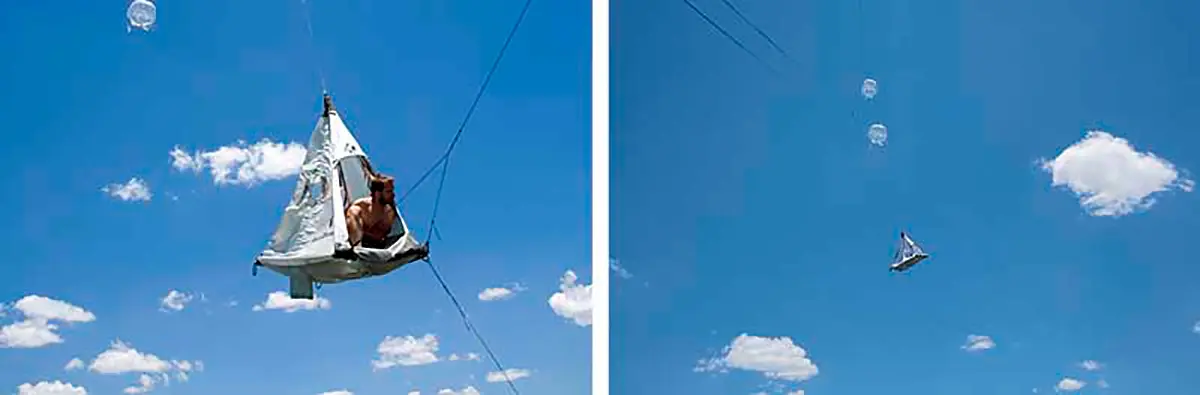
On the occasion of ¡AFUERA! (2010), the International Contemporary Art Show presented by the Centro Cultural de España in Cordoba, Argentina, Saraceno intended to climb up one of his large aerial sculptures, Globos aerosolares. The balloon carrying the artist went up almost at dawn, using solar energy, but it ripped and fell down catastrophically, leaving Saraceno injured. So, the immense balloon did not fulfill its function. An inadvertent metaphor for the country?
The same day of the frustrated flight in one of Cordoba’s central squares, the young volunteers of Un techo para mi país erected a model home supported on high by a pole, in order to promote their activities and raise funds. This NGO, present in 19 Latin American countries, works with families in precarious living conditions to build better dwellings and cover their basic needs. Then and there, with contributions of passers-by at the square, monies could be collected for the betterment of people’s circumstances. An attentive observer could not avoid connecting the volunteer’s modest home with Saraceno’s grandiloquent aero-solar balloon. How much does the future dream by the artist cost and how close is it? But, of course, utopia is the domain of artists, who in their effort to think the previously unthought-of often leave behind strictly realistic criteria.
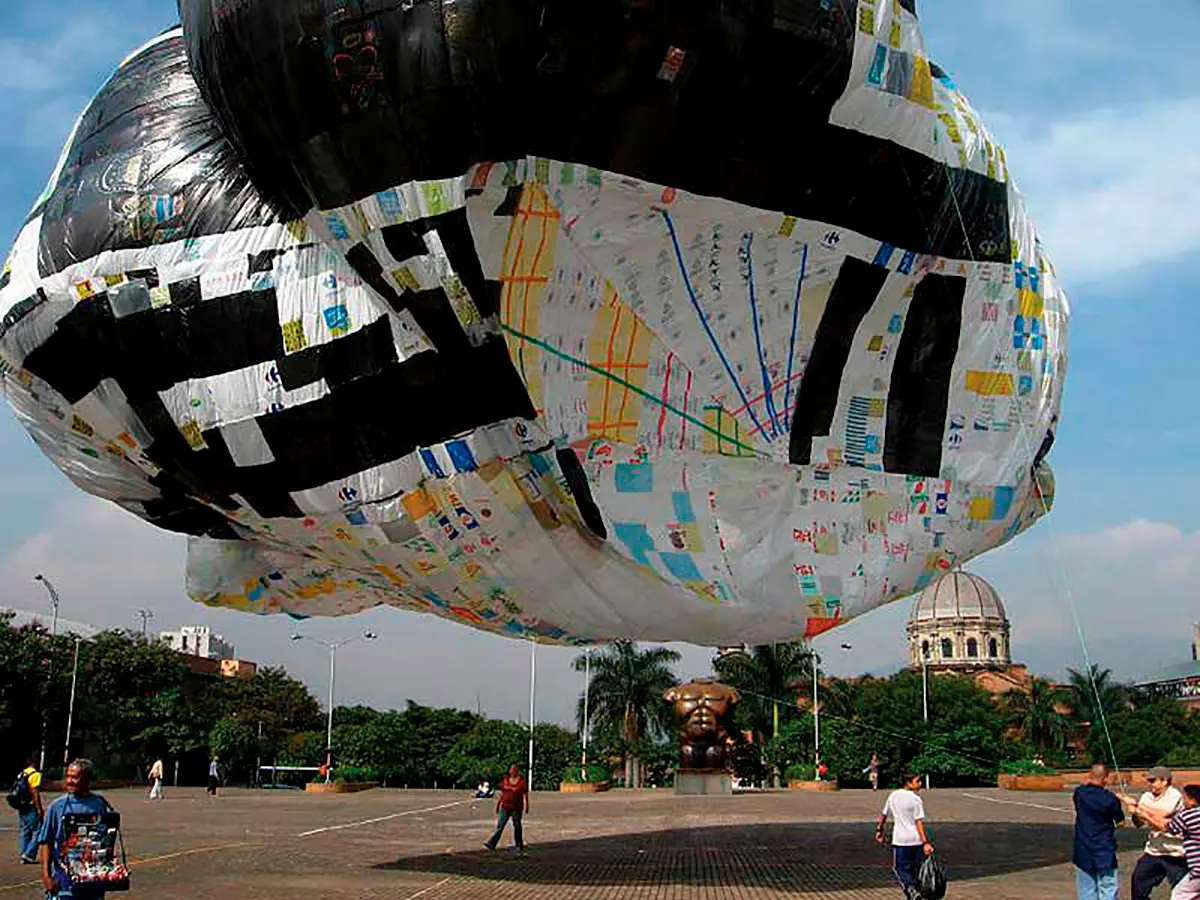
Saraceno’s Museo Aerosolar, created in 2007 in Medellin with thousands of presumably recyclable garbage or shopping bags attached to each other, also provokes questions. Saraceno encouraged children and adults to paint the bags and bring them to various collection points. Once the balloon was built with the materials thus collected, he maintained that it was “the first air-borne museum, built with recycled plastic bags from the world, flying and moving thanks to solar and human energy.” He also stated that, like the Eiffel Tower and the Chinese Wall, this museum is a reflection of a specific culture and a specific time.
Saraceno believes that the collection will grow as more bags are brought in. True, art invents and subverts values, but in many places (most?) n Latin America, such bags are not biodegradable and will take hundreds if not thousands of years to disintegrate. Also, how do we know when and where has the museum landed? Instead of encouraging their decoration, it would perhaps be better to discourage their use in commercial transactions altogether, as a way of saving the Earth from further deterioration.
On the other hand, at this point in Saraceno’s rich and successful artistic biography, his appealing works—which trigger our imagination and put our dreams to work—seem to be running the risk of repetition. With its monumentality and seductive effects, Saraceno’s oeuvre provokes an immediate, enchanted response on the part of its viewers. The danger is that they will start to function as a thematic amusement park rather than as central interventions in a debate about the state and projection of contemporary art.
Saraceno is now playing in the big leagues. While this issue of ArtNexus was in the works, Saraceno was finishing the last details of his most recent project: Cloud Cities, an installation presented on May 2nd in the Metropolitan Art Museum’s esplanade in New York City, and Cloud Cities at Maison Hermès in Tokyo, a show inaugurated on May 25th.
* Courtesy: the artist; Tanya Bonakdar Gallery, New York, NY, USA; Andersen’s Contemporary, Copenhagen, Denmark; and Pinksummer Contemporary Art, Genoa, Italy.
VICTORIA VERLICHAK
Her book Martha Peluffo won the 2009 Miguel Briante Book of the Year Award, given by the Argentinean Art Critics Association.