
According to the Royal Spanish Academy (RAE, its Spanish acronym), the official royal institution responsible for regulating the Spanish Language, the word “iterable” means: (From Lat. iterab’lis). 1. adj. Capable of being repeated.
Two variables frame this definition. The first one speaks of an applicable virtue, an embellishing term, a manifest that expands the possibilities. The second variable refers to a consideration embedded in the territory of the rarefied. That which is repeated is both positive and negative. It is a term that can measure the vulnerability of an object in connection to a specific time and space.
Iterable is also used to designate appearances, to discern between two things that will never be equal no matter how simple the element that differentiates them happens to be—for example, the direction of the winds, atmospheric pressure, or the alignment of the planets. According to this analysis, the lecture of equal objects represents an imprecise and unreliable supposition. Ana Adarve in Extreme North constructs a succession of landscapes that transport us to this place. Unsettling, monotonous, and rarefied landscapes in which uneasiness and a pervasive sensation that “something is about to happen” become these iterable elements; namely, elements that are capable of being repeated and of singling out the differences among them.
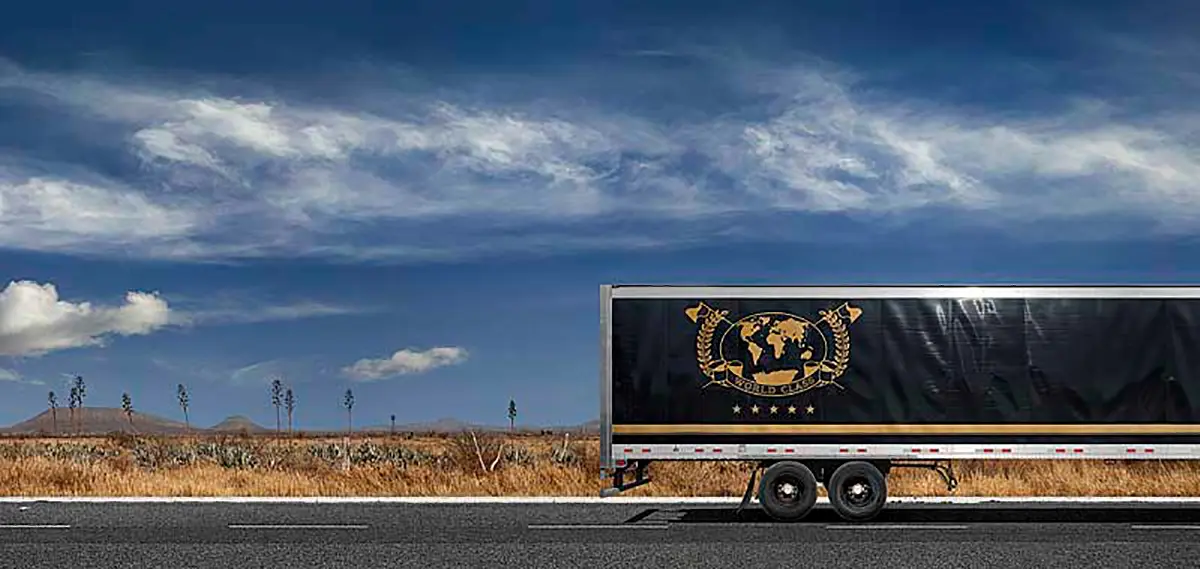
The landscapes shown in Ana Adarve’s photographic constructions do not exist in real life. The skies, winds, highways, and trailers depicted by this artist are not real. They are patchwork quilt-like constructions where elements like clouds, pavement colors, bushes, mountains—and even special circumstances like the smoke from an extinguished fire depicted in the work titled Charge 1—each has an individual value.
The works by Ana Adarve contradict the premise that the image overpowers fiction, as the entirety of these somehow deceiving photographic constructions share a common territory: the depicted abandoned state of the environment. It is a repeated element that is being elevated here to the category of a general theme. It frames photographs that, through their ethereal quality, have become an important achievement in her work. The tediousness and monotonousness present in all of these works are capable of transforming trailers, mountains, and skies into iterable elements and, thus, into muted generic entities. Adarve’s photographic explorations register a lot of particularities within each of these elements, in order to find recurrent patterns and turn them into studied, controlled, and tedious models.
It is important to clarify that her photographs are anything but boring. On the contrary, they contain such high states of tension—and reflect instants lived so fully—that they appear as if they were moving. This mysterious quality is also present in earlier works characterized her visual language, as it connects us to a creative state that is deeply knowledgeable of the ways in which an image can be rendered and of the impact it can have. Landscape to Ana Adarve is more than a territory of specificities—which, by the way, she renders with absolute respect and attention. To Adarve, the landscape also means concealment. Thus, a trailer that interrupts the visual field and sabotages the reading of the horizon, represents a patch on the image that has been superimposed to hide the truth behind it. This is the manner in which Adarve constructs her vision. It is a principle inscribed in photography and in the understanding of a point of view masterfully proposed by this artist. And, in addition to this, the artist incorporates the use of digital editing tools to manipulate, alter, and modify the images with such success that they surpass real images to become meta-images.
Twelve straight photographs, four photographic constructions, three photo-objects, and two videos were on display from May 31–June 30, 2012, at the Espacio 2 in the Galería El Museo in Bogota, Colombia. Created in its entirety in an area between the Mexican northeast and the State of Texas, in the US, the Charge series represents to Adarve an interesting evolution of her photographic constructions. It is impeccable work that somehow also manages to be magical and moving.
ESTEFANÍA SOKOLOFF