
Miramientos, an exhibition by Panamanian artist Ana Elena Garuz at the Arteconsult Gallery included her most recent acrylic paintings and a new series of small, flat cut-iron sculptures. The title is a Spanish word that implies ‘looking’ as well as ‘considering’, offering a clue to the intellectual process of this artist who has consistently explored abstraction, a field in which only very few Panamanian artists have worked, either in the past century or in the present.
The paintings in Garuz’s exhibition are square, with compositions constructed based on numerous differently colored lines that cross and overlap one another. At first sight, one is reminded of the children’s game of “Pick-up-sticks” in which a number of thin wooden rods is dropped on the floor, which must then be picked up one by one, without moving the adjacent sticks, in such a way that the players slowly untangle a complicated structure. However, Garuz’s paintings are not random configurations, nor do they offer a simple visual solution. Her multiple lines are irregular and zigzagging and, in many cases, they are not even straight. In fact, they convey the feeling of being lines that live and move, which the artist has captured in one particular instance, but that might continue moving in the next.
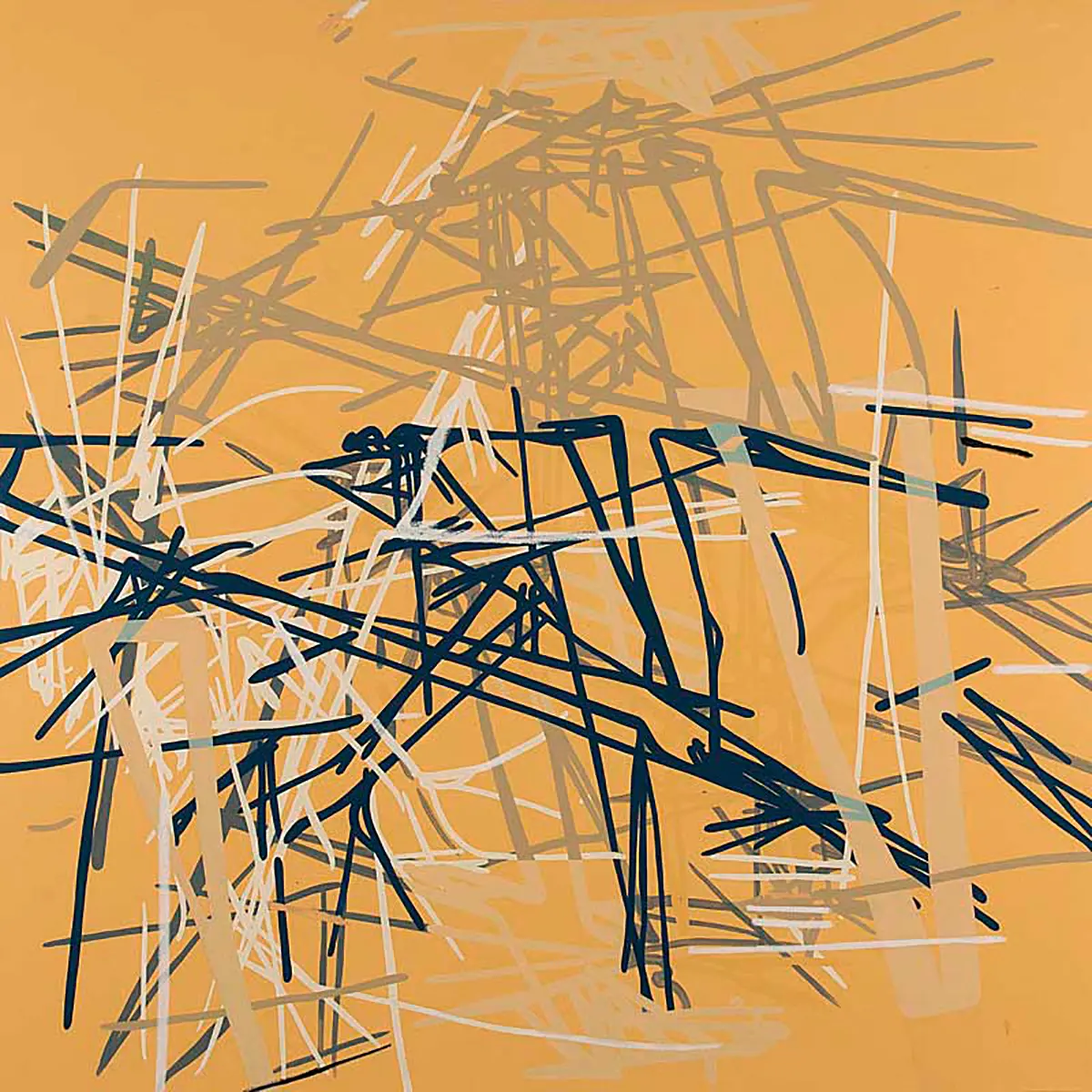
Garuz’s paintings invite us to penetrate the tangled web of her crossings and overlaps of forms and colors, stimulating not just our sight but also our thoughts. They prove to be careful constructions or even complicated deconstructions of imaginary structures. These lines have been thought out and painted with care and precision. The visual game emphasizes its own flatness, while simultaneously allowing our sight to travel through shallow and deep spaces. On the other hand, the use of variable thicknesses in her strokes and the inclusion of trompe l’oeil (fool the eye) shadows reaffirm the feeling of three-dimensionality.
Color also plays an important and variable role. Some compositions center on one main tonality, interpreted in a variety of intensities and densities, whether in the lines, the shadows, or the background. There are paintings, for example, where red is dominant, in which the artist alters the color by adding white or intensifies it with yellow, in such a way that the color ranges from a peaceful hue to a strident one, without abandoning the monochromatic whole. In other works, colors are used to create contrasts, through unusual combinations such as indigo, grey, and white on an ochre-yellow background. These are instances in which color, rather than acting as a unifying element, increases the dramatic effect and the dynamic quality of the compositions.
These abstractions are the consequence of gradual development. Ana Elena Garuz appeared on Panama’s artistic scene in the mid-1990s with gesture paintings that revealed ties with Abstract Expressionism and Feminist Art. In 1995, when she finished her Master’s degree at New York University, she presented what she called her Drawings with Hair. A year later, she held an exhibition in Panama titled Hebras (Strands) of works that combined oils, acrylics, wax, glue, and human hair, described at the time as “compositions of an intimate and visceral character that expressed an intense, organic sensuality”.1
Later, there was a stage in which Garuz’s work-related more closely to the spirit of Informalism or Action Painting, as in the case of her paintings selected for the Panama Art Biennials from 1994 to 1998. Behind her splotches, dripped paints and strong brushstrokes, one could sense a labor-intensive, even painful, process that was reinforced by the somber colors and textures reminiscent of body fluids. Subsequently, over the past ten years, Garuz has shown an interest in working in a less expressionistic abstract vein, with a fondness for curves and organic forms. Her compositions often resembled macro enlargements of the hairs in a brush or of twisted cords. She even went so far as to create three-dimensional pieces with long strips of black rubber, as well as photographs based on extreme close-ups of horsehair. In her paintings on canvas, there was a predominance of irregular ovoid shapes, which sometimes had what looked like nuclei, reminiscent of the form of human cells seen under a microscope. Just like her curves, these forms would be repeated in other colors or in the form of shadows on the canvas.
The use of straight lines in Garuz’s compositions, which previewed the forms in her new works, came up around 2007, when she painted them onto the surrounding walls, like extensions of her paintings of that time. Recently, she has also experimented with reproducing her favorite scribbles and forms in iron, which seem voluminous but still flat, apparently cold but also mischievous, which she presents mounted against the wall. In what seems like a logical extension of her paintings, these “sculptures” by Garuz—whether lacquered in color or polished and metallic—offer an interpretation of that evocative space that hovers between the second and the third dimension.
NOTE
1. Kupfer, Monica and Angela de Picardi. “Mujeres en las artes plásticas en Panamá”, a chapter in Mujeres en las artes de Panamá en el siglo XX. Panama: Fundación Arte y Cultura, 2011, p. 43.
MONICA KUPFER