
Ana Gallardo’s development as an artist started with painting. Later came a period without works. Later still she began the long and sustained series of works that comprise the corpus for which she is known today not only in Argentina, but in Brazil, Ecuador, New York, Spain, France, England, and soon in Belgium, among other countries. Difficult to classify, her works are often labeled ready-mades: a radio, bed sheets, kitchen utensils, parsley bunches, her own furniture, her belongings, videos, people, stories. These are all elements of everyday life to which she gives no new meaning; rather, she singles them out to emphasize the deep meaning they accumulated as part of her own life or, in many cases, the lives of others. Many of these objects have been part of her own personal, sentimental, private, family, community experience, which she brings to the realm of art. This language is difficult to express visibly, because it is made of fervid desires, of urgent dreams, and most of it is immaterial. In each instance, the artist accommodates herself to the trajectory, the traces, the design left by the specific situation. The objects are not necessary or filled with use-value; they are objects that emerge from an insatiable demand for concrete utopias.
Sicaria, Gallardo’s exhibition at Ignacio Liprandi, was comprised of four principal elements: a large charcoal drawing, the portrait of a female assassin aiming at the viewer; a text is written and carved by the artist on a wall; a video recording part of the company the artist kept for Estela, a former prostitute who had taken ill and was dying in a Mexico City geriatric hospital—we see Gallardo’s hands lovingly caressing the woman—a notebook containing an autobiographical, private narrative based on a story told by her father.
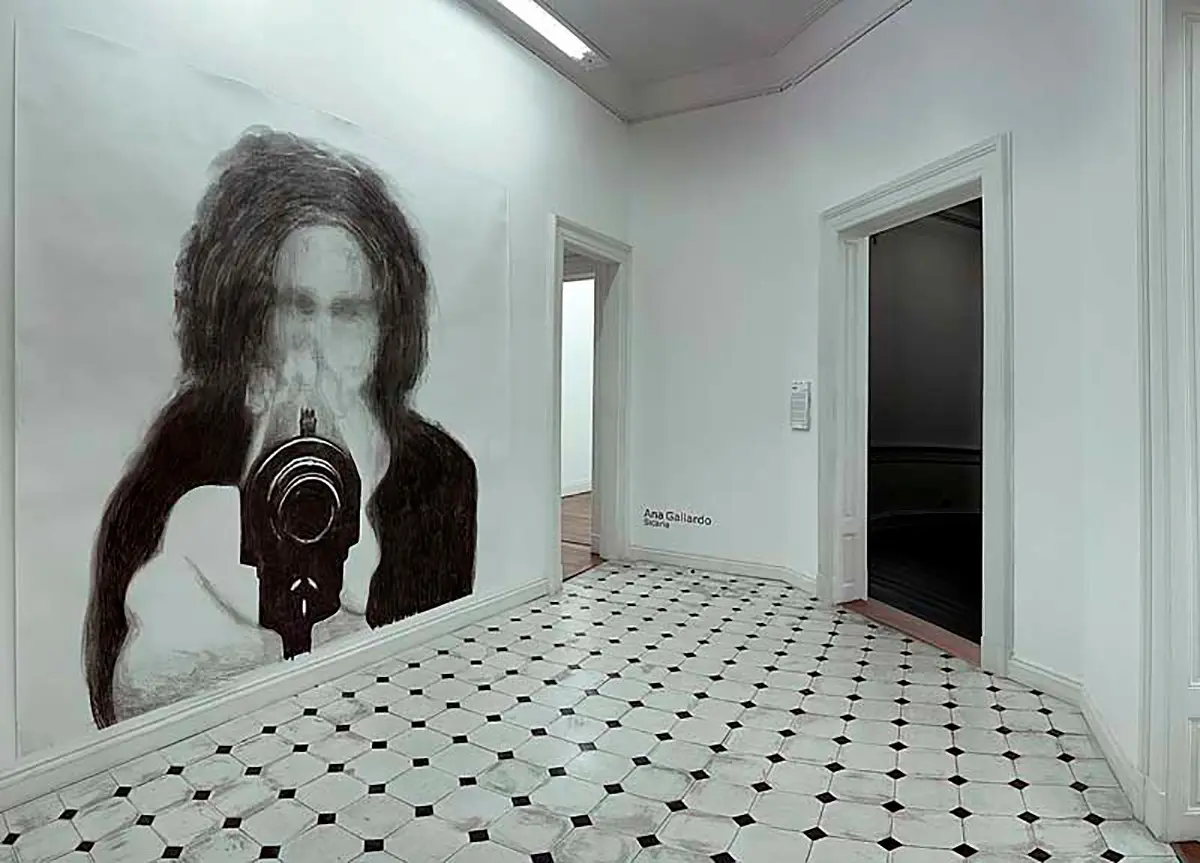
Gallardo confesses the need to return to proper art materials: the carving of the letters made with the required tool, one by one on the wall; the photographs do not fully convey the depth of the incision and the trembling, tremendously urgent hand stroke used. An act of catharsis intended to exorcise, through her identification with the director of the Mexican geriatric hospital, the carelessness, the inattention, the indifference with which patients under her charge were treated. Farther away, the charcoal on a large piece of paper, depicting a female assassin, is a symbol of the violence that in today’s world is not solely the province of men.
Although Gallardo had a larger project of playful, therapeutic, liberating exchanges with the elderly female patients, she was only allowed to take care of Estela, who passed away a few days after the artist’s arrival but not before their encounter had been recorded in a precarious video. The evident demands to be named: Gallardo helped her in her final departure, one of the most loving offerings a human being can make to another and a role that is usually reserved for those closest to us. As those last moments approached, Gallardo comforted Estela, caressing with the same hands that had felt the desire of “returning to matter.”
The last room in the exhibition only contains a chair with a small black notebook. Written in it is a short autobiographical narrative, based on a story Gallardo’s father told about sexual life with the artist’s mother, which was much more than traumatic. The man’s poetry, the woman’s sadness, their mutual isolation and loneliness, their ignorance. A narrative whose sincerity and transparency will take the breath away from any reader, as it also allows to intuit the difficulty of Gallardo’s own arrival in this world; yet, just as this is implicit here, so is her ample gift of understanding.
The artist says that, for her, “the exhibition is not closed,” and it isn’t because it not only incites and invites awareness among viewers but, hypothetically, calls those responsible for the Mexican institution in question, health care officials, education functionaries throughout the world, to see through the artist’s eyes both a specific reality and its potential for transformation.
A compassionate gaze is required; this is to say, seeing with the heart, the suffering-with of many belief systems. But for this gaze to be possible, the artist had to carry out several previous gestures: traveling to Mexico, accompanying Estela, or listening to and assimilating her father’s story. These gestures are not simple notations: they are personal offerings, sacrifices presented to the world.
Neo-capitalist culture, perhaps nearing its end, paid no attention to older, essential habits of coexistence. Such unconcern was nefarious for humankind and for art. Ana Gallardo’s work resides in the utopia proposed by the artist. One aspect of the work is visible, another aspect is invisible. Gallardo’s thirst for justice is intercepted by a great dose of affection, and it is possibly that which gives each works its shape. Because only in a world that is emotionally more attuned with and aware of itself can beauty be once again discovered.
MERCEDES CASANEGRA