
The late Twentieth Century witnessed both the consolidation of the phenomena of globalization and neo-liberalism, and the parallel emergence of an unprecedented civil movement, global in nature, that has continued to take shape and to gain strength across the planet, with a peak in 2011, when foci of civil protest irradiated in the most diverse corners of the globe.
From the Arab Spring to the Indignados movement in Europe and the Occupy movement in the US, we have been witness to (if not protagonists of) the awakening of average citizens decided to have their voices be heard and to transform society through strategies of mobilization and civil disobedience.
Recent Paintings from the Year of the Protester, Armando Mariño’s solo exhibition at The 8th Floor is inspired by the collective character, The Protester, designated by Time magazine as its “Person of the Year” in December of 2011.
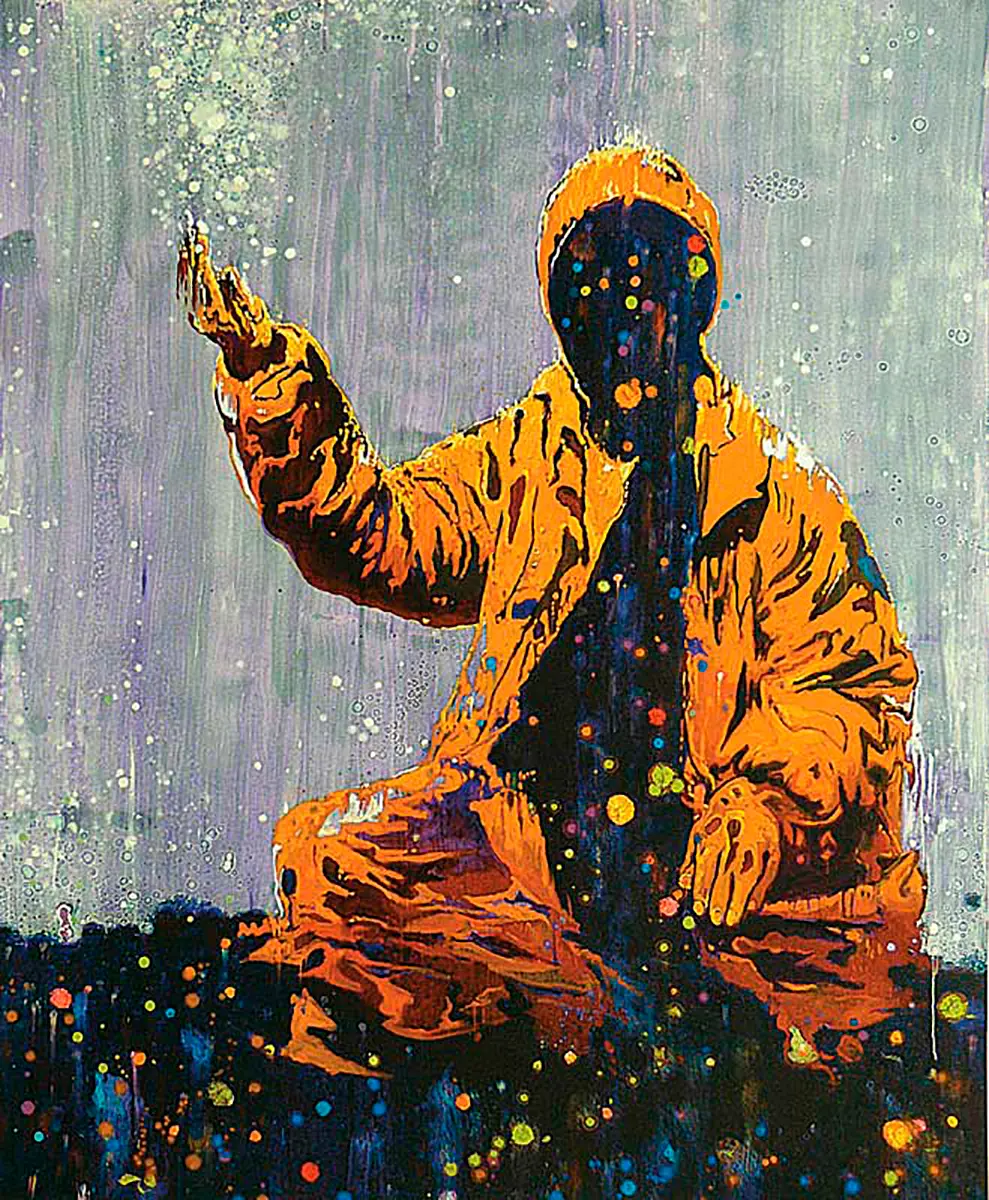
Inspired by press photographs that the artist clips and collects indiscriminately in response to their visual impact, Recent Paintings… goes beyond a mere naïve celebration and the resurgence of such a collective consciousness, and becomes a sharp-edged critical commentary on the trivialization of violence and the de-politicizing of activism as a media and ideological strategy of contemporary society.
Yet Mariño avoids all pamphleteering and structures his discourse on the basis of a deconstruction of visual language. This is what makes his proposal truly one of renewal.
The transgression of the photographic event implies an essential subversion of its original documentary character. By displacing the here-and-now of the photograph into a rarefied pictorial limbo and extrapolating the emergence of the public square for the aseptic art circuit placed au-delà de la societé, the artist disarticulates the social impact that is inherent to the first register and substitutes aesthetic enjoyment for the urgency of protest.
Thus, the tone that dominates his exhibition at The 8th Floor is one of spectacle rather than of human drama. In fact, the human figure tends to disappear, becoming a mere outline; a kind of macabre mask in the midst of a jocund scene, emphasized by Mariño’s unique use of color.
During the last decade, Mariño’s work has undergone an interesting shift, progressively freeing itself of all representational ballast, more firmly attached to the subject, and embracing a much more potent kind of painting from where an immanent force flows forward. This requires us to speak not of portraits in Mariño's current production, but, rather, of entities. Three visual elements are key to this: composition, brushstroke, and color.
After the photographs to be used are chosen, the image is subjected to a process of digital modification where the selection, recomposition, and alteration of color are essential. In Inferno, for example, the resulting image combines four separate photographs into what at first glance may seem a filmic sequence. However, the source of this progressive effect that gives Inferno the essential dynamism that characterizes it comes not from the world of film, but from advertising. What we see here is not the description of an event over a period of time the temporal dimension has been banished from Mariño’s work, as has any historical sense of our contemporariness but its opposite: the congealment of the present, its freeze-framing, just like in advertising messages.
Mariño’s free-hand brushstroke, which disavows clear contours, and his work in successive layers, added to the gelatinous nature of these paintings (which seem more in tune with synthesized imaged, specifically the so-called meta-particles of meta-clay objects characterized by their lack of any rigid structure and whose shifting nature is based on density), generate psychedelic atmospheres of a clear abstract bent that emphasize the unreal character of the environment in which, like phantasmagoric lucubrations, Mariño’s unsettling characters are embedded. Shaman, Run Protester Run, and The House of Colors are paradigmatic in that respect.
Added to this sophisticated treatment of the image is a well-measured use of color: a kind of neo-fauvism that finds its referent in the chromatic iridescence of the advertising world and the digital image. Mariño’s felicitous combination of these resources generates a confused perception, another defining feature of this series that seeks to clear a path between the turbid and the radiant, the ambiguous, and the evident, the real and the unreal, things remembered and things that occur.
Recent Paintings from the Year of the Protester is Armando Mariño’s first solo show in New York, where the artist has recently relocated. Comprising more than twenty oil paintings and works on paper, this solid exhibition which seems to contain the spirit of Debord is, without a doubt, a significant landmark in this artist’s career.
JANET BATET