
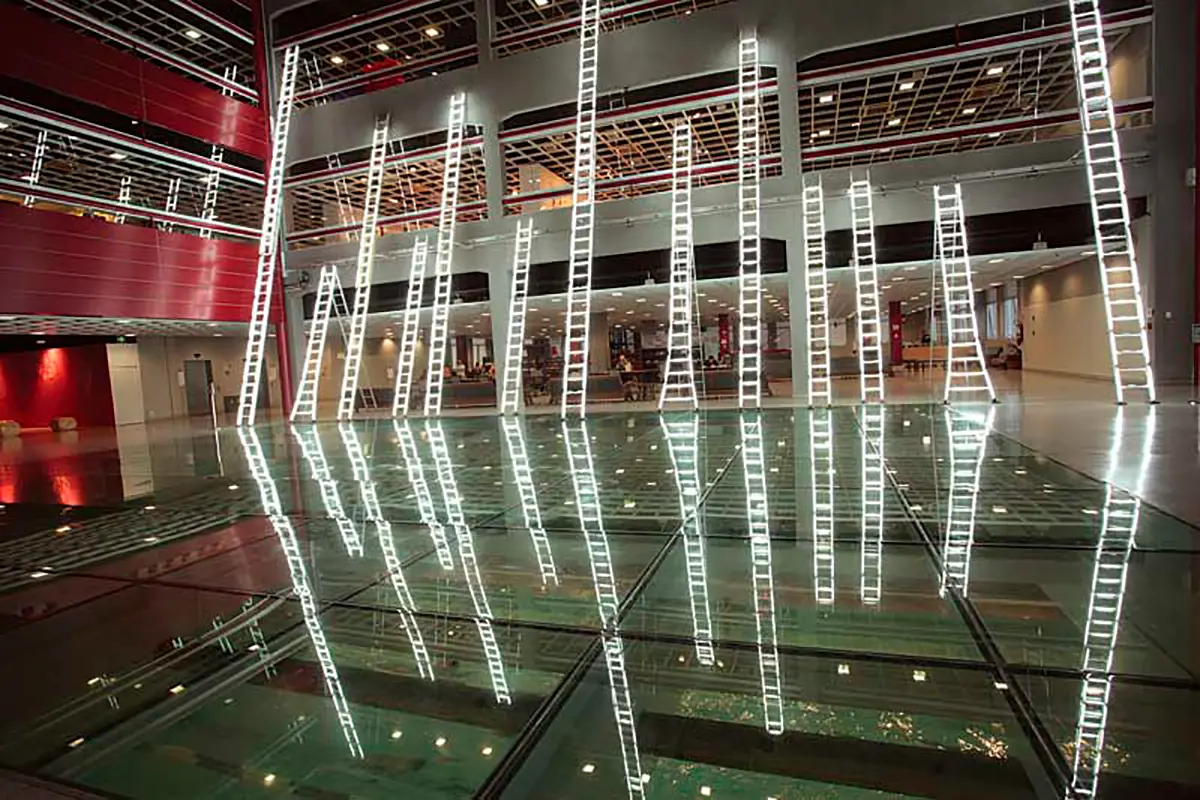
Thirteen industrial metal ladders covered with white fluorescent light bulbs were placed on a reinforced glass floor that can be walked on to observe the swimming pool located on the floor below. Of various dimensions, some folded and others resting against the wall, these ladders occupy the atrium of the main building of the Belenzinho unit that is part of SESC, in São Paulo. Some even reach up to the second or third floor, while a few others reach a little beyond the first-floor ceiling. The installation by Brazilian artist Carmela Gross (São Paulo, 1946) inaugurates Vano, a project conceived by the Núcleo da Imagem e da Palavra do SESC Belenzinho that invited many artists to intervene the space. Two exhibitions every year will be presented as part of this project.
The light from the light bulbs is projected onto the glass floor with the resulting effect of lengthening the ladders by making them appear as if they had expanded all the way down to the water in the floor below, as a series of luminous rectangles punctuate the swimmers’ progress across the swimming pool. The milky glass wall on the right side also reflects the group of ladders but inside creates an almost ghostly atmosphere, as the illuminated lines appear as if they were hovering in dense fog. It is also possible to observe from the upper floors the reflection of the ladders on the windows located on the other side of the atrium; once again the image is multiplied.
The installation generates a sort of integration that goes beyond form, for it intertwines the various activities that take place in the space of the Belenzinho building. The grid on the floor bounces back to the glass wall and the design of the white lines that outline the ladders is replicated on the grid structures installed under the ceiling of each floor. Their verticality invites the gaze to move upwards and awakens our desire to learn where the ladders lead to—if that were possible. Looking down, the movement of water in the pool dissolves the linearity of the straight lines it reflects. On the other hand, these ladders also function as hi-tech contemporary versions of ancient rope bridges; in this case, they are bridges that symbolically connect the floors that held different activities: sports in the lower floor, social activities, rest and reading areas on the second floor; workshops, dental offices, as well as small exhibitions areas on the second and third floors. Placed at the center of the building, these illuminated “bridges” connect all the realms of human life that are simultaneously taking place in the institution—health-oriented, social, educational, and cultural.
It is not the first time that Carmela Gross uses fluorescent or neon lights in her work. Her artistic trajectory as a drawer and her inquiries into all the possible variants of this language eventually led her to move past ink and paper and to experiment with the three-dimensional space and its response to lines, colors, and light. Gross often establishes in her interventions a dialog with the architecture and history of the place that houses her exhibitions. In doing so, the artist offers viewers—more than the mere contemplation of the work per se—a fresh way of perceiving the space and its surroundings—as she successfully did in Ladders. Other noteworthy examples are the holes she created in the pavement of the old Matadero Municipal, the former municipal slaughterhouse that today houses the Cinemateca Brasileira—one of the largest video libraries in Brazil—during the first edition, in 1994, of the project of urban interventions Arte/Cidade. On that occasion, Gross exposed the layers of the various materials that constituted the “skin” of the floor, as she instigated a sort of pseudo-archeological curiosity. In 2004, with Aurora, a name that referenced the infamous street nearby, known for its brothels, and the beginning of the day—as Aurora in Spanish means dawn—always feverish in this bohemian section of downtown São Paulo. Gross intended to integrate the space of the Galería Olido with that street, by rendering the Aurora name with pink light bulbs and placing it along the glass wall, so it could be read from inside the place or from the street. Along with the establishment of a dialog with the history of each place, in other works, Gross has also relied on a somehow formal and chromatic approximation to the local architectural elements. In Hotel, for instance, a work that participated in the 25th São Paulo Biennial (2002), Gross commented on the temporary nature of the works exhibited in the building; in contrast with the perennial nature of the art institution. This artist transforms her analysis through interventions that generate reflections on the use of each space. In the case of Ladders, she subverts the function of the atrium of the tower as a space for distribution. That which originally was a hole, an interval, now assumes its other face, one of being part of a reunion.
Ladders reproduce on an internal scale that SESC promotes in the Belenzinho area. The industrial neighborhood lost many of its centers of productions during the Twentieth Century. As a result, unemployment soared as did urban violence. The establishment of the institution in the neighborhood offered the inhabitants in the region a place for cultural encounters, sports, and social life. In the Vano Urbano, it also works as a “bridge,” just like Carmela Gross’s Ladders.
SYLVIA WERNECK