
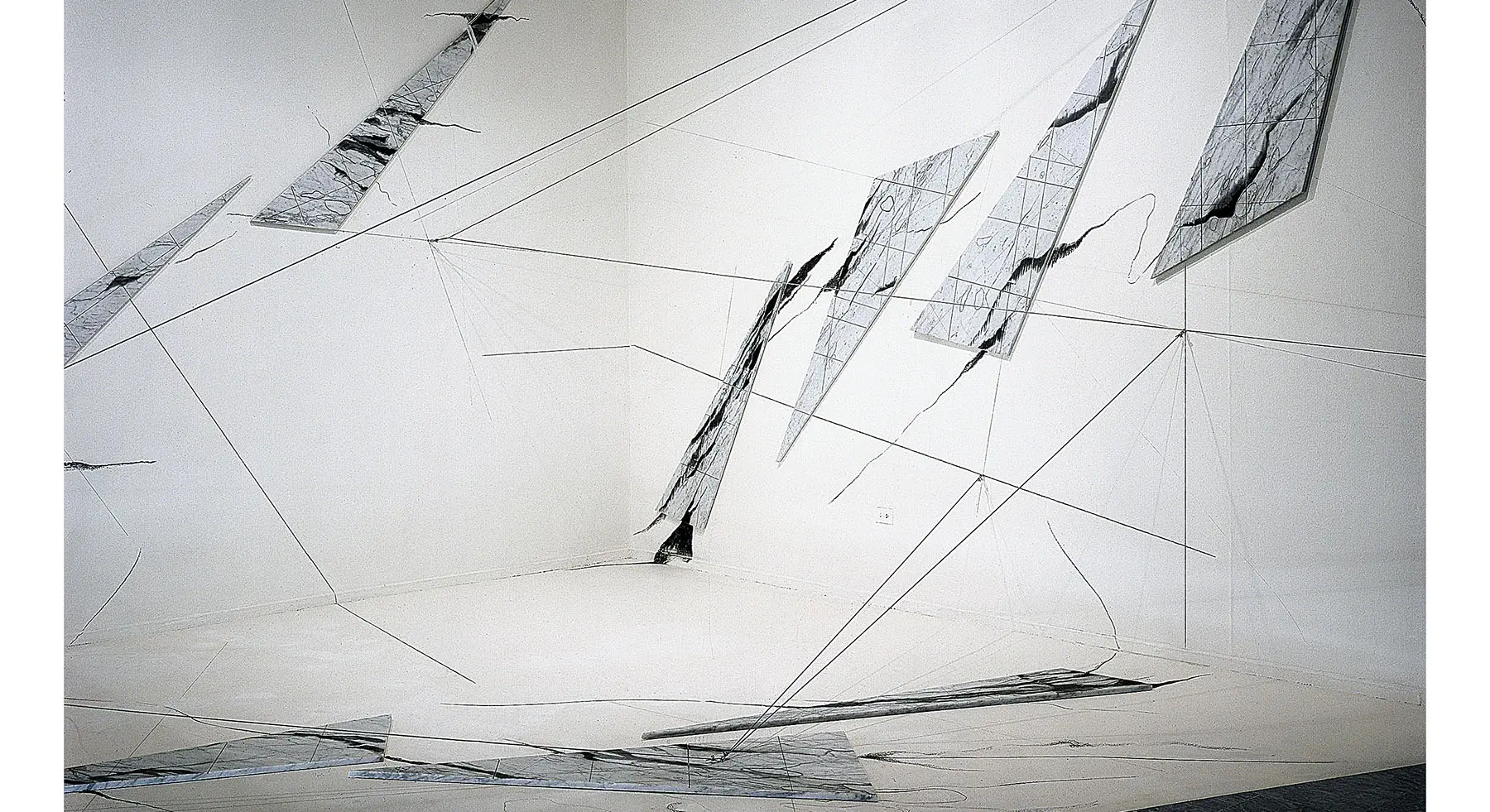
More than 12 years have elapsed between the presentation of Cerrotopobligrafía I, created by Carola Bravo for the 5th National Guyana Art Biennial, at the Museo de Arte Moderno Jesús Soto, 1998—my first encounter with her work—and Bravo’s most recent show at the Fernando Zubillaga Gallery. This time can be reviewed with a chronological intention, but it can also be perceived from a different perspective: as an epoch-defining historical process, or as the time between the emergence of a generation of artists and their achievement of public recognition.
Back then, beyond the interest aroused by Bravo’s proposal in itself, I was moved by the intensity of her work, her will to create, which could not have had in those circumstances a more eloquent expression than to be installed, somewhat á la Michelangelo, on a number of scaffolds. Drawing the outline of territory, giving meaning to cartography that made reference to a specific location, but also to the event of the nation’s visual arts in which it participated.
Since then, the same creative will has continued to shine through in the artist’s exhibitions I have had the opportunity of seeing, shows that confirmed the rationale of the initial discourse but, above all, a visual enunciation that achieved a new formalism. This circumstance reveals the presence of several interests in her creative dynamic, and points towards the recognition of other aesthetics; it expresses, in that way, a quest for new formal and conceptual resources. Despite such a need for novelty, Bravo’s work retains a reflective action around the concept of space.
The space that, in the immediacy of our every day, extends towards infinity has existed forever, much before our arrival, and will continue to exist to be discovered anew by entirely different humanity. This concept exists inasmuch as human beings define it, construe it in their minds as a reality, give it shape and meaning in their daily lives, ad recreate it through various discourses. Two creative pursuits that are essential to everyday life have remained constantly associated with it through the ages: architecture and art.
Architecture, in its attempt to recreate space as a realm for life; art, perhaps as the expression of the most highly evocative language confronted with the need to discover space as a reference for creation. Yet above all those considerations, the dominant that remains is man’s desire to reinvent space as it knows, explores, and glimpses it in its dense complexity. Carola Bravo is engaged in that permanent quest; investigating in order to propose new perceptions of space, the artist bases her work on what is near, on the close at hand, and discovers the keys that govern the unfathomable.
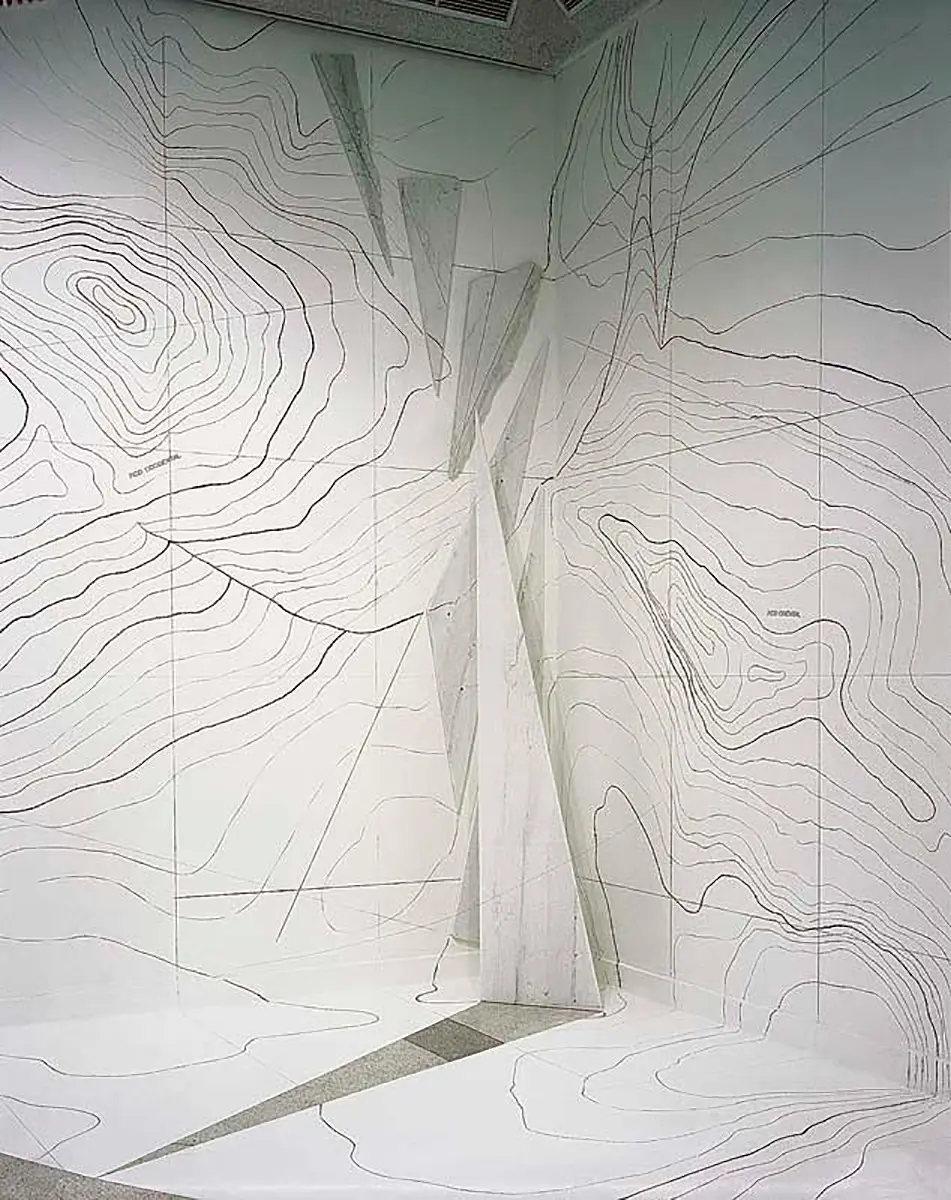
Thus, the construction of Bravo’s language began with the drawing of cartographies, a particular recreation of topography that allows for an articulate, and so practical but in a way also circumstantial, of the territory, of the world we inhabit; from our point of view, the work of the artist has sought to sensitize viewers to an understanding of that reality. An experience that has covered the walls of museums, galleries, and alternative spaces with sinuous, enveloping, recursive lines, intervening street curbs with expressive drawings, always with the purpose of particularizing the ground in which we move. Bravo’s proposal makes it possible to recognize, in those tracings deployed on such varied surfaces, of the strength of the line as value, as shape, but also as a trajectory that points to an intention, and ultimately as a message.
Yet, beyond her communicative will, Bravo seeks to clarify the questions aroused in the viewer, and also in herself, by those very lines. This reading of her work allows us to identify two clearly differentiated moments or periods in her development, with continuities between them that go beyond form (even if such interpretative segmentation seems somewhat arbitrary): the first moment of an expressive nature, and a second moment dominated by a rationalistic intention. And in terms of the expressly visual, as a continuous process of complication of the image through new techniques and formal resources.
In the new reading, the space of the earliest creations loses the visibility of an extended surface and its unitary character in order to become fragmentary circumstantial, and disperse, in equal measure dense and significant. Responses that could find theoretical support in debates around the contemporary idea of culture and the process of change in a global society, both understood from a deconstructive standpoint.
In her series Geovacuigrafía, in which granite made an appearance as support for Bravo’s creations, there is an intention on the part of the artist to represent the idea of space through cartographic lines. Now using the specific graphic aspect of the material’s veins but limited by its physical reality, Bravo exploits from the rigor of a geometric, deterministic formality, a kind of control action on the expressive, at times snake-like, linearities that register the territory. In these cases, she leans on right-angle triangles intervened with graphite and ink with the purpose of revaluing the stone’s own lines, which seem to refer to the irregularities of the Earth’s surface. The link between the various works is reached by “occupying” the room with lines that flow on floors and walls, a formal resource that connects space with Bravo’s drawings on granite. On other occasions, the design of the installation proposes different three-dimensionalities where the works and their unique cartographic variety configure territories that are barely suggested by the tracing of lines but are surprisingly comprehensible in the viewer’s experience.
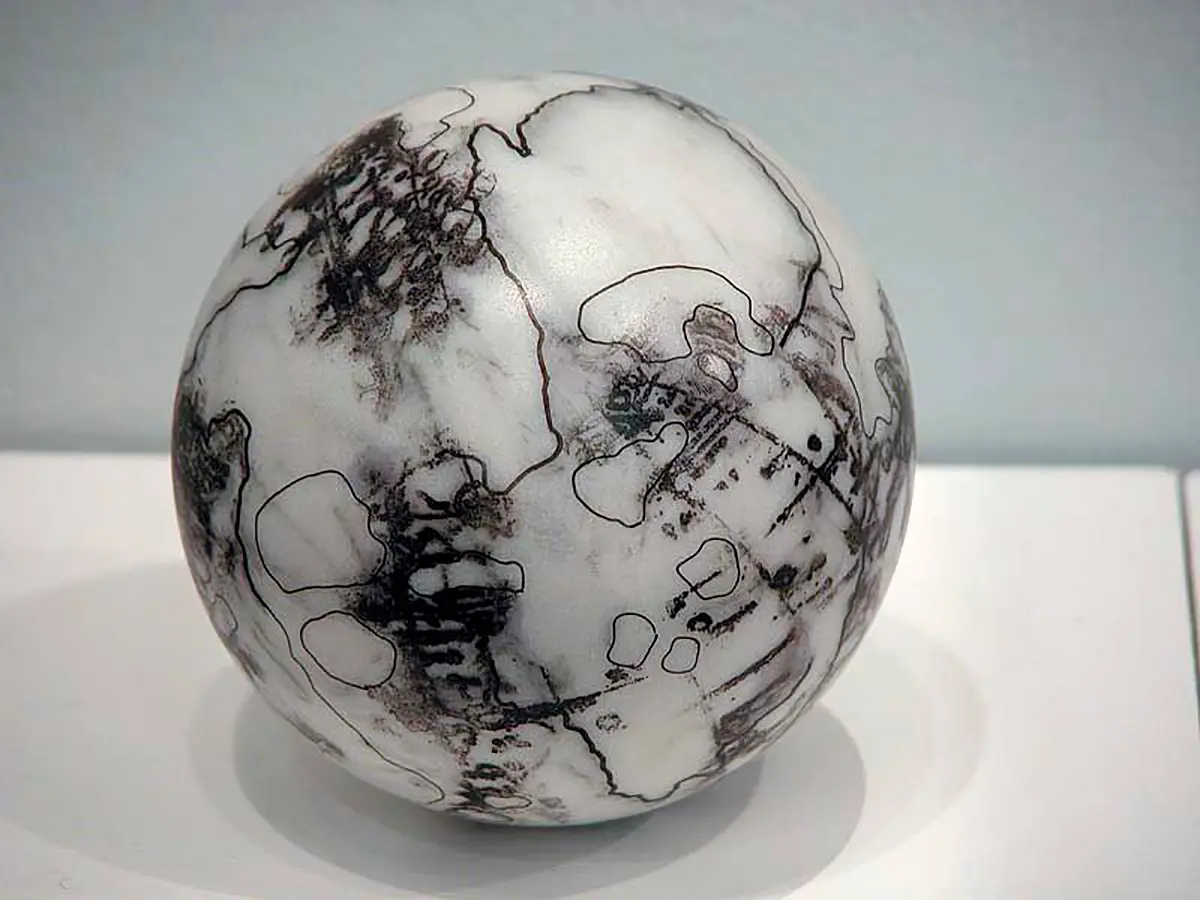
Then came the Espacios dislocados, which marked a deepening of Bravo’s prior explorations, a kind of return to intentions suspended in time that at a certain point return to the center of the artist’s interests. This judgment is valid for some of her series, for example, her moon-inspired works, already seen in 1999 in the exhibition titled Pedazos de luna. Bravo goes back to the subject with the Series lunares, works that propose the “recognition” of cartography marked by the forceful, and at the same time sensitive, presence of the sphere, displacing the paradoxical regularity and flatness of her terrestrial cartographies—a new formality taking over her creative space and dominating the scene. Then appeared the Lunas criollas, Lunas criollas I and II, Terra-Luna, Mapas lunares, and Lunas cuadradas. In this group, the Earth’s faraway satellite, almost always there in the night sky, acquires a different kind of presence, so close at hand that it becomes accessible. We recognize then, in those works, the regularity of its craters and deserts, as well as its unfathomable loneliness.
Cartografías imprecisas, an exhibition presented at Casa Romulo Gallegos, the CELARG, in Caracas, kicks off a new period in the development of Bravo’s oeuvre, which continues to guide her into the present time. It was no longer a matter of articulating a new formalism, but of achieving precision on the conceptual elements that underpin the work. Nevertheless, the most notable shift in Bravo’s art happened towards the mid-1990s, through a revaluing of geometry, of “constructive” procedures, as a result of a change in the way of seeing and new interest on the part of the artist to make her production better known. In this period, we can mention important exhibitions such as Trazografías and Espacios Mutantes.
Bravo’s most recent show, Registros intuitivos, at the Fernando Zubillaga Gallery in Caracas, puts on display an artistic production that has matured from the dimension of the concept, and in consequence, has consolidated as a creative pursuit. A first aspect to be foregrounded is the plasticity acquired by a language that is intuitive at its root but becomes rational in its form; a language that is deeply sensible as a response to a comprehension of its surroundings but nevertheless controls its emotions in order to propitiate a will to reflect, an aesthetic enjoyment that goes beyond formalism.
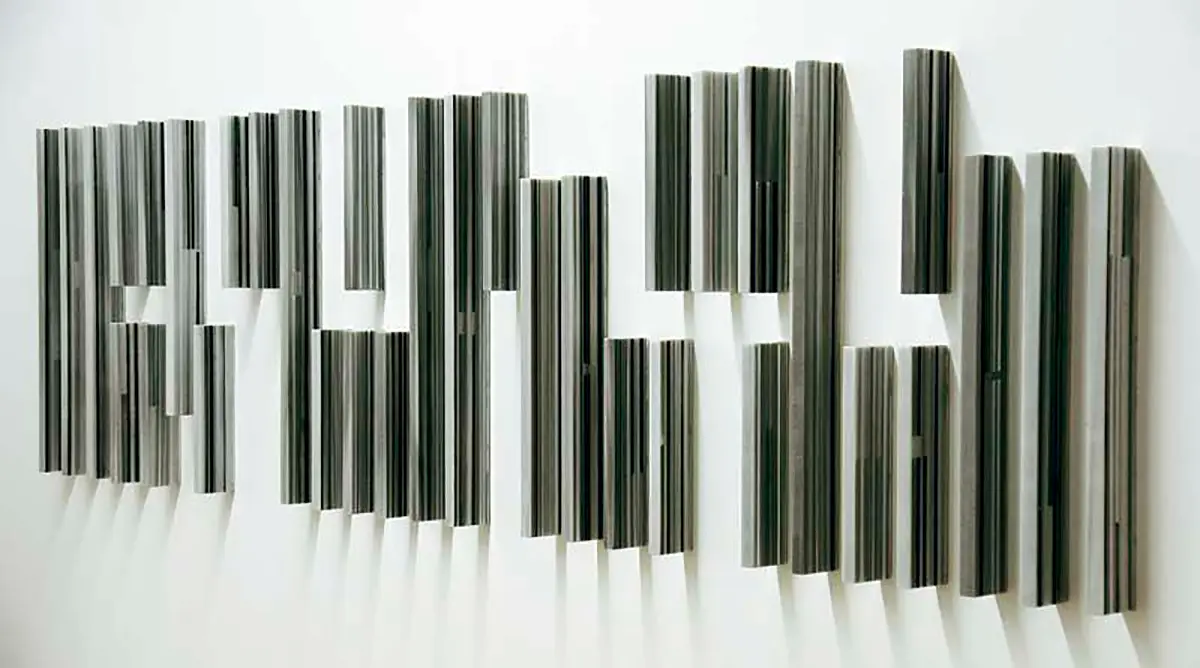
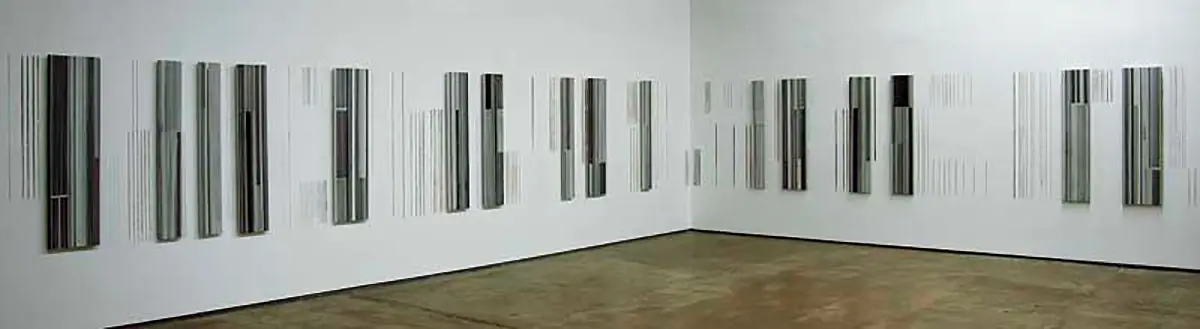
The show is comprised of three series the artist has titled Estrías, a series of works in granite intervened with graphite, charcoal, and ink. The set is the result of several situations related to Bravo’s personal experiences and artistic quests. But adding to the work’s process of reflection and construction is another interesting fact related to the dynamic of the local scene, with what is happening in the country’s cultural stage, in particular with the vision of the generation of artists to which Carola Bravo belongs, a cohort we could call, without hidden intentions, postmodern. We are talking, at any rate, about the group of young artists who discovered, based on a critical revision of a key period in the history of the country, particularly significant in the cultural context—the two decades between 1950 and 1970—an unparalleled period in our artistic history, given to reflection, analysis, and creation but also a time of mistakes, conflicts, and loss. This group of artists focused its attention on that period where we find names as important as Carlos Raúl Villanueva and the equally relevant Alejandro Otero, Armando Barrios, Carlos González Bogen, and Jesús Soto. From her interest in that time Bravo moves towards another topic in her own work, a topic present in her show for the Zubillaga Gallery: an encounter between Otero’s coloritmos, thought, analyzed, and then converted into works of art.
The formal link between Bravo’s works and that emblematic set created by the leader of the “dissidents” between the mid-1950s and early-1960s is undeniable, yet they differ in many respects. Concerning this exploration, the artist says: “I was interested especially in the rhythm that is created in the coloritmos, as well as space and depth that are achieved. In other words, the different planes that can be generated thanks to basic drawing and walls.” However, her works are different not only because of the materiality that imposes a value, but also because of the very creative act, and finally because of the result that is an aesthetic object, which in Bravo’s case comes into being through the absence of color and the combination of that which is contributed by the natural element, added to the artist’s intervention that transforms those shapes into an artistic event. And despite that, they are close to their forebears in the process of perception of a space that becomes deep through the phenomenon of vibration.
Critics have characterized Bravo’s proposal in Estrías variously. For Sandra Pinardi, these are “tectonic pentagrams”; poet Rafael Castillo Zapata recognizes them as “narratives of territories”; Susana Benko perceives them as text, graphics that cannot be decoded but are filled with meaning. A variety of points of view that nevertheless coincide in recognizing the communicative intent that emanates from Bravo’s works and is potent enough to stimulate the viewer’s sensibility, which is ultimately the reason for being of the work of art.
Carola Bravo’s work as an architect, art critic, museographer, and university professor has been consistent; she has persevered in her exploration of the complexity of space and its purpose of unveiling some of the space’s secrets. Also, she has been concerned with demonstrating that art is an intention verified in what is created, inform that emerges from the will, and from the effort in the pursuit of an important achievement. But above all, her work is the verification of the fact that such results are an image of that in which one truly believes.
FREDDY CARREÑO
Architect, researcher, curator, and art critic, member of AICA - Venezuela.