
Elias Crespín’s kinetic sculptures moan and hum, creating the illusion that we are in the presence of organic beings, even though we know that hidden motors move the metal rods and wires that comprise his works. Although all of the works in his recent exhibition at the Cecilia de Torres Gallery, his first solo showing in New York, are ostensibly pure abstractions—geometric compositions made from stainless steel, aluminum, and brass rods and wires shaped into grids, systems of parallel lines, concentric circles and pentagons—they are remarkably evocative of aspects of the natural world. Playful and inviting, each work is a self-contained object meant for contemplating in a gallery or home, rather than in large public spaces. Their domestic scale and organic character relate to the artist’s famous grandmother, Gego (Gertrud Goldschmidt), whose hand-rendered metal sculptures quietly defied the grand modernity of the kinetic works her peers were making for public venues in Venezuela. Crespín’s continued pursuit of this trajectory that began in an environment in Venezuela very different from today’s raises such critical questions as: What type of interactive experience can kinetic sculptures offer individual viewers in a gallery? What is the social significance of this work in a contemporary context that transverses the global and the local?
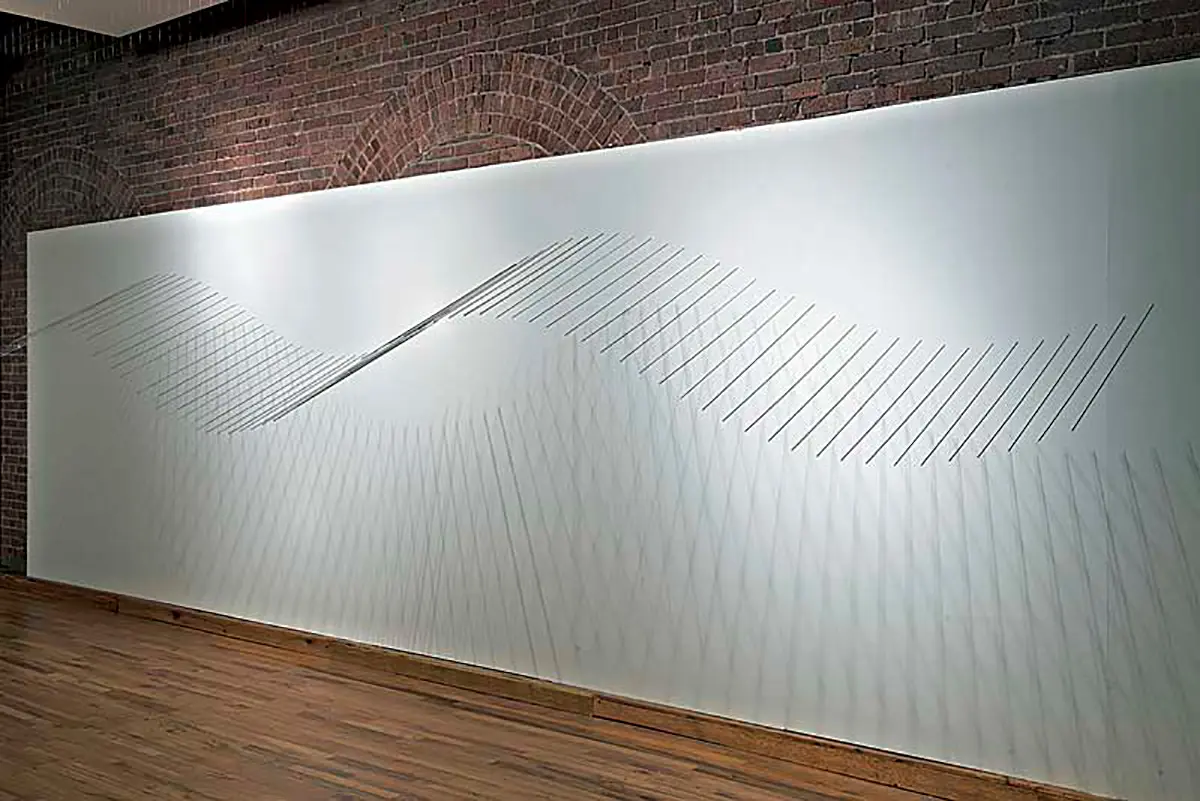
At Cecilia de Torres, seven different kinetic works constructed from stainless steel and brass rods or wire are displayed in a single gallery. They look like distinct works because each hangs from white platforms that hover about four feet below the ceiling, on top of which the machinery that runs the artwork suspended below is neatly hidden. The main elements of the sculptures—the stainless steel and brass rods, wires, and lead weights—hang from these platforms on near-invisible nylon threads. Silhouetted against white walls behind them and rectangular white platforms below, the metal rods, wires, circles, and pentagrams of the works appear to float against these white fields. The platforms have the practical purpose of preventing viewers from walking into the works but they also have the curious effect of playing the role of traditional pedestals, which counter-intuitively forces Crespín’s seemingly unconventional works into the traditional category of sculpture.
The show features objects from three different series from 2012. The largest, two from Crespín’s Plano series face each other, each an undulating plane of parallel, two and a half foot rods that runs almost twenty feet long. The rods undulate and dance, sometimes in concert and sometimes in opposition to each other. Cycling through about twenty different movement sequences over the course of ten-minute loops, with time the Planos each begin to appear to have their own personalities. They are controlled by an application Crespín wrote that runs on an iPad, laptop, or even a smartphone. Their owner or a curator is able to control the works by adjusting the speed of their movement, though it is really Crespín, with his computer programming, who determines how the work is animated.
And it is through the process of animation that he displays his artistry at transforming the seemingly mundane geometry of his materials into elements that appear to defy their materiality. Pulsating and flying, the Planos resemble fields of rippling grasses or the lapping waves of the ocean. Shifting and rotating, the concentric pentagonal and circular rods of Pentaconcéntricos Latón and Circuconcéntricos Latón alternate between suggesting large celestial bodies and microscopic cells. The final grouping of works in the show, Tapiz 7, Tapiz 5, and Malla 8 Paralelas 2 relate most closely to Gego’s drooping and malformed grids, but with the humor that Crespín’s animation brings to a grid of metal rods that are pulled and malformed by a combination of nylon threads and its own physical limitations.
In all of these works, Crespín renders invisible forces temporarily visible and calls our attention to the dynamic and unstable nature of vision. Luminosity, shadow, and reflection are as much his media like metal, motors, and computer programming. The artist’s desire to stage such engaging and interactive experiences on a small scale not only reflects significant and well-known shifts in the patronage of art in Venezuela, but it also reminds us that the Venezuelan kineticists almost always deployed their aluminum and Plexiglas to engage with the natural world. It also attests that the core experience of kinetic art lies in the wonder of an individual viewer’s discovery.
HARPER MONTGOMERY