
The work of Rio painter Elizabeth Jobim is the result of a balance between the constructivist matrix of her compositions and poetic freedom. In analyzing her oeuvre, it is pertinent to note even the most remote debates on the meaning of constructivist art, this is to say, art conceived as a construction rather than representation. While since the avant-garde period many artists have explored innumerable debates around constructivist art’s potential for signification, Jobim once again demonstrates that the most abstract kind of art is also free to be interpreted in its different aspects.
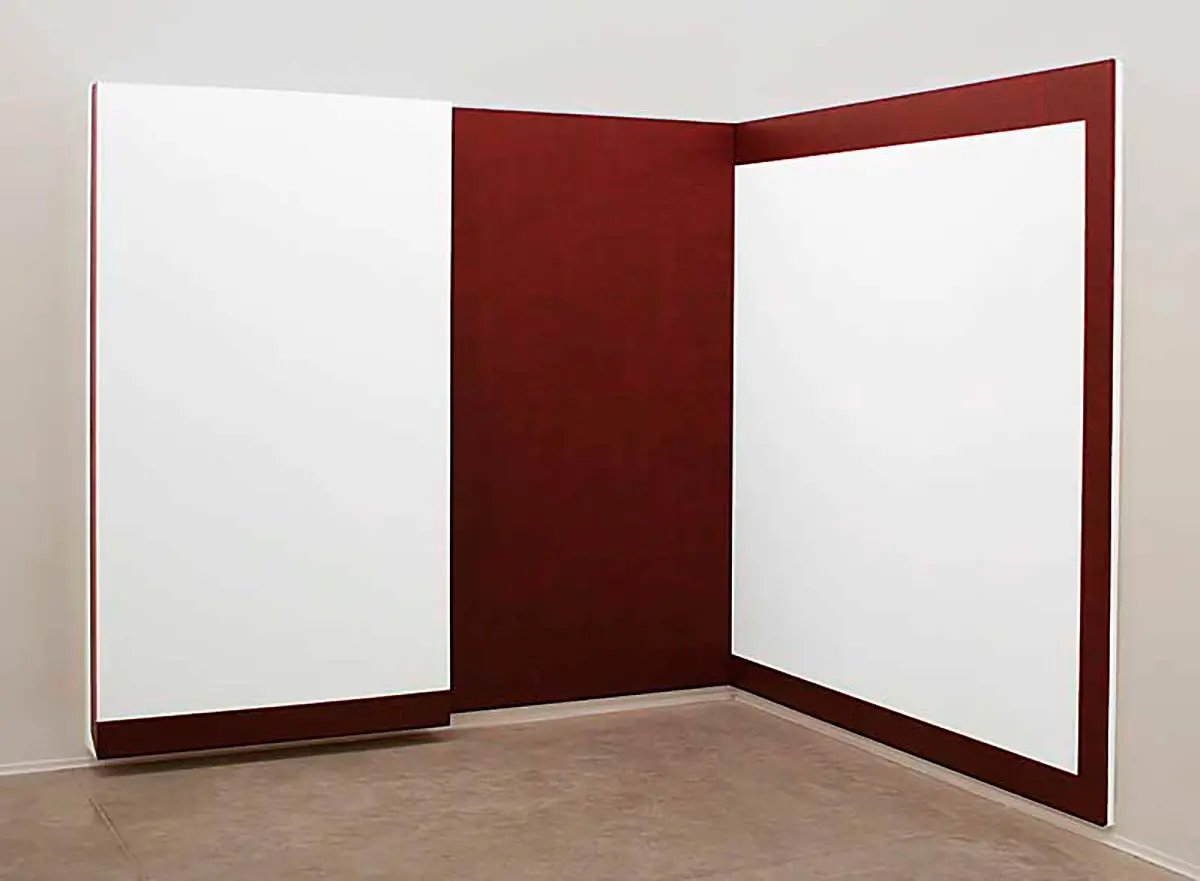
This was on display in Mineral, her recent exhibition at Lurixs: Arte Contemporânea, in Rio de Janeiro. The artist’s most recent production, comprised of diptychs and triptychs, reveals simplified forms that refer to the traditional format of the canvas and also to geometric solids. It is a noticeable departure in her trajectory, as in recent years Jobim had devoted herself mostly to large panels set around the walls of her exhibition spaces. Despite the shift, her recent works continue to dialog with their architectural environment. Set to more circumscribed spaces and featuring new colors (with a satin sheen), they also affirm a direct link to constructivist matters, such as the illusion of depth and the relationship between bi- and three-dimensionality.
Jobim’s work gives continuity to the traditional lineage of Rio concrete art, which emerged as Grupo Frente in the 1950s and was immediately reasserted with the arrival of the Neo-Concrete movement. The essence of the work of these Rio artists was a free interpretation of the more radical purism of the early European manifestations of constructivism; their influence is felt in later generations, for instance with Jobim, who studied with Aluisio Carvão (1920-2001), a member of the Neo-concrete group, and with Eduardo Sued, who coined the term “dialectical constructivism” to define his own work’s singularity.
Like Sued, Jobim sought a personal development for her constructivist roots. As a graduate in visual communications and with a Master’s in Fine Arts, she also studied with Anna Bella Geiger, whose intellectualized positions must have influenced the pathways followed by her art. Jobim’s geometric constructions were always more lyrical and nuanced, like the residues of pictorial matter that drip from abstract images.
It is also possible to establish a filiation between this artist and the Modulated Surfaces created by Lygia Clark (1920-1988), since the notions of modulation and articulation are present in several of Jobim’s series. In her works of the early 2000s, for example, she uses exchangeable fragments of drawings and, through a montage technique, creates relationships between forms that change every time the works are exhibited. Thus, she investigates matters that are essential to concrete art, such as the relationship between the part and the whole and notions of continuity and discontinuity.
Like all constructivist artists, Jobim started initially with the Western figurative tradition. And she always used reminiscences of that tradition, as she does when finding inspiration in rock arrangements to create her compositions, whose broad and irregular lines establish contours and suggest volumes. In the late 1990s, Jobim also created small-format paintings based on works by Giorgio Morandi (1890-1964). Morandi’s serene universe was reconfigured by Jobim by means of gestural strokes. Also, the still life always remained as an internal problem in her works, as seen in her images of color tubes on canvas painted in the 1990s, with colors and textures that also bring to mind Morandi’s pictorial universe.
In more recent works like those on display at Lurixs, Jobim circumscribes her work to the approximate plane of the canvas, almost in two dimensions. She plays with corporeal volumes by displacing areas of the canvases, and in this way prompts her viewers to connect directly with the work. Each painting calls for motions of approach or distancing, asking us to circulate around it. It is as if the canvas were built in front of our eyes, according to our movements, thus giving our enjoyment a sensual rhythm even in the face of the seeming sobriety of her geometric rigor.
Jobim’s works contain cracks that direct our gaze towards an infinite background or shadows that project uncommon geometric shapes. There is always a suggestion of illusion that makes us unsure of what is real. Some shapes seem to suggest that the work’s surface is actually the wall. Jobim once said that her work “comes from that moment of seeing things, of the way we see them, but also of how we build our vision through a kind of geometry that organizes our perception of the spatiality of things and of the world.” In this way, the artist proves that geometric language is, above all, a field open to investigation and exploration.
ALESSANDRA SIMÕES