
Fernando Arias’ oeuvre has taken shape as a journey where, with a sharp and critical gaze, the artist interrogates and questions the values established by religious and political power. As he encountered different places in his wanderings, Arias discovered the cultural values and human contradictions at the root of deep social conflicts. Arias’ maverick gaze, geared towards the recovery of an ethical stance, has driven him to express his views in artistic actions involving his own body; he has also used the strategies of installation, creation of objects, video, and photography, all resulting in powerful images. At the same time, Arias has led and directed various community projects intended to find a place for the arts in the lives of populations outside the artistic circuit.1
Arias’ journey began in his native city of Armenia, growing up among his bacteriologist father’s test tubes and his own construction-set games, and took him first to Bogotá to study advertising. From there, he moved on to London for a Master’s degree in Graphic Design and a definition of his interest in the arts; then it was back to Colombia—first El Chocó, then Bogotá and for some time now it has been a back-and-forth between his native country and the UK. Arias has worked and exhibited in Latin America, the Middle East, and Asia. In his travels he has observed the world intently and, as his own web page puts it, “experimented with the human condition.”2
Two separate moments can be discerned in Arias’ career, begun in 1990, that are nevertheless connected through a kind of “umbilical cord”, defined perhaps as an effective force that drives the artist to express himself vehemently as an individual subject and as a member of the human race.
First Phase: His Body and the Body of Others
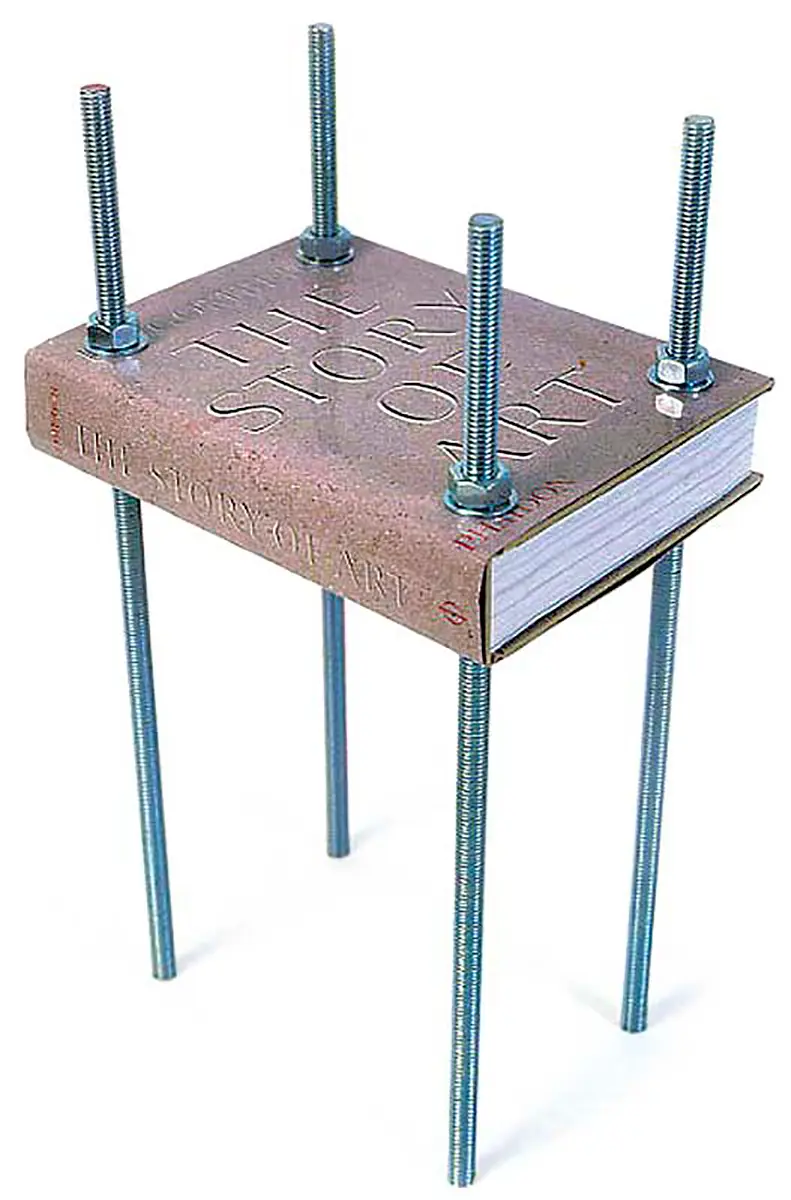
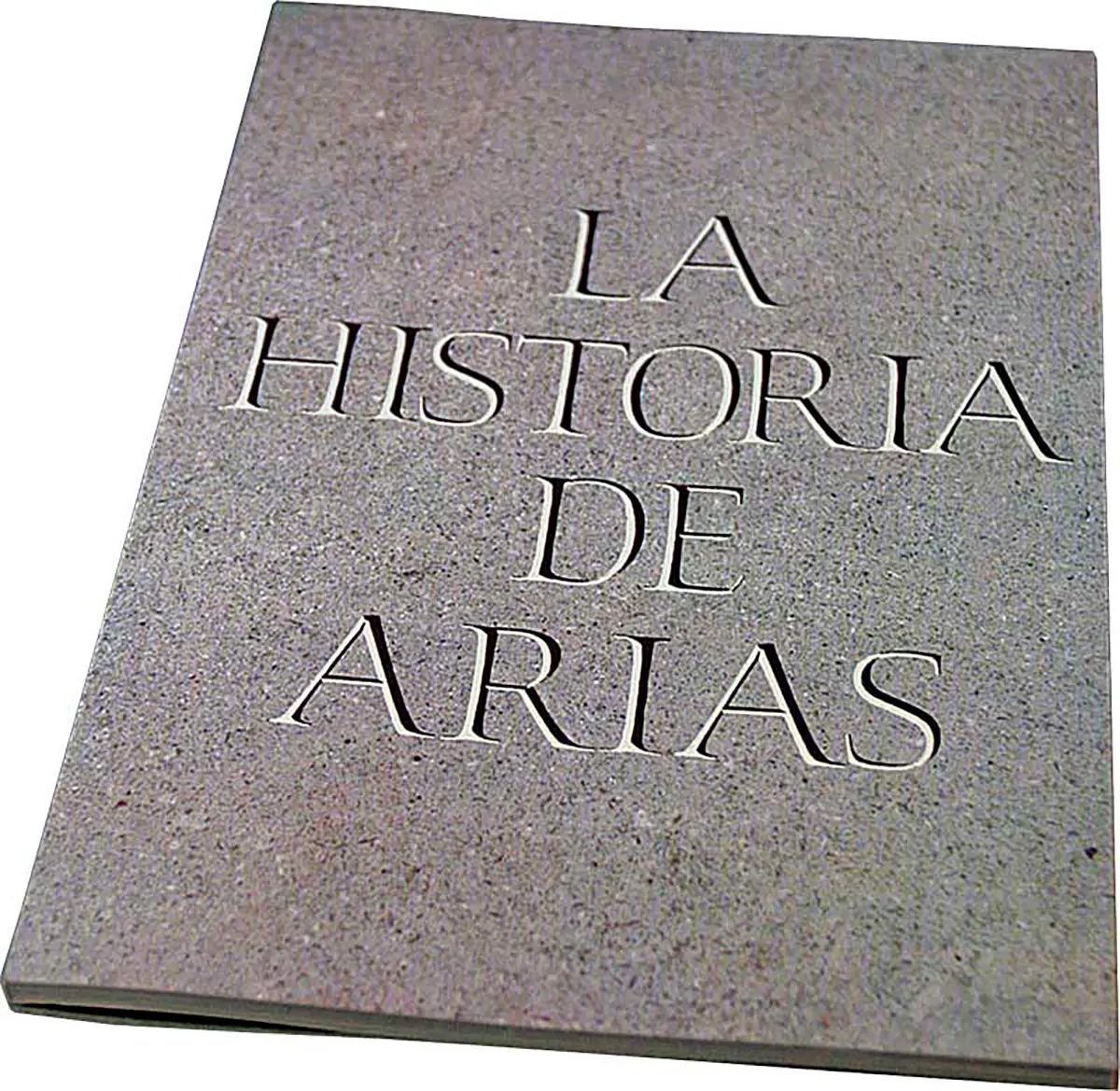
The first period in Arias’ development, focused on issues of the body, emotional ties, identity, and sexuality, is presented in La historia de Arias (1998.) This publication was complemented by the creation of 15 metal books allusive to Gombrich’s The Story of Art, the first volume acquired by the artist after his arrival in London. Screwed onto iron supports, these metal books become tables of a kind, in an ironic allusion to the most elegant coffee tables. As part of that project, fifteen UK institutions were invited to mount an exhibition. The title of the publication, filled with art-historical resonances, also strikes an autobiographical note, and the works included in it reserve a prominent role for the body through the use of fluids (blood and semen), umbilical cords, and Arias’ own skin. In some instances he uses his own body and, as he has put it, “lends it out it”3 in order to speak of his own issues and those of others.
Arias’ earliest works, Cuarto frío, Análisis, and Seropositivo, dealt with AIDS, blood infected with a deadly virus, that which designates life and death—a topic present throughout his entire oeuvre. The instruments he uses, platelets and lab equipment, retain their links with familiar objects from his childhood; “the aesthetic of these objects,” he says, “gave me ideas for my installations, (…) to create objects, to transform them, to seek something like a new dimension in them…” *
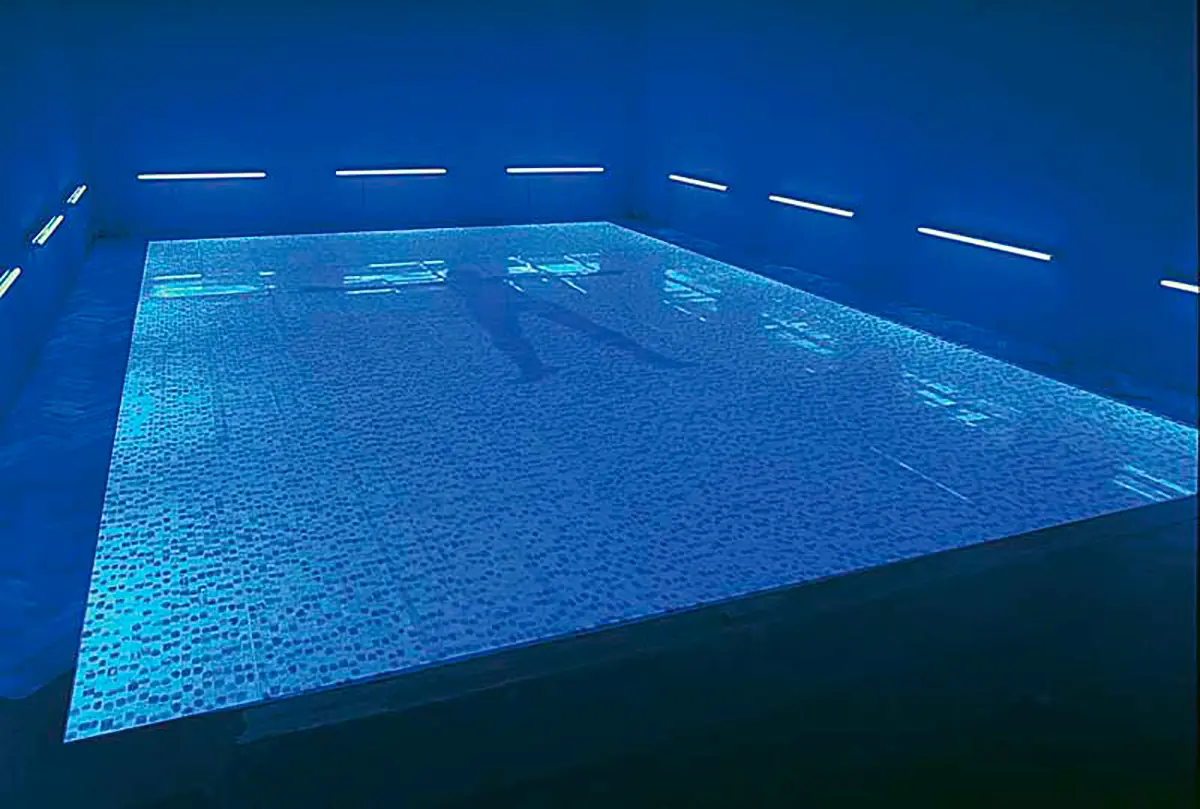
In Seropositivo, an installation at the Museo de Arte Moderno set above a reflecting pool, we see a photograph of the artist with his arms extended, cross-like; the photograph is covered by lab plaques. To achieve this unforgettable image, Arias lent his own body in solidarity to the expression of what was happening to other bodies, subjected to the loneliness and isolation of a terminal illness that was surrounded by all kinds of social prejudices. In parallel to the installation, Arias carried out a series of street actions such as distributing flyers to young male prostitutes in order to “raise awareness among minority groups concerning an issue that impacted not only them but many others as well.” * Years later, Arias revisited the topic of AIDS in Happy Hour, a 1998 installation that used blood and semen to create a deadly cocktail and added a sound element: the singing of Happy Birthday.
Emotional connections, the need to belong and be attached, feelings all that are part of the human condition, were present in three works from 1997-98: Le pedí a mi madre que me pusiera de nuevo en su vientre y a cambio me tejió una carpa de crochet. (“I asked my mother to put me back in her womb, and in turn, she knitted a crochet tent for me.”) All is said in the title: he asks to be returned to the maternal womb; faced with this impossible request, his mother, with patience and love, crochets a tent for him. As in other, later works, here Arias is just the agent of an action that involves others who are not in the field of art, which allows them to enter in that way. Maternal love extends into Madre Tierra, an installation that had Arias sowing umbilical cords on the ground of a farm in La Calera, where he lived for nearly two years. With this work, Arias says, he intended to allude to “the mental umbilical cords we develop with other people.” * He had already used the same human material in an action titled Introduciendo cordones umbilicales humanos desde la parte Mexicana de la frontera con Estados Unidos (Introducing human umbilical cords from the Mexican side of the Mexico/US border).
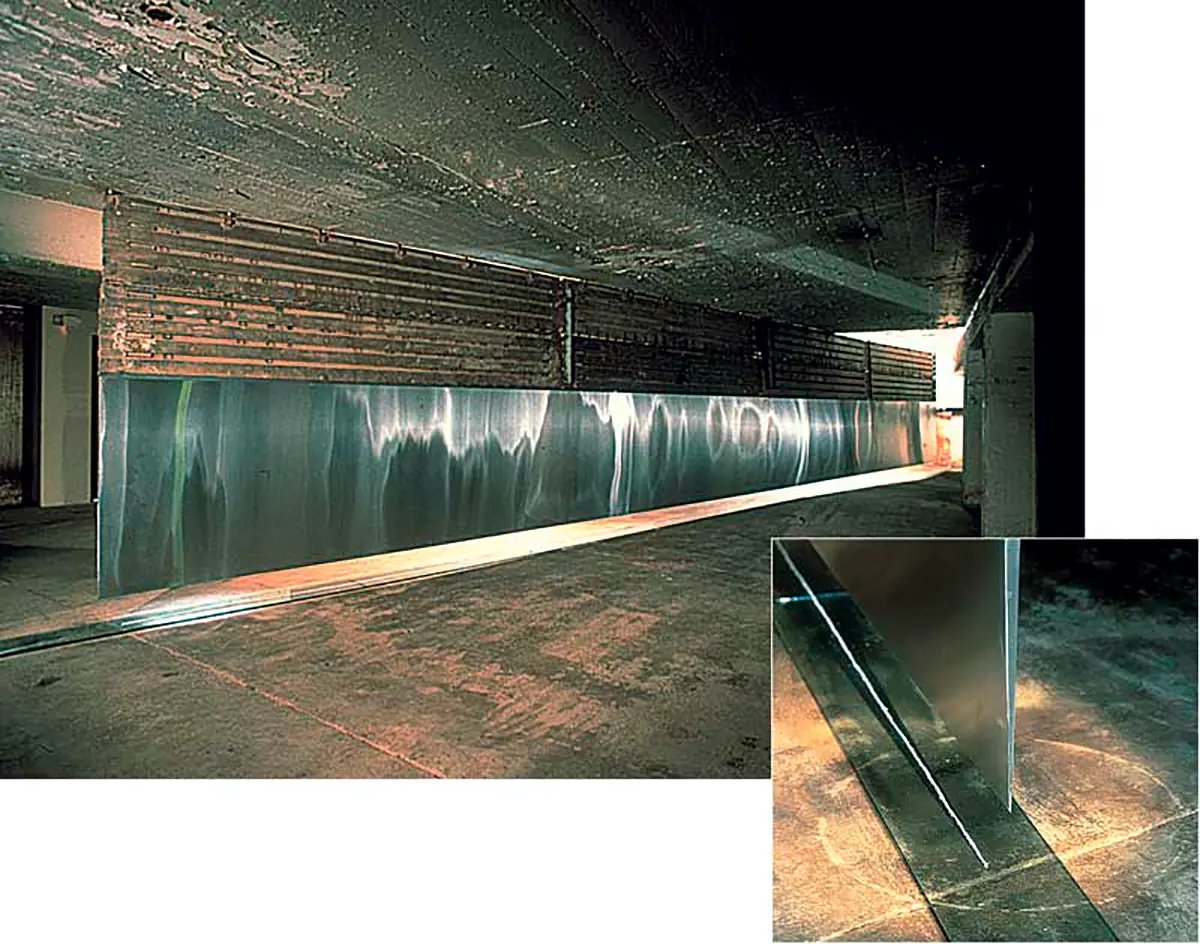
The topic of the border, of national identity, so problematic for many Latin Americans, is also present in La Línea and La Mula. Zulma Delgado writes: “Arias was invited to InSITE’97 as the only Colombian representative in order to reflect on border situations between Mexico and the US. There he created La Línea and La Mula. The former is an idea about the border that uses a large stainless steel blade to project a line of white powder on a large mirror below. La Mula is a performance with an endoscopic device that reveals the inside of the artist’s own drug-free intestines. Here, he works with the idea of Colombian-ness in alien territory.” The presence of the body in this work is forceful; the artist stands in front of the viewer with the endoscopic device in his anus, showing—telling—people that “I am carrying no drug-filled condoms.” *
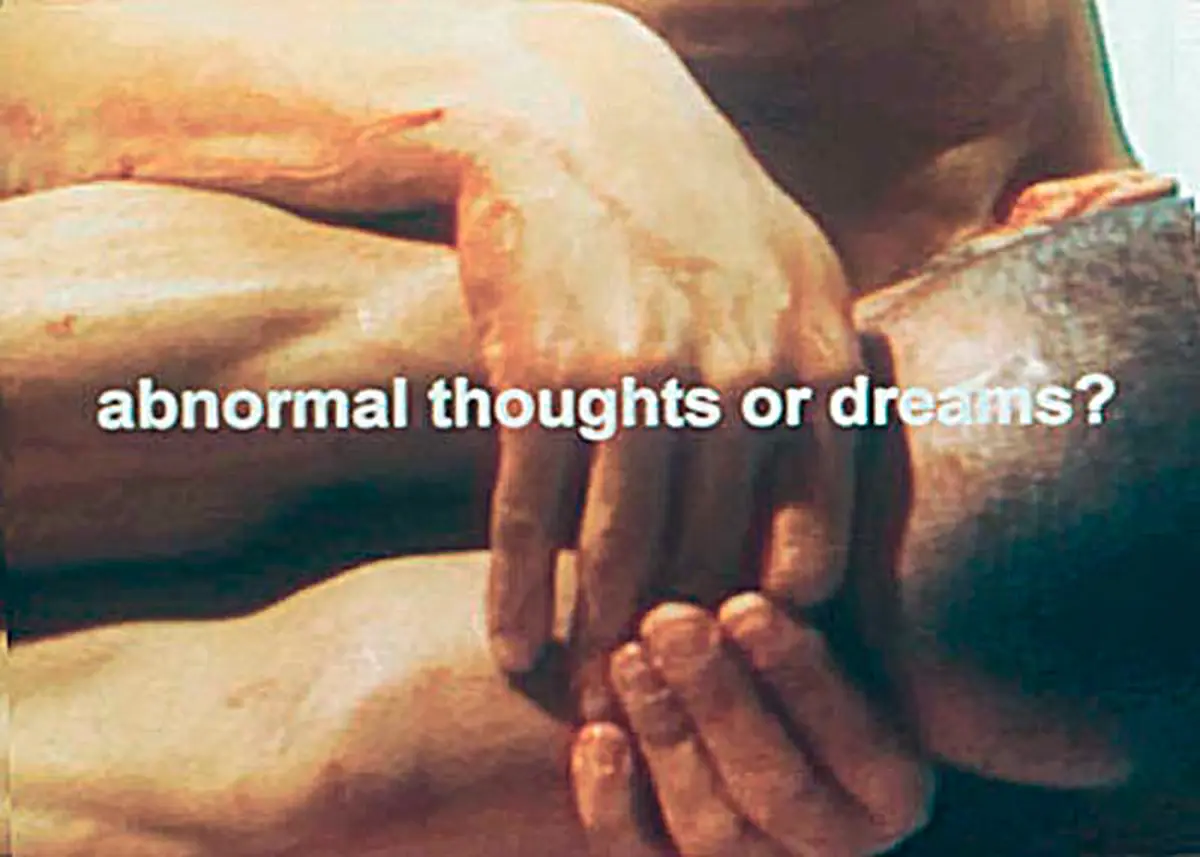
Two deeply moving works by Arias present strictly opposite views. Sueños o pensamientos anormales (1996) was created for curator Els Van der Plas, 4 who invited Arias to exhibit in a former psychiatric institution. There, the artist presented photographs extracted from a video performance created during a residence in Western Front, Canada. 5 In this work, Arias confronts, as an artist and in his human condition, the myth of blood, violence, and sexuality. He manipulates blood and other bodily fluids, playing “with the territory of the body and identity.” We see his naked body covered by pieces of raw meat. This image is in clear contrast with another, an exceptionally beautiful one that again shows Arias’ naked body, completely exfoliated, in a fetal position (once again, maternal love), an almost white image that resembles the drawing of a man with porcelain skin. Fragility and crudeness intertwine in these images.
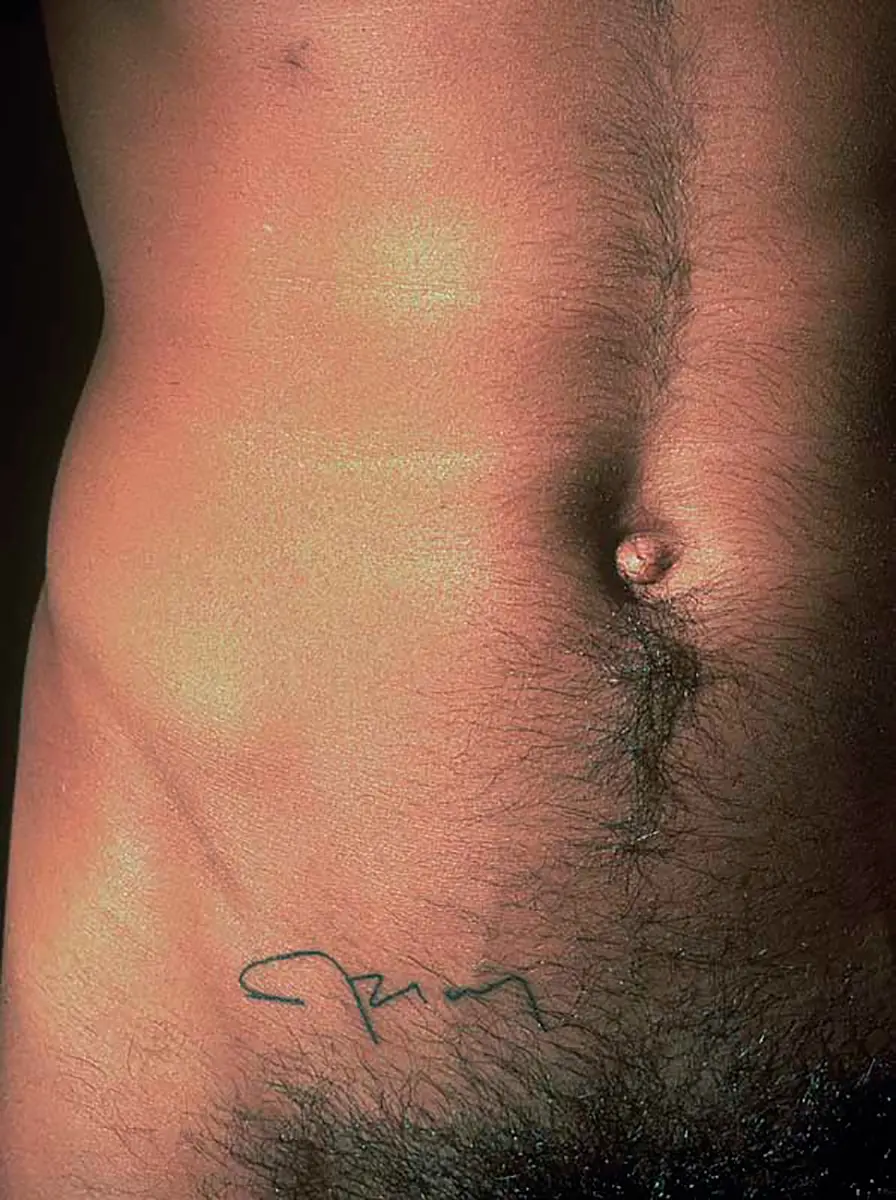
The body, Arias’ own skin, is present as well in one of the last works of this period, ¿Quién da más? (1997), which participated in ARCO 1997. Here the artist offers up his skin, transforming and exposing it in the service of his ideas. As Zulma Delgado points out, Arias decided “to offer up for sale a tattoo of the artist’s signature on his own skin, (…) bringing to the fore a crisis of the relationship between artist and collector as that between ‘prostitute and client’, says Hans-Michael Herzog in the book Cantos Cuentos Colombianos. Questioning ideas such as authorship and authenticity, mocking that which is conceived as ‘artwork’ by art commerce, validated by an author’s signature.”
To close this autobiographical cycle where the body has been present in a variety of ways, the artist’s own words are paradigmatic:
“Thanks, body. You have served me faithfully. You have taken me to the places I desired. You have been the shadow for my own shadow to project onto and chase me. Through you, body, I have been able to materialize my thoughts as Art. You have also transformed my food into fecal matter and other orders. Thanks, body, for putting up with me. I hope you excuse the symptomatic disturbances I caused.” 6
But we need to understand that the works in La historia de Arias refer to a “collective I”, to “the image of a human being confronted with what we really are, because in the end that flesh, that blood is part of our being and at that point I felt the need to bring it out, to express it.” *

Second Phase: Social Bodies, El Chocó, and Other Places in the World
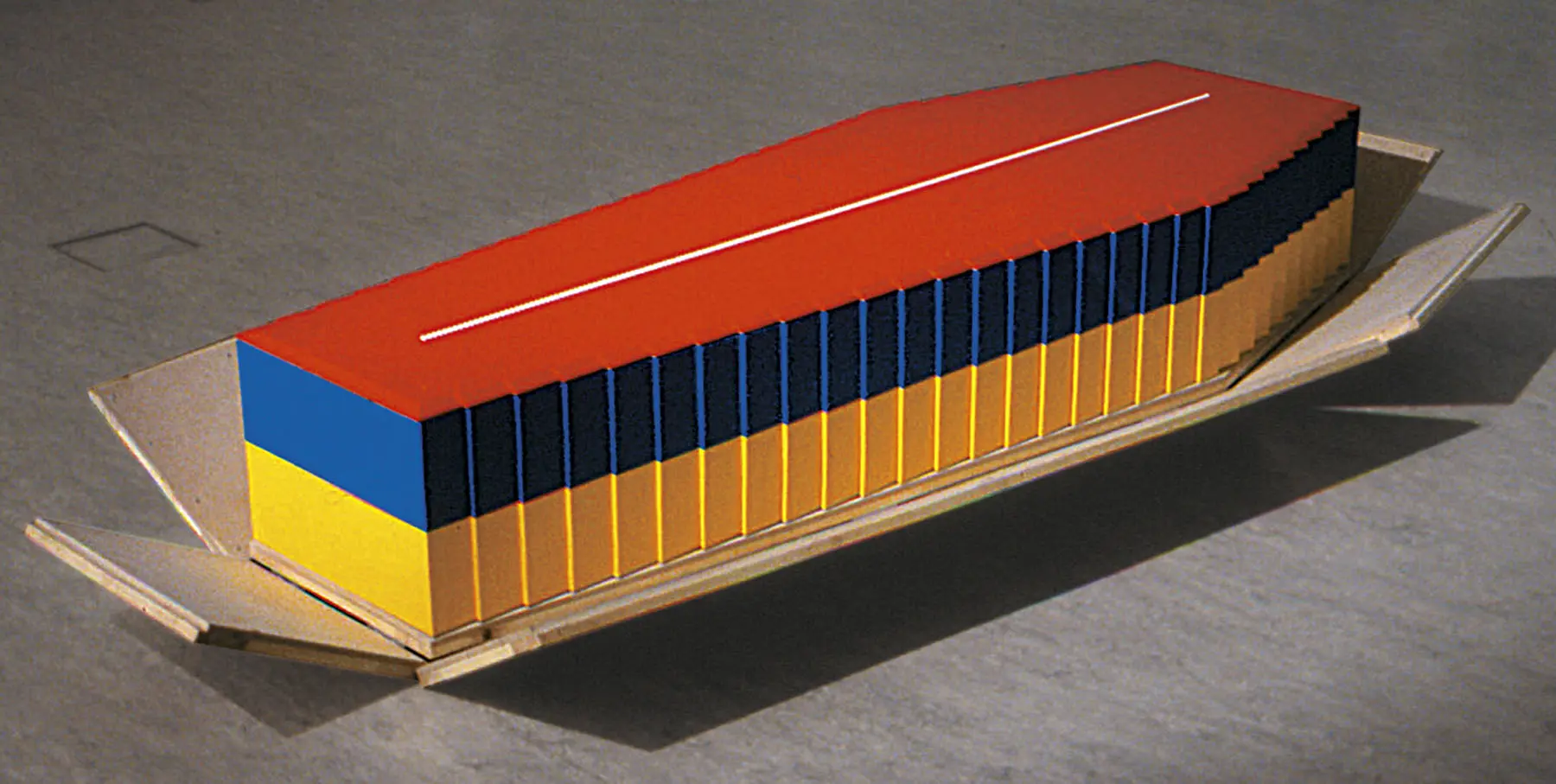
Ataúd de Lego (2000) is among the initial works in Arias’ second phase, where he alludes to problems in “social bodies,” human groups, and vulnerable ecologies. Life and death are present in this particular work, as in many others, conditions that his early works named through the blood adhered to laboratory gear and which here shine through building-block games connected, like Arias’ bacteriological equipment before them, to the artist’s own childhood and personal history. Such subjective payload in the art that deals with “social bodies” reveal the expressive and emotional power that drives 'Arias’ tackling of a variety of projects, those in this second stage of his journey included.
The casket, acquired by the Daros Collection, is built using “Lego pieces in the colors of the Colombian flag and a white line instead of the cross. Arias plays with the concepts of childhood, play, drug trafficking, and death. Concepts that generate a forceful contrast. This Lego coffin will be the artist’s casket, used during his wake. Afterward, his body will be cremated and the box will be given to children to play with.” “Life goes away,” Arias says, “but what can be more beautiful and at the same time darker, what can be more real than those children playing with their own death?”7
This impressively beautiful and brutal work of art contains an autobiographical element. But the children Arias has in mind are from El Chocó, a region in Colombia’s Pacific coast that was to set the artist’s life and work on a new course. After his encounter with this region, Arias began to express his opinions and feelings in pointed statements and to focus his gaze on vulnerable populations. His objects, photographs, and videos, loaded with connotations of various orders (political, religious, sexual), vehemently point out the incongruences and contradictions with which we live, particularly those groups settled in areas of conflict in Colombia and other parts of the world. The artist’s body will no longer be the necessary vehicle for expression; others will be on display in order to reveal their condition under an inquisitive lens that continues on its journey through many parts of the world. The following narrative by Arias clearly outlines the standpoint from which his most recent work launched:
“I went to El Chocó for the first time some twelve or thirteen years ago. I went because my brother, who published a magazine called El Andariego, asked me to write an article about the region. So I went and it was love at first sight. Then I started to go more often, and a month after that first visit I was already living there in one of the African-descent communities, right on the beach, and at once I started to connect with the people, taking photos and making videos. Later, on one of those trips, I saw that a brigade was stationed there and there were soldiers by the beach. I was struck by the way El Chocó became the boiling cauldron of the country’s persistent conflict, because there you have guerrillas, the paramilitaries, drugs, everything there in the midst of such exuberant natural beauty (...) and also with all the mining and all we have in that region, the forest so rich in biodiversity. So many eyes in that area!
“I am interested in exploring the human side, but of humans who are living inside that conflict: who they are, who they continue to be despite the conflict. Who is this soldier who has to be there for 24 hours but still brushes his teeth, still thinks about his mom and his family as he smokes a cigarette, who sees a flower and thinks it is beautiful? All those details we forget when we say ‘This is a war,’ and there you have soldiers, and people, and violence, and all that…
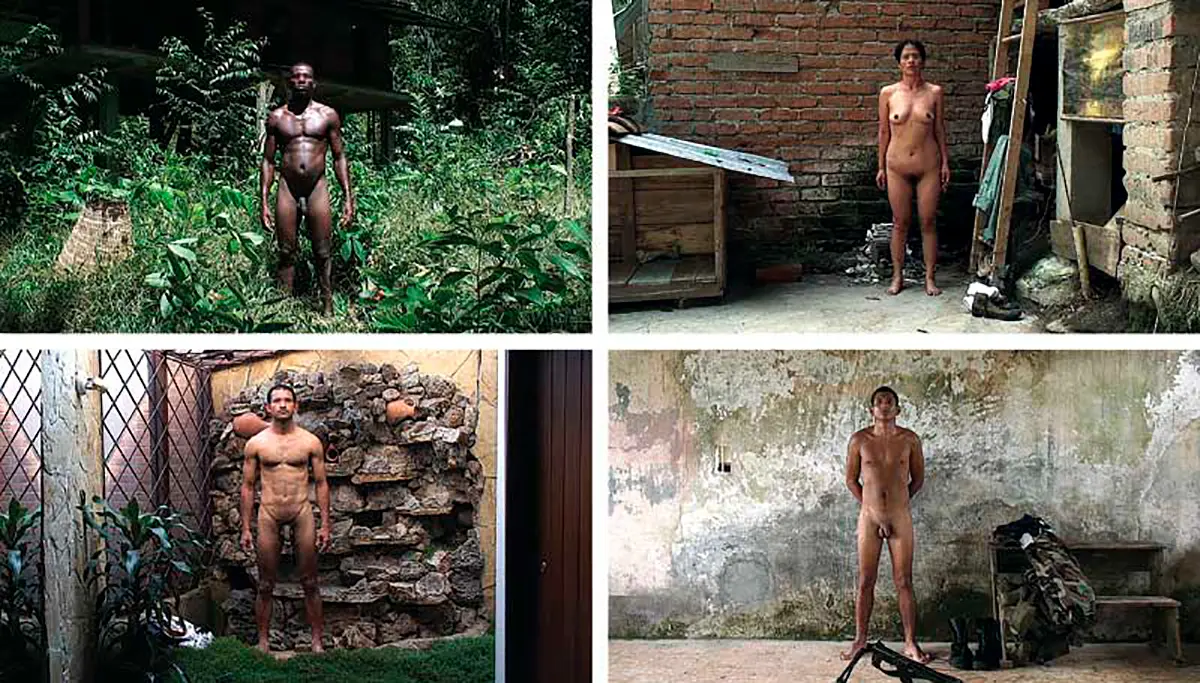
“So, this also applies to the guerrillas, they are people in the same situation. Anybody, any human being gives the idea to create Humanos derechos, to unveil, to ask them to please leave all that behind and show me who they are, lay down those weapons, take off that uniform, and be just a human being. I played with the posture, a human straight like that; I do it with the soldiers and then I found a paramilitary fighter in Bogotá, and then a female guerrilla in Quindío, and a peasant in El Chocó.
“I did it with those four and it was a long process because, in reality, it is not easy to ask someone to bare themselves for the camera, especially for some of the characters it was really, really hard to confront such bareness, because it wasn’t just physical, but of the mind also. I did this work for myself, without having to respond to a situation such as a biennial or an invitation.
I also started to make a series of videos that evolved because by then my relationship with people in El Chocó had grown and matured. I was able to ask some of them to let me record their lives, those moments when nothing is happening but many things are happening at the same time, that Chocó time that seems slow but in reality is a different kind of time, a different dimension. *
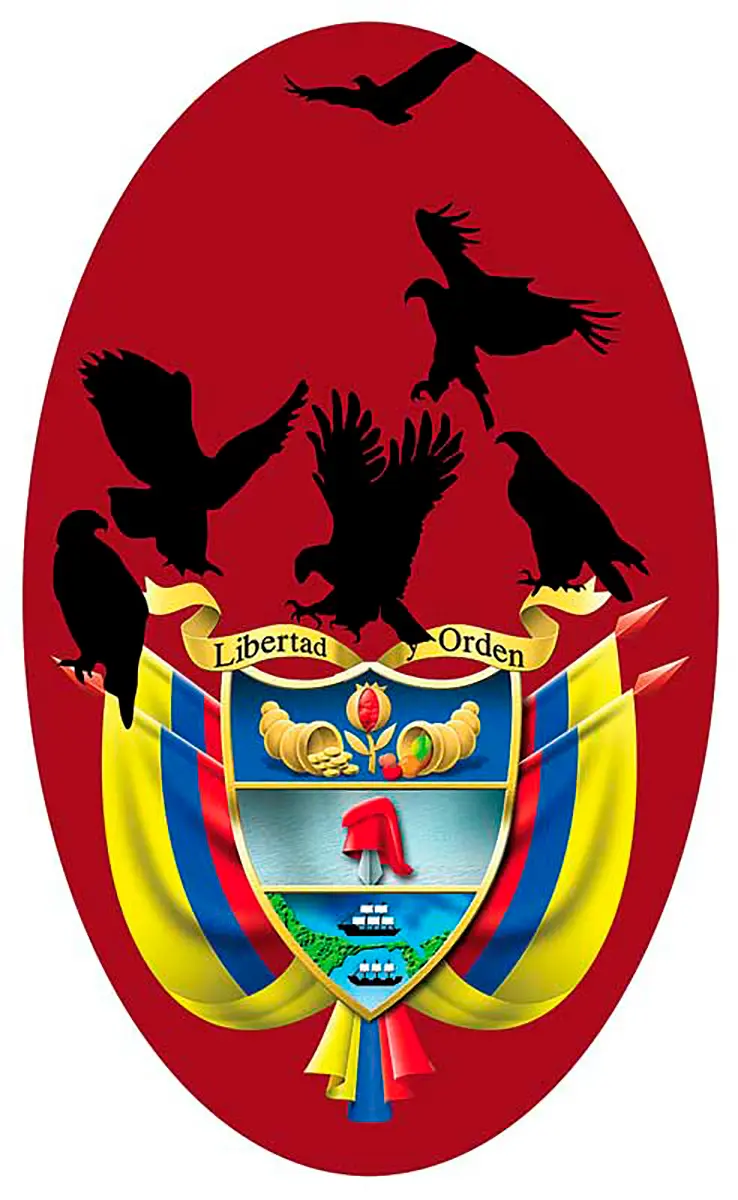
As Arias explains, from that experience, which reestablished contact with his country, emerged projects like Humanos derechos (2008), developed in Colombia and Israel with the sponsorship of the Netherlands’ Prince Klaus Foundation. Some works from this series were included in País para quién (2009), an installation in a beautiful, blighted Republican home in Bogotá. In using the Mapa Teatro building, says Santiago Rueda, with its coffered ceilings, its arches, its French-like columns, Arias has recovered a highly resonant image in the Latin American imagination. This is the house of power. Where bureaucracy, the army, and the Church come together and where many ritual spaces and acts are located. On the one hand, gestures of religious celebration; on the other, a sum of patriotic icons that gather in the space of a Presidential office. 8 With respect to this work, Arias has said: “I was trying to recreate the decadence of power and did so by playing with the symbols, altering national symbols, that whole iconography we are taught to pay homage to and never touch. So I propose the opposite, to be more realistic and to tease out new possibilities that perhaps come closer to reality…”
El país de los demás (2012)9 is Arias’ most recent installation. There he deals with the issue of coal mining in Colombia, where huge swaths of terrain are given to foreign concerns and which threatens the destruction of the ecological balance of a large portion of the territories around the Amazon River. This work takes up the gallery’s two floors. On the lower floor, it welcomes visitors with a misspelling of the country’s name that is common among foreigners: Columbia, written in Antonio Caro’s Coca-Cola script,10 an appropriation move that updates the meaning of the original. Another linguistic appropriation referred to as an analogous topic is SALE (2011), a powerful object in bronze.
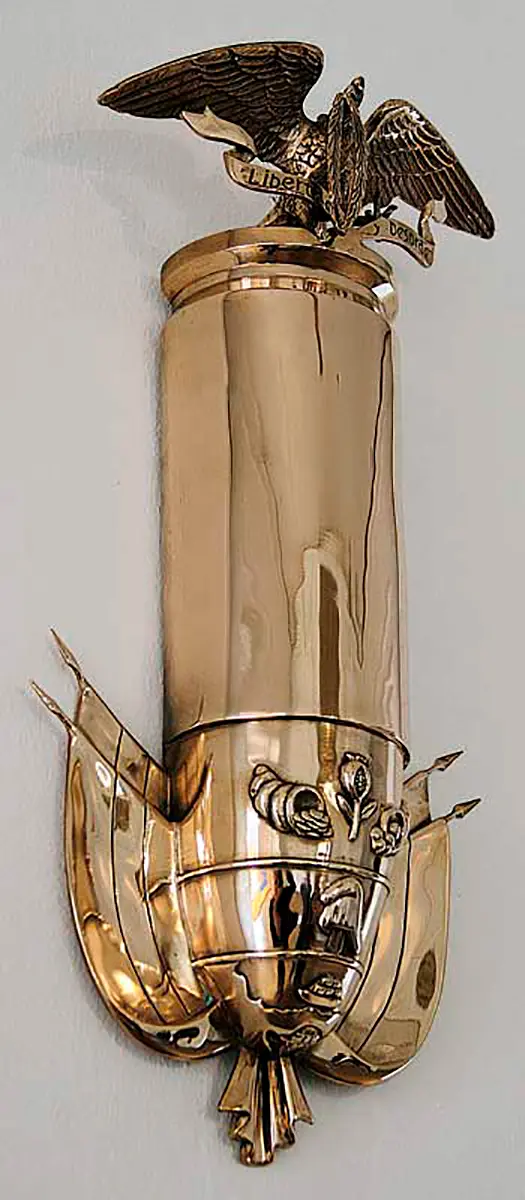
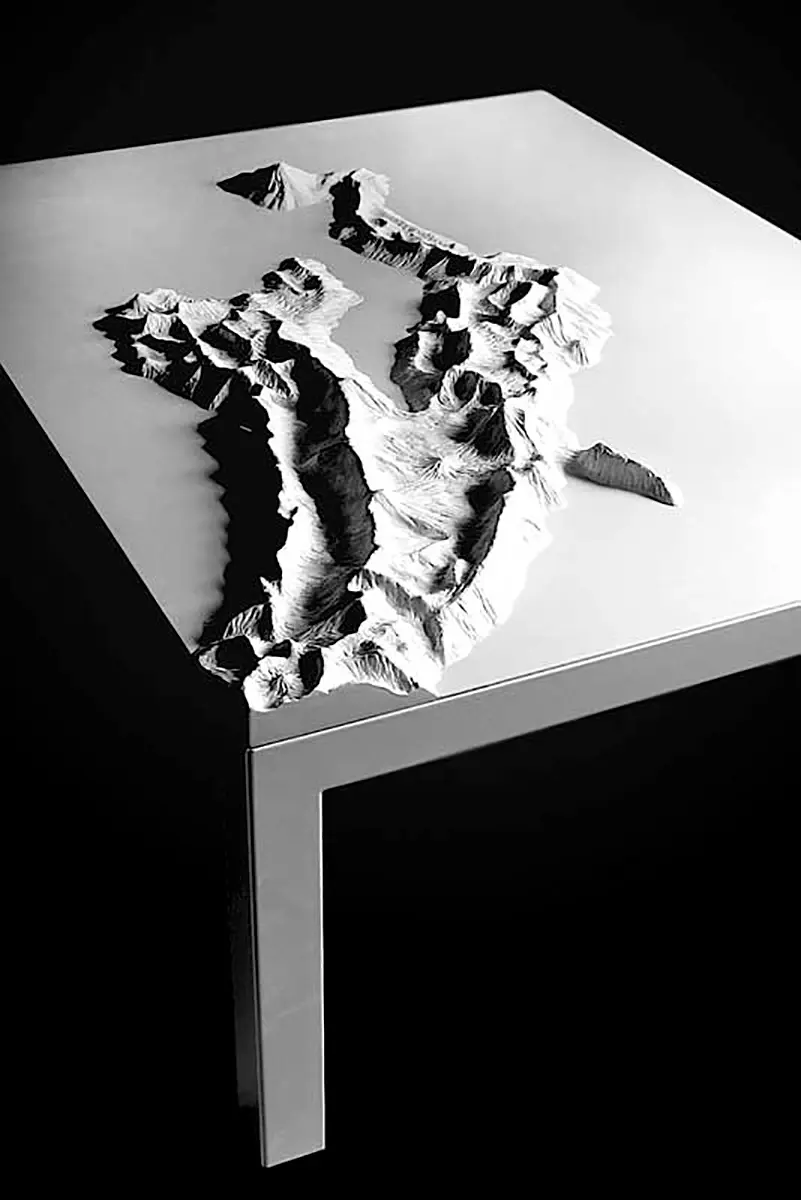
“I offered President Santos and his cabinet the use of the image in Sale, inspired by Robert Indiana’s famous LOVE sign of 1975, for their promotional campaign. As associated logos they could also use the image of the sierras from Agua que no has de beber, of 2011, also a gilder bronze with small diamond points inserted in the moors and water sources. I acknowledge that President Santos’ speech reminded me of my advertising and marketing studies.”11
Arias had made many points abroad as he journeyed around the world. Among them is the billboard displaying the word Infidelidad presented at the 2003 Havana Biennial, where he once again uses language to create meaning and express his ideas. He works with drug addicts in London, where he met a Colombian and took impressive snapshots. In Srinagar (2012), in Kashmir, a conflict area between Pakistan and India where he found a striking natural beauty alongside powerful military pressures, he lived with a family that had one member working at a textile plant. With them and other local people, he got to know the place’s cultural values; the product of this contact is a series of beautiful rugs made following Kashmiri traditions. The images of these rugs are part of photographs where Arias captures the daily lives of soldiers among the civilian population.12
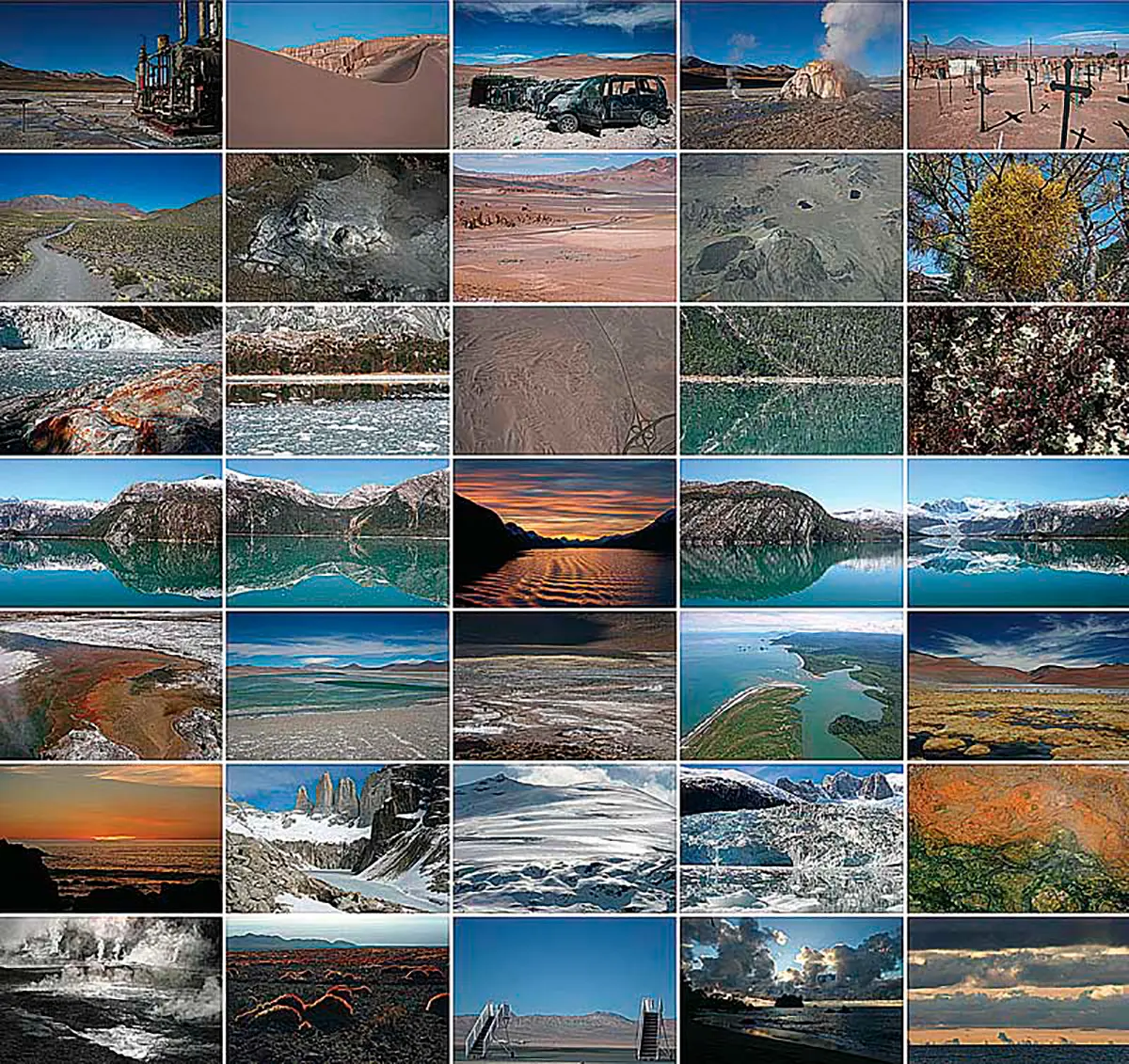
And to bring this journey to a close after touching only on some of its stations, It seems pertinent to mention the year 2005, when Arias won a fellowship from Great Britain’s Arts Council and the British Film Institute and begins El viaje necesario: "The end of the world, Patagonia, is the place of solitude that will allow me to experience the desolation and freedom I require for this necessary voyage (sic). A voyage through time and space in order to reflect on my cultural and national identity, which I have had to rethink from different territories, different perspectives, and all that" The route will touch on three key points forming a triangle: London; Chocó (Colombia); Cape Horn (Argentina); London.13
“For me, it was like a conceptual utopia to bring those two places that are like my home, the place where I live, and to be able to walk it on the earth. Is that clear? It was like a joining together, a little like a quest, at a time when I was living in London, of the return home, of connecting the two places. *
Many geometric shapes could be outlined on the globe based on Fernando Arias’ journeys. His words about that “necessary voyage” that takes him to the ends of the earth seem to also apply to his career as an artist, which combines a deep need for roots and affection with a constant search for displacement. A tireless quest that has powered a variety of projects seeking to name life in places that only know war or places inhabited by peoples for whom death is exceedingly close.
NOTES
1. Plataforma Chocó, Más Arte Más Acción Foundation, Chocó, Colombia. Santiago Rueda Fajardo, ArtNexus Magazine 27, June-August 2011, pp. 119-119.
2. http://www.fernandoarias.org/index.php?idi=1
3. An unpublished interview with Fernando Arias by Guillermo Villamizar was extremely useful in the writing of this article In what follows, quotations from that interview are designated with an asterisk (*).
4. Els van der Plas was, for a time, the Director of the Prince Klaus Foundation, which has sponsored many of Arias’ projects.
5. These video stills were titled Plataforma Chocó. The photographs were part of an exhibition at the Gate Foundation, curated by Els van der Plas.
6.http://www.colarte.com/colarte/conspintores.asp?idartista=1485&pagact=1&dirpa=http%3A%241col%24%241col%24www.colarte.com%241col%24recuentos%241col%24A%241col%24AriasFernando%241col%24critica.htm
7. http://www.tabakalera.eu/daros/artistas.php
8. Santiago Rueda Fajardo, Plataforma Chocó, Mapa Teatro, Bogotá, 2009.
9. An exhibition curated by María Belén Saiz to be presented at NC Arte, Bogotá, 2012.
10. Antonio Caro’s Colombia, is a paradigmatic work of Colombian art of the 1970s.
11. Fernando Arias, in a text for Errata magazine.
12. Along with a series of videos, these rugs were exhibited this year at the Eduardo Fernandes Gallery in São Paulo, Brazil.
13. Fernando Arias, in a text for Errata magazine.
MARTA RODRÍGUEZ
Art critic and researcher.