
Two moments of an author’s production are presented at the same gallery: the 1970s and 2011, in addition to some connecting threads from the 1980s and 1990s. Showcase quality, a work worthy of a collection, intimate and overwhelmingly Latin American at the same time, and always Argentinean at its core. Horacio Zabala is an artist who has developed a peculiar brand of conceptual art. For those who do not know his work, this exhibition offers an intense and subliminal survey of the Argentinean political context during the 1960s and 1970s. It is necessary to widen the spectrum of information and to establish life connections. Why use here the word “life”? Because art and life are inseparable. Because in Argentina—where architect Zabala was born—the aforementioned decades were highly tragic; the military governments were responsible for consolidating the term desaparecidos (disappeared)—the general term used for the government-sanctioned criminal actions performed against the citizenry.
In conceptual art, the narrative is not found in the image but “in between the lines.” Social oppression transcends and reverts into corresponding images; rather than focusing on the image, our perception centers on the reflections we find beyond the surface. It is necessary to understand that these are thoughts associated with key moments in life. The exhibition conveys its approach through the presence in New York of a singular artist who was part of the Grupo de Los Trece, an association linked to the Center for Art and Communication (CAYC, its Spanish acronym) in Argentina. Artists, architects, and organizers, working individually or collectively and headed by Jorge Glusberg, CAYC’s founder.
Most works are on paper—rendered with pencil, ink, acrylic, or oil pastels. There are three three-dimensional constructions that articulate the space and underscore the authorial conceptualization. The exhibition also evidences the architect behind the artist; in the modular unity, the squared paper, the careful treatment of each work, and even Zabala’s hand-written typography. This group of 18 works includes key pieces from the 1970s—Art is a Jail—and some important recent works that serve to expand this artist’s artistic language without resorting to repetition or unauthentic approaches. Here it is important to mention the usually appropriate selection of works and museography by Henrique Faria. There is a high stretch of wall between the lobby and one of the spaces that usually showcases exceptional work. I feel compelled to mention this because many people miss it. The spot creates Bach’s style of silence and is an incentive for those people who complain about not having enough space to place their artworks at home. It was on this spot that Zabala’s Hipótesis XXV (Hypothesis 25, 2010) was shown, a piece of variable dimensions created with acrylic on canvas stretched on wood, with some sections of enameled wood. It is the same technique and materials used in another object from the same series and other volumetric polyptych titled Seis Libros (Six Books, 2011), also of variable dimensions, which consists of a succession of hermetically closed red books and syncopated placed black commas.
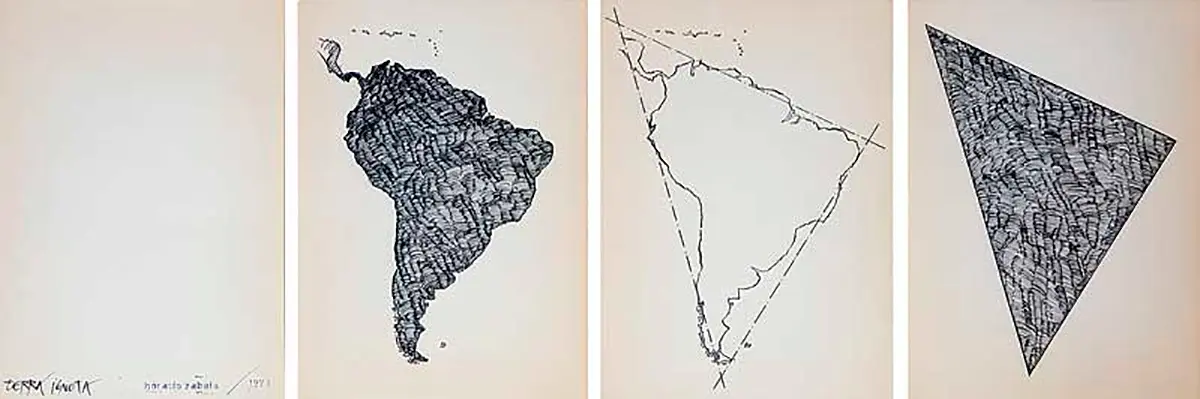
During the 1970s the digital era began to make its presence felt. Artists would write, keep notes on paper, and correspond by mail. The video began to leave its mark as well. Many artists had steady jobs—bureaucratic or professional—and would incorporate the letterhead papers of the business they worked for in some of their series. The works from the 1970s are contained in one of the exhibition rooms. They are small works, most of them consisting of several pages—polyptych of four sections. A panoramic gaze of the room reveals the thematic preponderance of maps rendered with pencil, ink, or acrylic painting; printed and burnt maps, handwritten texts on burnt paper. While most of the works are two-dimensional, some show reliefs because of the damage caused by the burning or due to the superimposition of materials. Such is the case of the work titled Seis Imágenes del Fragmento 30 (Argentina) III (Six Images from Fragment 30 [Argentina] III), and Combustión (Combustion), both from 1973. This diptych contains fragment 30 of Heraclitus hand-written by Zabala. Also from this period is the work titled Terra Ignota (Unknown Land), ink on paper polyptych also from 1973, in which the artist saturates with graphics two of four maps of South America. The left map—absent—contains the data and a seal with the name of the artist. It evokes the disappeared—the accumulating deaths. The other three maps drown, cover, and enclose the continental mass inside the frame of expanding dictatorships. From the world of censorship, repeatedly appropriated in several periods of history, Zabala gives us Le Monde Censurado (Le Monde Censored) of 1983 and 1996 and other periodicals. These works address something that just by being mentioned is immediately understood and, sadly, is repeated in several geographies. There are also the inverted pages of The Wall Street Journal, a right-wing business newspaper. There, one can read about successive devaluations and social pressures; the other two ailments affect Latin America. I conclude with a vote of confidence for the inhabitants of these histories who, like Horacio Zabala, demonstrate their ability to resist and determination to focus on creation.