
If I close my eyes, I can still smell the blue-green freshness of an enchanted place called Inhotim. Yes, Inhotim, a word that in the contemporary art circuit has become synonymous with abundance and which, pronounced by an inhabitant of these remote landscapes at the heart of Brazil, sounds like music.
Inhotim is the contemporary art collection amassed by Bernardo Paz, the Brazilian mining magnate. Like all collections, it begins with eccentricities that make it unique. The particularity of Paz’s collections resides in the fact that it has been created with the intent of populating its owner’s hacienda, space far away from radical urban centers, of difficult access yet an obligatory stop for those who pride themselves in the accumulation of art-center experiences around the world—undoubtedly, one of its greatest charms as well. Inhotim is located in the Brumadinho municipality, 60 Km south of Belo Horizonte, the capital of the state of Minas Gerais. A sertão region 1 that in the Nineteenth Century was mostly a mining settlement. The name of the place is not related to any of its particular features, but derives from a nickname: “Senhor Tim”, as the mining boss at the time, a Briton named Timothy, was known. Over time, it became “Nhô Tim” or “Inhô Tim”; the land of Inhotim, a singular point of origin for a space that has become, today, the most exalted and coveted point of pilgrimage for art agents the world over.
At some point in the late 1990s, Mr. Paz made the decision of embarking on a quixotic quest: to transform his already important contemporary art collection into a cultural institution, to be opened to the public progressively starting in 2006. Paz, the current owner of “Senhor Tim’s” land, is a man of European descent and 61 years of age, and the figure he cuts would not be miscast as Zeus in a Latin version of Clash of the Titans; it is perhaps from there that his nickname comes: “The Emperor of Inhotim,” as he was dubbed on the special supplement Americas of The New York Times. 2 His vision was to transform an arid land into an oasis for art. Two years have passed since I visited that oasis, and the remembrance of what I found in the land of this contemporary emperor has not faded.
The team that would be responsible for organizing these ideas and gives concrete shape to the unique project was formed in 2004. Three curators were hired to deal with the collection, artists, gallery people, and, of course, the most important character, the collector himself. The group is led by Allan Schwartzman, American, and includes Jochen Volz, from Germany, and Rodrigo Moura, from Brazil. According to documents published by the cultural complex, the constitution of this triad has to do with the reach of connections established by Brazilian art with the global scene, and the idea is to provide a stage for the most relevant names in contemporary art from 1960 to unfold their magnificence without constraints or cost-shaving. Another specific appeal of this space, and at the same time one of its major obstacles, is the seeming lack of budgetary limitations as far as current levels of investment go.
In the interview given to The New York Times, Paz made clear where his true interest lies. “I don’t consider myself passionate for art. But gardens, that’s what I like,” he declared. Inhotim is really a unique botanical center, managed like an imperial garden that combines lake topographies with organic sectors of endemic vegetation, with an Amazonian saturation on a par with the most exquisite gardens built through the ages. A botanical park, with an exuberant collection of more than 1,400 palm-tree species—the largest such assemblage in the world—and the preservation of many others. The site’s organic aesthetics started with the plans drawn by Roberto Burle Marx (1909-1994), also a visual artist, the father of modern Latin American landscape architecture and one of the world’s greatest green architects, who visited the property in 1984 in order to bring his projects in line with the place’s geographical features. The garden is Inhotim, the unequaled masterpiece of this collection, where the collector is at the same time the maker—thus reasserting one of the major tenets of the collecting enterprise: “to collect is to create.” The property where this myth is recreated currently comprises 5,000 hectares.
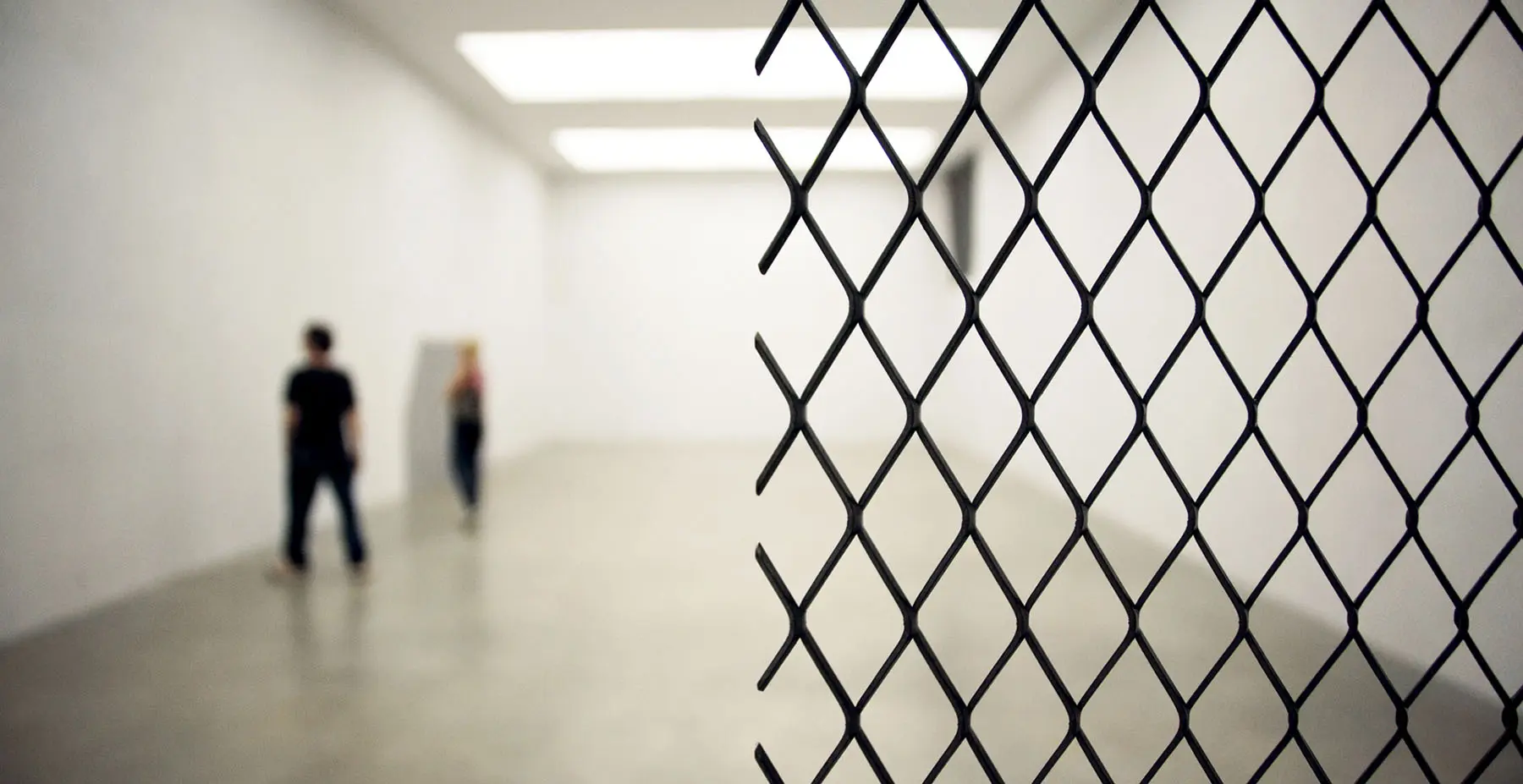
I heard formally of this place in 2009. It was at a lecture by Colombian artist Doris Salcedo, who described Inhotim by comparing it to Dia: Beacon—a comparison where, without getting into the details, let’s say that the US collection did not come out on top. Since then, and with a certain familiarity with Dia: Beacon (as I am a declared admirer of its cultural policies above those of any other collection, public or otherwise, I have known), I developed an obsession with visiting “the most important site ever projected for contemporary art,” as Salcedo put it on that occasion. Perhaps the sole similarity between Inhotim and Dia: Beacon is that both are majestic art collections located outside powerful urban centers, save the fact that Dia is easily accessible from New York City, and that Inhotim commissions artwork specifically planned for the site directly from the artists. One must note that Inhotim holds in its collection one of Salcedo’s most ambitious works: Neither, a site-specific installation where forged fences with vertical rhomboid motifs are embedded into the drywall that covers the building like a skin, generating a disquieting visual interplay that posits questions about the way we relate with one another. In turn, the installation of this work generated a specific site within the collection once it was acquired by the curators from the White Cube gallery in London, after its first and only commercial exhibition in 2004. To achieve this, Salcedo worked with architect Paula Zasnicoff Cardoso, who also worked with Matthew Barney in another one of the collection’s mega-projects.
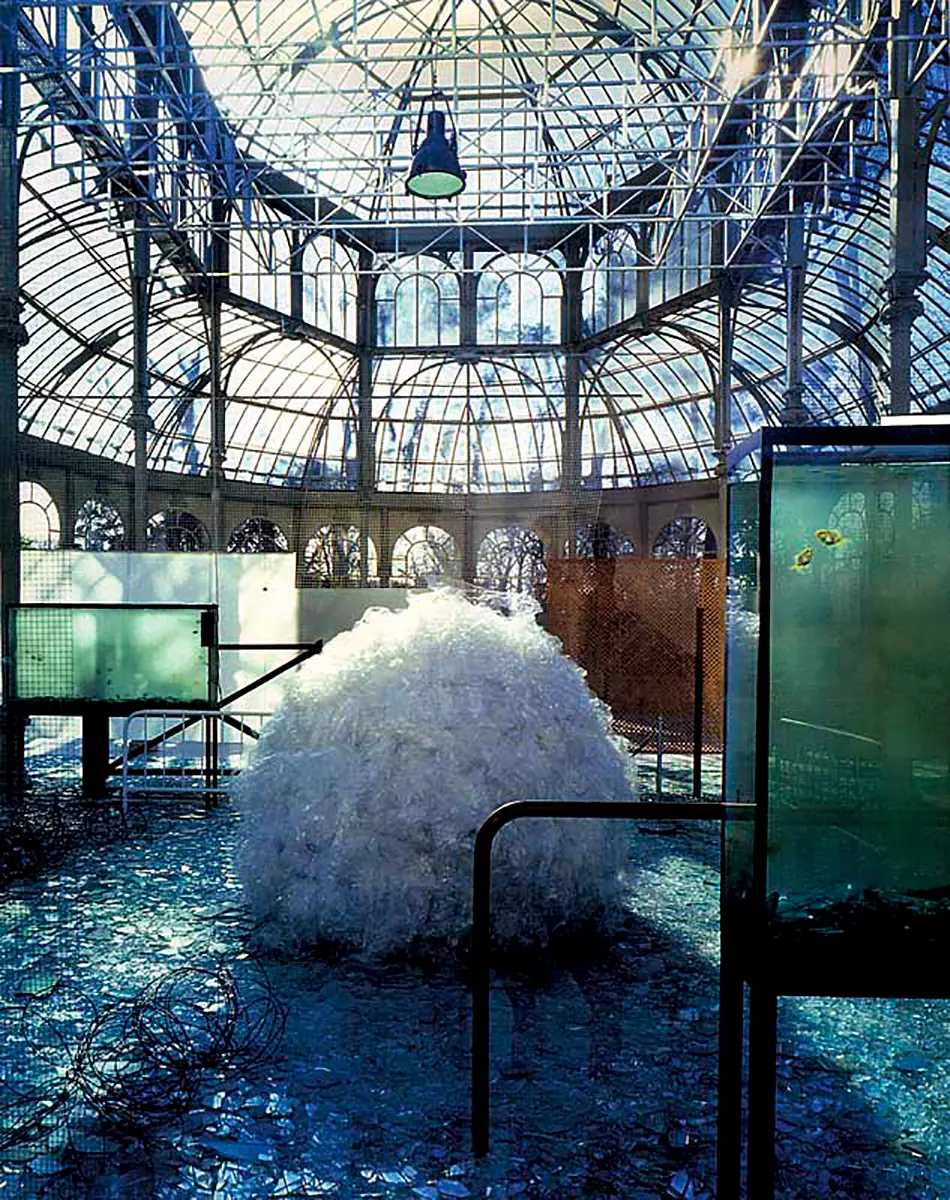
Salcedo’s work was reproduced following the artist’s instructions after its initial installation. Without setting aside a single detail, Neither seems to have been tele-transported from London to Mr. Paz’s hacienda. As one exits the center of the property, just leaving behind one of the several five-fork restaurants that service the complex, Salcedo’s work is located on a hill that crowns the path and borders a lake. To the left one can see one of the first pavilions, built for Tunga’s True Rouge installation in 1997. The buildings are majestic and perfectly proportioned for viewers to appreciate each work in great comfort, as if in their own home. The silence of the forest is rather eloquent, and it is accentuated even more among the Pharaonic formats of the buildings in question, which resemble the Taj Mahal or the Mausoleum at Halicarnassus. Perhaps this has to do with something Mr. Paz has said about his intention to make this a place for transcendence. ‘This is a project to last 1,000 years”, he declared, biblically, in his interview with the Times.
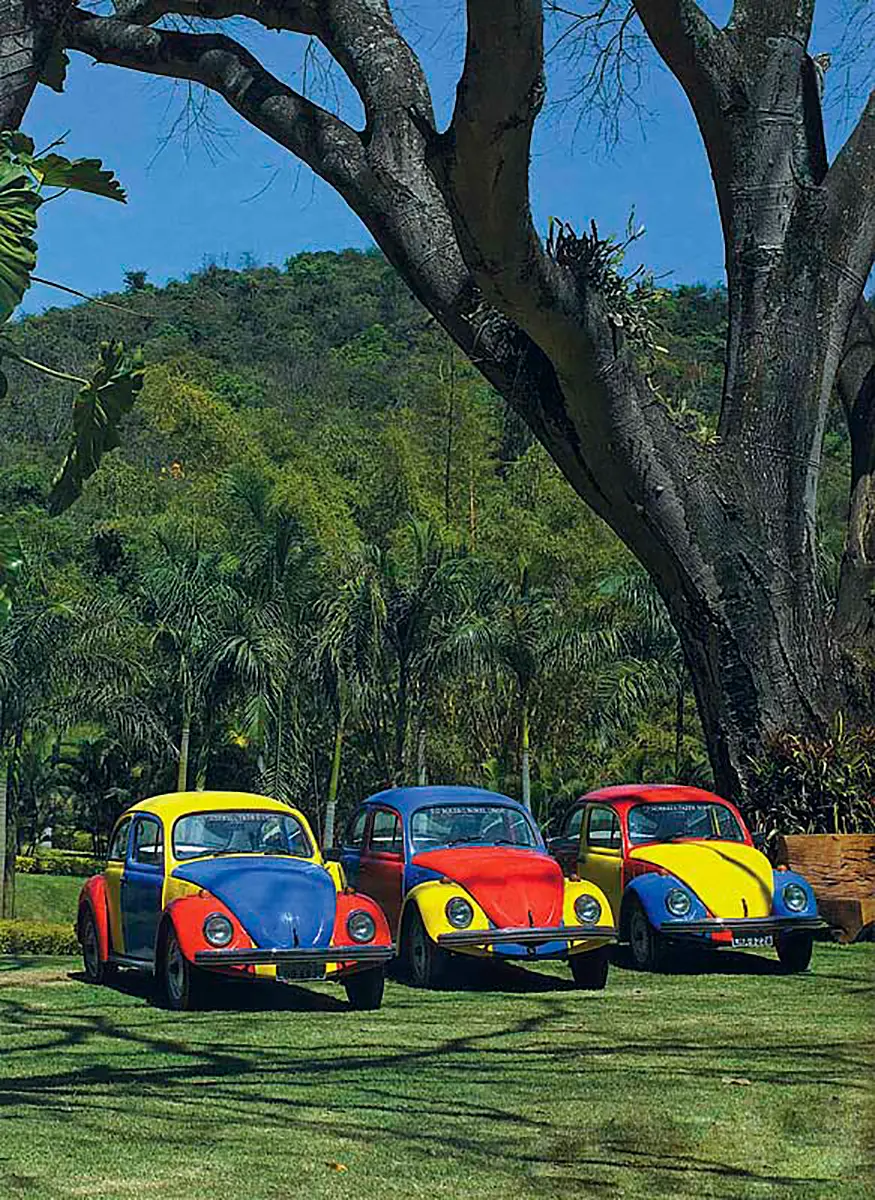
In terms of art museography, the emphasis is on the 17 galleries or pavilions; to them, we must add the 24 works placed out in the open—not all of them necessarily stationary, as is the case with Troca-troca (2002), by Jarbas Lopes, an interactive work that uses three Volkswagen vehicles to make cultural-promotion announcements in the area around Inhotim. As Mr. Paz declared, this complex has space for another 2,000 works of art, to be complemented in the near future with the construction of an amphitheater with the capacity for 15,000 individuals, hotel furniture, and also the construction of loft-like lodging for those who want the experience of being part of a large-scale collection.
Inhotim’s dominant aesthetic is clinical: there is extreme asepsis, despite the rural location. Such order reminds us of the Catholic tenet that man’s work is the domination of nature for his benefit. It is an environment of absolute, absurd control. Yet, this principle contrasts with the rhizomatic character of the many paths that can be taken, visitors can wander as they please, with the exception of the walkway that reaches Mr. Paz’s residence; otherwise, the entire complex can be freely traversed. The size of the park is significant and must be taken into account as a visit is planned, as a single day is not enough to take in all the buildings (to date, 17 galleries, with spaces for individual and group shows).
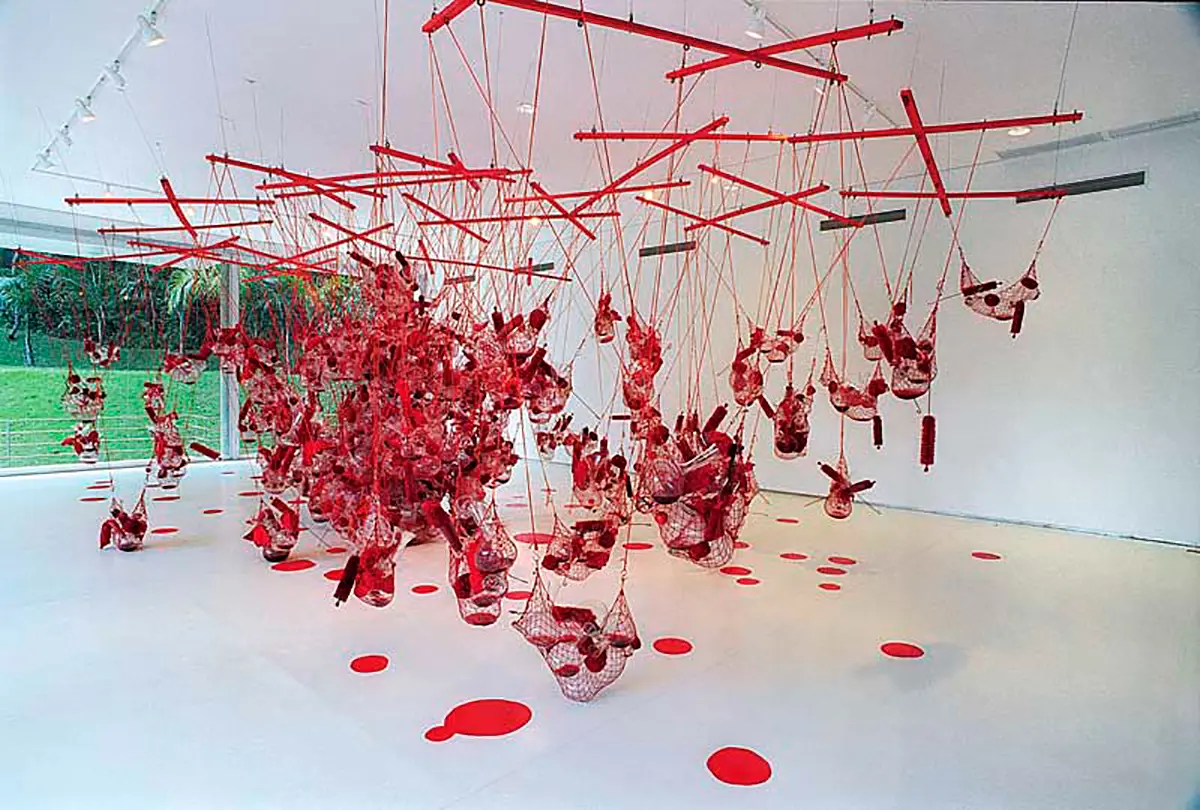
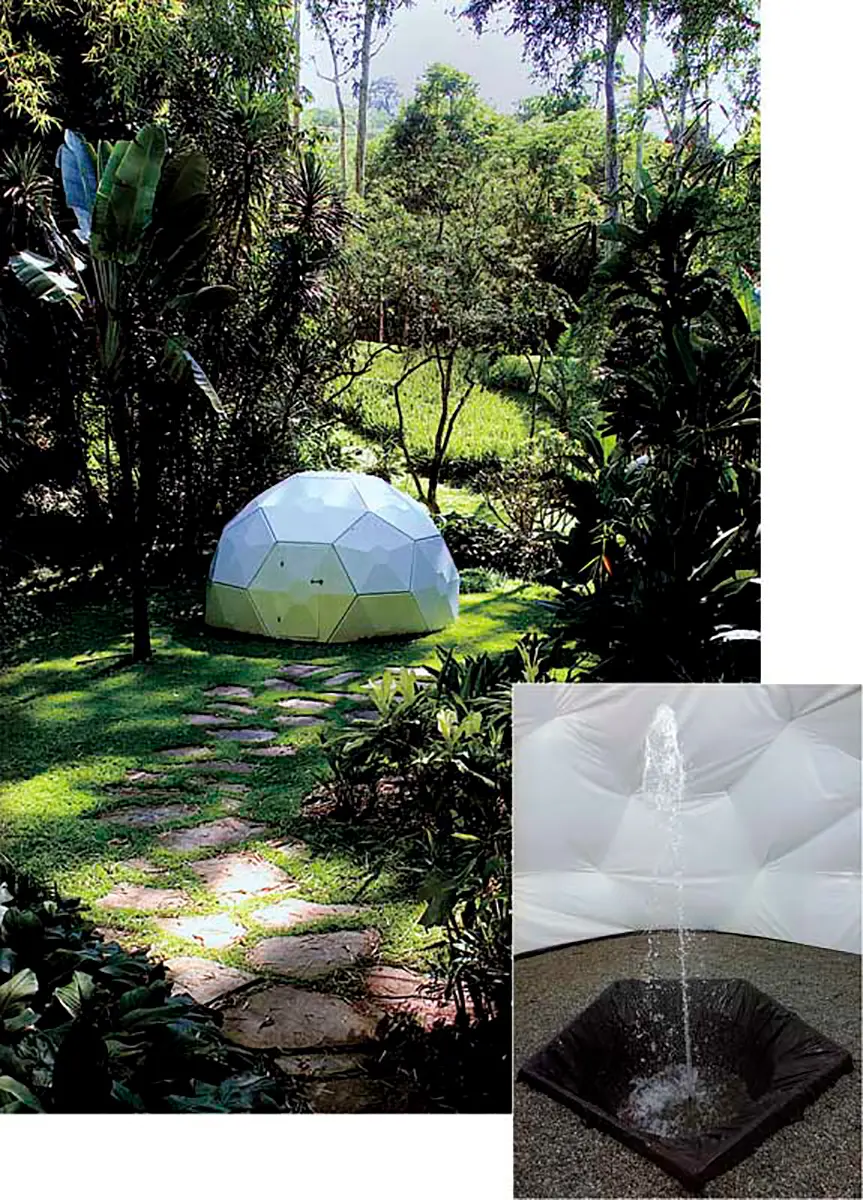
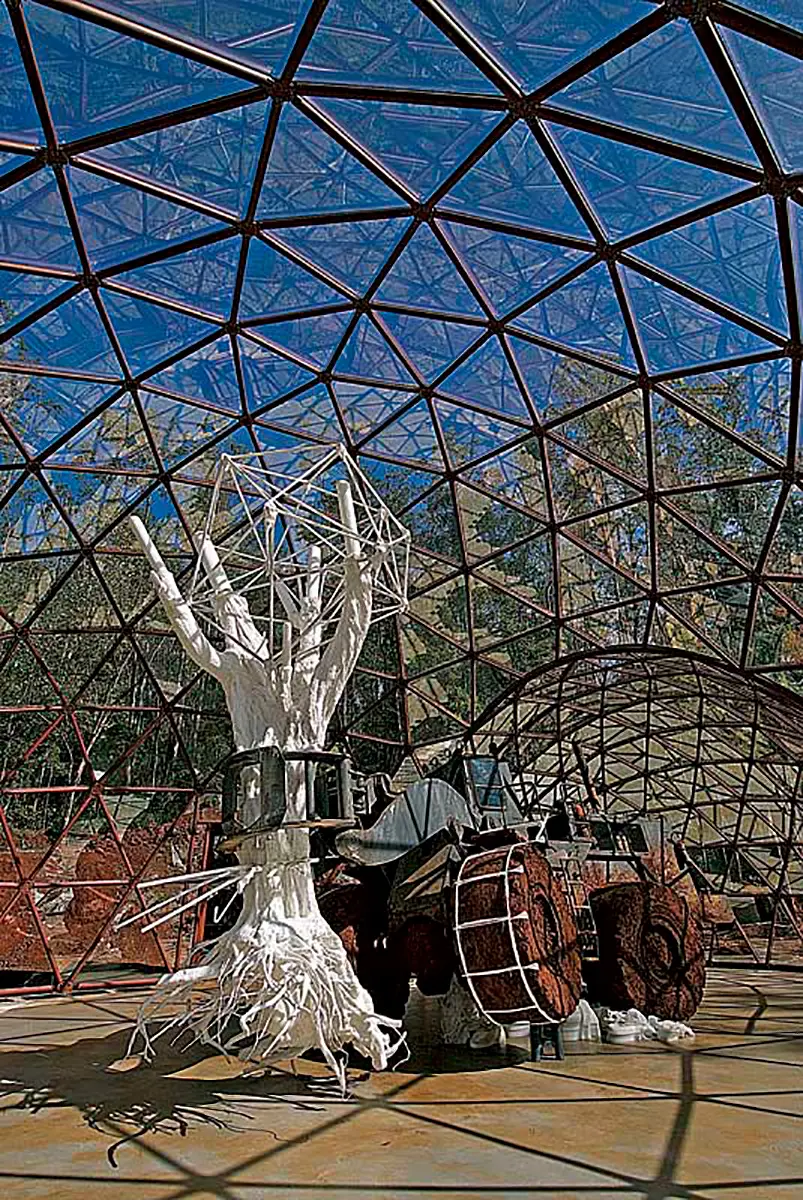
It would be beyond the scope of this article to review in detail the works in the collection according to their aesthetic or commercial value, or their unique significance. In the first instance, the collection represents a notable selection of Brazilian art, with the presence of Hélio Oiticica, Tunga, and Cildo Meireles as its highlights. At the international level, it is fascinating to encounter a Matthew Barney work embedded in the rainforest, where a de-foresting tractor holds the dummy of a tree in white polyester resin and parades it around Salvador de Bahía in a performance sponsored by Mr. Paz some time ago; Doug Aitken’s Sonic Pavilion (2009), a polarized glass rotunda that lets us hear the sounds of the earth, with a hole right at the center of the construction producing voices that are buried 200 meters under the surface; or Olafur Eliasson, so far from home, with an icosahedron-shaped construction that brings to mind the igloos used by the Inuit people, inside which a water source is frozen as a strobe is triggered. What was most difficult for me to understand were the dimensions handled by the artists, if we take into account that any limitation occurs in the context of a seeming absence of limits. The question doesn’t wait: How restrained should an artist be in the planning of a commissioned site-specific work when resources appear endless, in order to avoid falling into the pitfalls of excess or creating a monster on the basis of his or her most pernicious aspirations? Who is, in the end, the artist reflected in these unsettling “mausoleums”? How will this space and these works be read once Mr. Paz’s 1,000 years have passed?
The collection in question is extremely heterogeneous and focuses on two large taxonomic bodies: art and plants. Its thematic and formal cohesion is determined, in most cases, by the relationship between the works and the natural environment, a reassertion of the fact that what really dominates here is the tamed natural space; in sum, what we have here is a botanical garden thematized by contemporary art. The selection of artists and works seeks to balance the presence of local names and international ones, albeit the number of Brazilian artists is larger than the number of foreigners.
The site is certainly excessive on all fronts; it is, if you will, outrageous. The beauty it contains can reach into the logic of the monstrous. Toni Negri defines beauty as a principle of the “surplus of being,” 3 where this surplus is always in equilibrium with the bearable, first for the being of the res, which is to say, the essence of the beautiful thing, and then, bearable for those who relate to the things that are being labeled “beautiful.” What is plausible in the end is the social consciousness that envelops the project in its entire existential dimension, present in the programs that seek cultural intermediation with a variety of publics, with special emphasis on populations adjacent to the cultural complex known today as Inhotim—Institute of Contemporary Art and Botanical Garden. Among its lines of action, the most relevant is the one titled “Inclusion and Citizenship,” which works toward development in the region and is accompanied by the ‘Educational’ front. Where the academic agenda is defined with projection into the community and visitors in general. In a yearly operation reaching between US$60 and US$70 million, coming almost in their entirety from Mr. Paz’s companies, Inhotim employs some 1,000 people between technicians, biologists, gardeners, art agents, mediators, and, of course, contraction agents. In 2011, close to 250,000 visitors were reported, a very significant number if one takes into account the distance from any well-populated urban center. Admission per person is US$20 on Wednesdays and Thursdays, US$28 Friday through Sunday, and on holidays. Tuesdays, admission is free. This reflects a system concerned with self-sustainability, although it is clear that admission payments will never suffice to cover the maintenance costs the organization must incur. Works produced in and for Inhotim pose unprecedented conservation challenges.
The collection’s time is on one side of the scale; on the other are the works’ maintenance costs as well as those associated with the landscape, all of which imply a well-exercised, long-range financial muscle. I cannot even imagine what would become of this place without the resources it currently has at its disposal to sustain its achievement… perhaps a contemporary ruin on a par with its past specter.
Inhotim is an institution that has assumed the responsibility of its present and its presence in a formerly marginal space of Brazilian geography. This is precisely what marks the difference between a private collection, geared only towards its collector’s enjoyment, and one that is open to the public: its responsibility towards the rights of those who have made possible the myth of contemporary society. Such is in the end the great challenge facing an institution that reformulated the meaning of the name Inhotim, a place forged by the memory of miners of the past and the life of their families. It bears noting that every collection starts on a whim and that another whim could mean its end. Here, however, there is no going back: once a collection opens itself to the public, it becomes the responsibility of all involved to see that its legacy remains active and continues to tell its story.
NOTES
1. The Sertão consists mostly of semi-arid, low hills that are part of the Brazilian Plateau. Most of the Sertão region is located between 200 and 500 meters above sea level, and it is very difficult to handle in agricultural terms.
2.http://www.nytimes.com/2012/03/10/world/americas/bernardo-pazs-inhotim-is-vast-garden-of-art.html
3. Negri, Toni. Arte y Multitud. Carta sobre la belleza. Ed. Trota. 2000.
* All the photos are from Inhotim Collection, Brazil, courtesy of Instituto Inhotim, Brazil.
OSCAR ROLDÁN ALZATE
Curator and Political Scientist.