
Visual representations of subversive, chaotic, damaging, or deadly events have been the favorite themes of many artists throughout the history of art. The final aspect of several fatal events is approached from an aesthetical perspective and remains as a vestige of “the day after.” Painting stays as an instant frozen in time—captured by the photographic camera—even if such an image also generates a narrative full of possible “before the” variables as well as other possible “after the” variables.
Alles Kaputt, “everything is destroyed,” or “everything has been abandoned,” is the name of the series of paintings and drawings by Mexican artist Javier Areán (México City, 1969), presented at the Toca Galería in Mexico City. The central theme in the series addresses disasters after the fact—mostly natural or accidental—and generally involving automobiles. The works are based on photographs from the 1950s, and are reminiscent of Andy Warhol’s work but rendered in a markedly post-expressionist style. In other words, it is not the crude facial expressions or the few characters that circle around the accident; or the acidity of the colors that render the human flesh, the skies, and the natural landscape—typical in German art—that stands out in Areán’s images. Nor are the violent neo-expressionists' brushstrokes from the 1980s. Areán resorts to a certain type of perceptibility that belongs to impressionism, but is tinted by a romanticism that responds to the impressive beauty of the landscape. And there is another element: the possibility of reading the work as if it was a video that tells a story. This third element makes Alles Kaputt a series that can be identified with a new kind of expressionism—although his work is also clearly influenced by the prototypical expressionist movements.
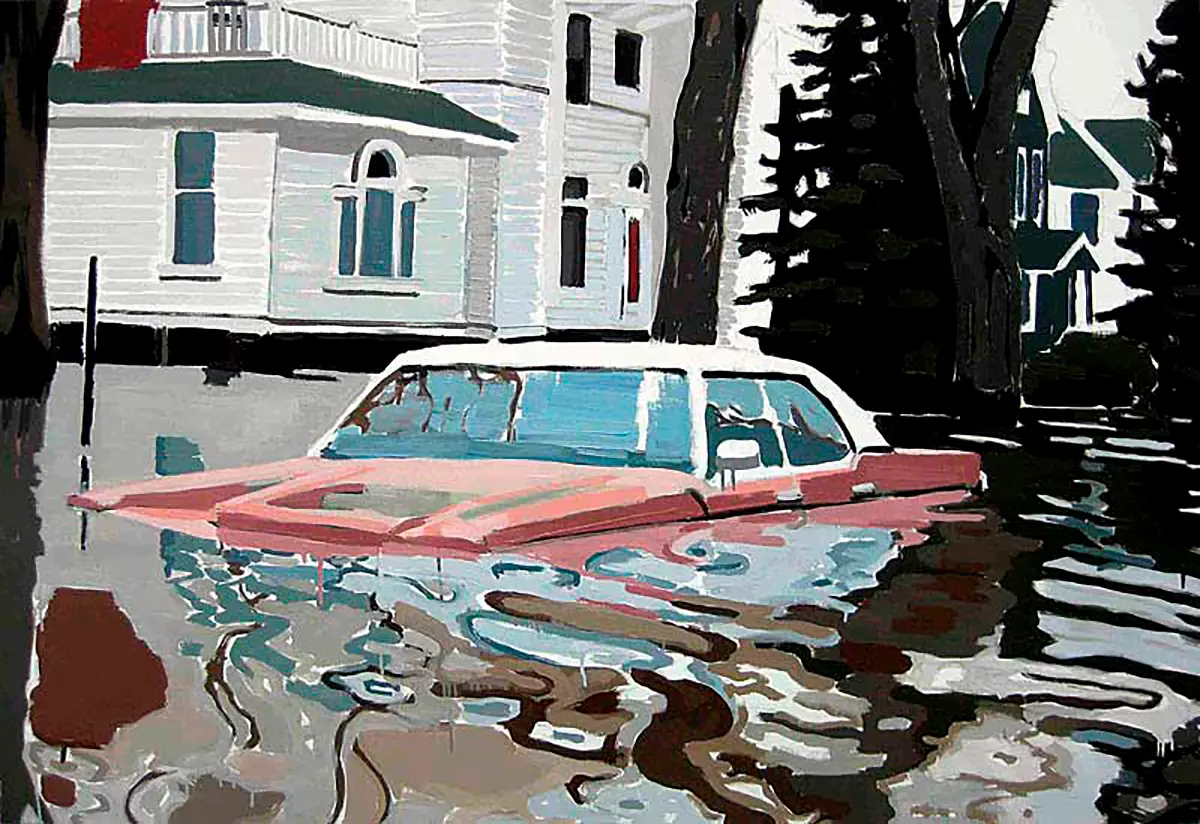
The word “catastrophe” comes from the Greek kata—down, against—and stréphein—I turn—in other words, to blend, to overturn, and also: disaster, disorder, misfortune. Formally, the large paintings in Alles Kaputt can be interpreted as the representation of natural disasters and their consequences on crashed, turnover, and rickety cars. A second reading would refer to a catastrophe that has occurred in the literal sense of the word: to turn downwards. And in this sense, the pieces blend their content and reveal a fragment of reality that, decontextualized from its temporality and place, is perceived as an aesthetic experience. There is no morbidity in its beauty, although it is convulsive in the Bretonian sense of the word: to move, to incite, to provoke, to stimulate. The combination of the elements Areán draws on paper or canvas, in addition to the black tones or lively colors of his oils, results in a series that is not limited to the narration of an event or to the recount of an anecdote, but one that is instead immersed in the deepest layer of the surface, of the skin, where the veiled truths can be found; there, Areán extracts the sublime and presents the result of a catharsis transfigured into a work of art. From a fortuitous event, he creates an image that begins where the artist fixed his gaze, and the sensations, thoughts, perceptions, and knowledge engage in a process of final delight.
Whether it is the countryside, amid the pastures and under a clear sky, or buried in the frozen snow, Areán’s cars appear as anemic entities caught in a terrible moment. Nonetheless, such misfortune does not appear to be eternal. The frozen landscape, the rundown houses, or the warnings about the proximity of a storm, are elements that are part of the surroundings near the car and do not take away from the main figure immersed in its transitory metamorphosis. It is not a dead car condemned to be totaled, but rather one that has suffered a setback and is about to begin the process of fully recovering its form and function. A surprising aspect in the images by this artist is that, while the cars acquire certain human-like qualities, the landscapes on the other hand appear inert, staged, and artificial, like replicas created to frame the scene of the accident.
Only rarely do human beings appear in Areán’s images. And when this occurs, like in the work Green Crash, the only purpose they serve is to witness the damage suffered by the car. More often than not, the scene feels as if it has been abandoned, like in the case of the Coche en Nieve (Car in Snow) series. There are other examples with simple titles like Coche Gris (Grey Car), Coche en Picada (Car Plummeting), Tres Coches (Three Cars), etc. Noteworthy among other works is the painting Desastre (Disaster). There, an inundated pink Chevrolet became one of the victims of Hurricane Katrina. The vehicle appears to be patiently waiting to be rescued with resigned eyes and the outline of a Giaconda-like smile. Its makeup remains almost intact and the nicely kept hair will soon disappear. The water is calm and a large wooden house appears in the background next to a group of trees with all of their branches perfectly still. The Chevrolet is not a witness to other scenes where the sun may illuminate dilapidated uprooted homes that have become part of a pile of rubble. Not so, in this instance, the car’s surroundings are peaceful because the horrible event is already over.
LUZ SEPÚLVEDA