
With more than 40 solo exhibitions under his belt, José Tola presents yet another one entitled Born from so Many Deaths. According to Tola, he decided to give this name to the exhibition because “we come from so many deaths and from so many deaths we are born; or, in a more personal sense, the succession of our experiences eventually ‘die’ but through them, we are able to be ‘reborn’ into the flow of our existence. These experiences that allow us to ‘remain’ are the undercurrent of the exhibition and the background of each of the works included in it.”1 Thus, according to Tola’s philosophy, each day represents a new rebirth. His work immediately impresses viewers because of the emotions bared by the artist.
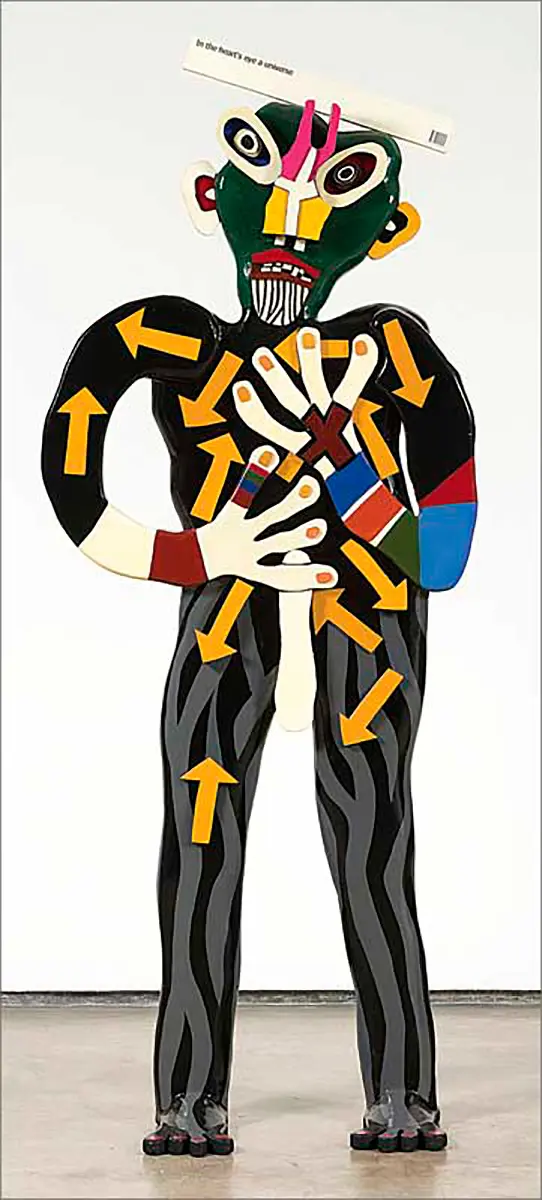
The characters in his work are deformed, with eyes in several positions, flat or grotesquely large noses, and mouths that are often represented horizontally with well-defined lips and straight teeth. The arms sometimes are missing the elbows and the hands only have four fingers. There is an air of decay in the subjects, but not of death, as these are deformed people who are nonetheless very much alive; many times immersed in activities that are not easy to understand, thus conferring the images with a mystery and leaving viewers thinking about the images well after they had seen them. Tola’s work is very much in the vein of the movement Art Brut or Marginal art.
There are two characters in the work titled Siempre Tuve Todos tus Sueños en mi Vigilia sin Poder Dormir (I Always Had All of Your Dreams During my Vigils without Being Able to Sleep), a man on the left—recognizable for his beard, a nose longer on one side, equally asymmetrical nasal orifices, and a nose very close to the mouth. One eye is also higher than the other and in different positions. This man has no forehead or hair, and the only hair he does have comes from the upper part of his left eye. The other subject is a woman, and she can be recognized as such because of the two bracelets that she is wearing. One of her harms appears to be pulling one of the man’s arms. She also does not have hair and her almost perpendicular eyes adorn a rather bitter face. Viewers are not quite sure what is going on. The only recognizable elements are these characters. Nonetheless, art is essentially forms and colors, and there is plenty of both in Tola’s art. This artist demonstrates a good combination of colors, forms, patterns, and images.
All of Tola’s images rely on warm colors—greens and blues—and the characters drawn as if by children, confer his images a unique look. The characters are dresses in exquisite clothing. Although Tola uses the deformation of his characters as his main approach, none of his works look like the others. Viewers are able to tell whether the characters are women or men, but they cannot tell what is going on in those images. This creates expectations that confer the works an aura of mystery. Through this easily recognizable visual language, his use of color and form, become the key factors for the success that his work enjoys.
When I asked him what inspired him to create his work, Tola responded “I base my work in the life experiences that I have had throughout my life. Some of them have been pretty powerful, others very dramatic, others yet I have taken from the realm of the ‘subhuman,’ where most marginal people live, right beside an ‘elite’ dedicated to unimaginable consumerism and waste. My images also emerge from personal feelings that are part of my internal world that has increasingly found less common ground with the exterior. My relationship with the exterior has become a rather large gap that has become increasingly more difficult to negotiate and, thus, has led me to a self-imposed exile. From there I do enjoy the occasional visit of friends or other people I like, although such encounters end up worsening my days.”2
In the work titled Tú que Puedes Detener al Mar y al Viento, Detén una Estrella en mi Mano (You Who Can Stop the Sea and the Wind, Stop a Star in My Hand), there is only one character with a twisted arm and a twisted leg in an impossible manner. A hand emerges from the back of the subject but without giving away the owner of this hand—which adds to the mystery. The turquoise color dominates the entire painting and surrounds the white arm of the character. There is a pattern of dark stars on the orange background. There is no perspective or volume, and the background is flat, which raises the viewers’ intrigue. It is actually the image of a supreme being, of a god or of the God, but most importantly, it centers on the power of the human challenge to become great.3 Tola painted the god with a certain degree of delicacy, as his face is not as deformed as the rest of the characters. Although none of the works display any symmetry, they do achieve a balance of colors and spaces.
When I asked Tola to tell me the reason behind the idea of making deformed figures, he responded the following: “These ‘monsters’ or however one wishes to call them, are characters that populate my reality; beings with which I spend my daily life and who, to me, are better preventatives of the human race. Sometimes, when I get out of my world to pay people like you (from the outside) a visit, I have the disconcerting sensation that your kind belongs to another species altogether; one that is very different from the inhabitants of my world.”4 Each of us lives in our own world and our surrounding. This fact influences what we do and how we do it. The exhibition is completed by 6 sculptures in the shape of men, five standing and one seated. Created with pressed fireboard, the images are then sanded, glazed, and painted with lively forms and colors. The large works measure 2.20 meters and are imposing. The characters of the sculptures are just like those in his paintings but now with the face details rendered in relief.
In some of the works for this exhibition, Tola uses a variety of materials, like diamond dust, cutout photographs, painting reproductions, bronze, copper, or silver leaves. He also attached to one of his works an engraving by Obey. Tola demonstrates that despite not using the same visual language, his work is not repetitive or static, as he is continuously reinventing it.
NOTES
1. Interview with the artist, June 2012.
2. Ibid.
3. Ibid.
4. Ibid.
AUGUSTO CHIMPEN