
Juan Carlos Romero (1931, Argentina) is a renowned artist who still believes in the use of words as instruments and in the visual arts as vehicles for transformation. He cultivates a low profile and works with tangible data that inform his struggle against oblivion and help him determine ideological contents—revealing the social mood and environment of the socio-economic violence in the Argentina of today and always. His book, Tipo / Gráfico (Ediciones Arte-blogarte, Buenos Aires, 2012), published in Spanish and English, includes images and records of actions from the 1960s to the present time and writings by Romero himself with a foreword by Hugo F. Romero (no relation to the artist). The book was published to coincide with the opening of the exhibition of the same name.
The selection of works exhibited allows visitors to assess the communicational value of the pieces and to evaluate the economically made typographic posters created to endure outside conditions with the objective of taking art into the streets. These posters take us back to the beginning of Romero’s artistic production and shed light on the convergence of his militant and artistic practices. His romance with visual art began in 1964 when he was part of a group from the telephone syndicate. Alongside some of his comrades, Romero strived to choose the best “graphic work for electoral advertisements, and then we learned of the existence of typographic presses that reproduced posters on the cheap… So we made three different posters. But we did not win the elections,” affirms Romero.
It was then that Romero learned to love the aroma of ink and the types of wood and paper used during the printing process. Through the years—and the eventual use of several printing techniques—Romero affiliated with several groups and put his artistic skills to their service by participating in visual experiences and collective actions to intervene in the public space, such as gluing posters on city walls. Some of the groups he belonged to included: Grupo de Gráfica Experimental, Arte Gráfico Grupo Buenos Aires, Grupo de los Trece, Grupo Escombros, and Grupo 4 para el 2000; La Mutual Art-gentina and Zucoa Noes. He is currently a member of the Grupo de Artistas Plásticos Solidarios.
Romero has been using conceptual art as a tool for more than 40 years of artistic trajectory, as he predominantly relies on the printed word. He has delved into several graphic approaches and even worked with photography and installation, mail art and visual poetry, experimental engraving, and ephemeral art; artist’s books, performing actions at established cultural institutions and alternative spaces, and even on the street. Before his defining conceptual period, during the first years of his career, Romero created xylographies that generated the illusion of movement, as observed in the work Real /Virtual. Argentinean Kinetic Art during the 1960s was presented at MNBA in Buenos Aires.
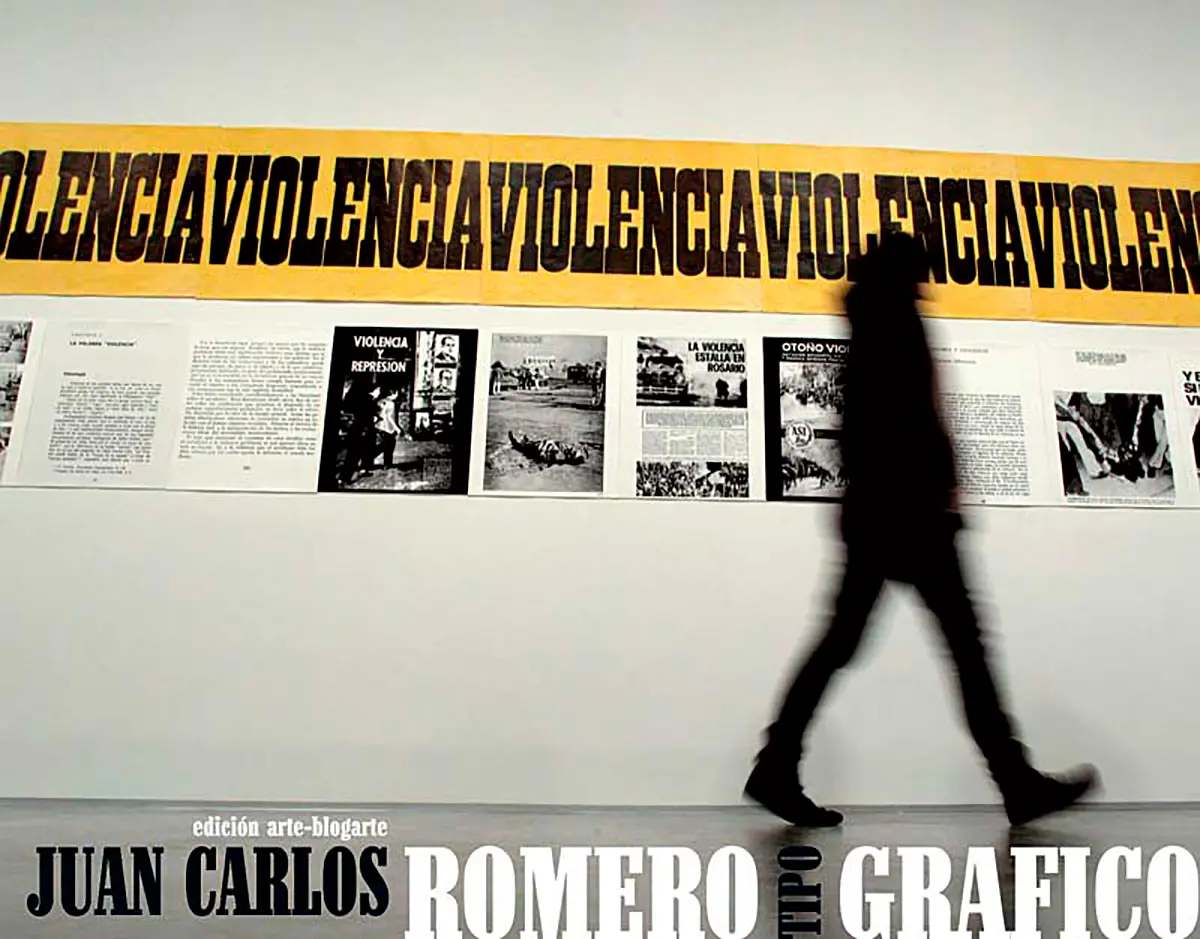
The 1970s finds Argentina immersed in a period of great national upheaval caused by the ending dictatorship of Alejandro Lanusse—who finally leaves power in 1973—the intensification of guerrilla activity, the lethal work by the so-called Triple AAA dead squad, and the return to Argentina and eventual death of Juan Perón. During this time Romero was a member of the Grupo de los Trece and Jorge Glusberg invited him to exhibit his work at Centro de Arte y Comunicación (CAYC) in 1973. There, Romero presented the installation titled Violencia (Violence) and covered the exhibition rooms from top to bottom with repeated posters in large characters that read “VIOLENCIA;” printed press clippings, fragments of writings by other authors, and some photos complete the installation. The exhibition opened at the beginning of 2012 at the Museo Reina Sofía in Madrid.
Aside from expressing Romero’s political conscience, in this initial installation, the artist facilitates the viewer’s immersion into the work and, at the same time, eliminates the artistic object as he installs it in the observer’s perception and places it in the abstract world of ideas.
Both his past and current posters contain the same kind of typography and a very standard and popular character; in color, these resemble those posters that advertise a dance or a fair and that promise drinks and free admission for the ladies. Nonetheless, without any frivolity, the multiple works help Romero to scream the symptoms and to fix the silences, to propose inquiries and to point to truths; to confront the forms of power—also the ones professed by the institution with respect to production, circulation, and reception of the works.
Many of the words used in his posters are borrowed from newspapers. Romero often reveals words that he selects, prints, and photocopies. He borrows words from the mass media and practices a new type of communication—as one can appreciate in his installations with newspapers. The art sets in motion the possibility of manipulating information and, in a spectacular demonstration, turns the operation upside down. By emphasizing words—that come from posters or large advertising signs—Romero restores a language and invents his own agenda of priorities. Thus, he expresses doubts about the different ways of reading, about the always ambiguous meaning of words; and the notions of materiality and intellectual property.
VICTORIA VERLICHAK