
Amidst Europe’s largest visual-arts events and gatherings, coinciding with the almost simultaneous opening of the 7th Berlin Biennale (April 27th) and Documenta Kassel 13 (June 9th), Manifesta 9 was inaugurated on June 2nd in the small Belgian city of Genk, close to the Dutch and German border. Renouncing the appeal of ancient cathedrals or an old district to impress observers, Manifesta chose for its ninth edition the old site of a coal mining operation that flourished in the Limburg province during the industrial period of the Twentieth century. Like the region itself, the city fell into decay once its largest source of employment was closed; now, thanks to this international event, it was once again on the map.
It was obvious that the agenda of Manifesta had changed radically with respect to the previous edition, held in the Spanish cities of Murcia and Cartagena. In complete opposition to its predecessor, which invited three curatorial collectives with differing ways of producing exhibitions and experimental visions of artistic practice, this edition proposed a chief curator who would recover the concept of a traditional art exhibition in a significant space. The risk and complexity of expanding over two cities disappeared, and Genk became the event’s sole site. 1
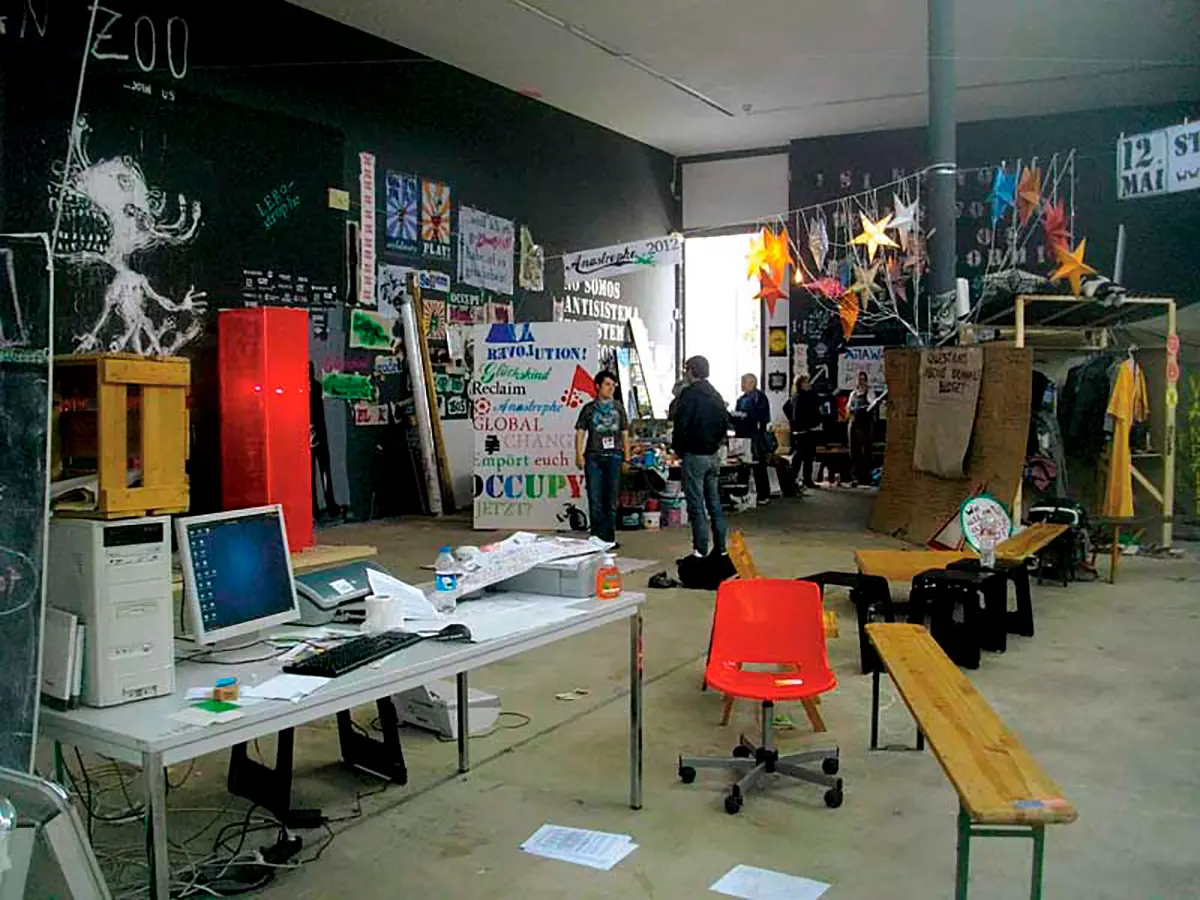
After the controversy that surrounded the eighth Manifesta, one would have expected a greater radicalization, or at least a more militant posture in terms of proposing new curatorial models. But we were not in Berlin, where so many things were happening in parallel to the polemical 7th Biennale with the groups of Occupy Biennale, and where the event’s main site, the KW building, was literally occupied by the aesthetic of billboards and propaganda against hierarchies, capitalism, and institutions.2 Barcelona’s 15-M, Occupy Museums (Occupy Wall Street), and other groups invited by the Polish curator Artur Zmijewski slept, cooked, and held open assemblies that questioned even their own presence inside the secure walls of the art center and demanded horizontality. In contrast, the volunteers of Manifesta and the local public proudly presented visitors with the recovery of their historical past in a prestigious international event. Here, the exhibition unfolded in a seemingly more modest, less spectacular fashion, and the city itself was more discreet. Why such movement towards withdrawal?
Upon arriving at the bus and train station, visitors were interrogated, rather obviously, from the façade of the most visible building: Tú que me lees, ¿estás seguro de entender mi lenguaje? (You who read me, are you sure you understand my language?) 3 The question that emerged most immediately was whether this belonged to Manifesta as a site-specific urban intervention, and, if such was the case, why was it in Spanish, a language perhaps unreadable for the locals? What kind of dialog could be produced by a selection of “contemporary” artworks in that location, so isolated from art-world centers? Later I learned that the intervention was not part of the biennial. It was, nevertheless, relevant, inasmuch as it participated within the expectations created around a cultural event in a much calmer political and cultural context.
The radical polarity between the eighth and ninth editions of Manifesta was, of course, the consequence of two curatorial exercises that differed in their way of deploying exhibitional devices and artworks in the absence of their creators. Mexican curator Cuauhtémoc Medina was chosen over two other candidates in order to give the event a more coherent course, with a solid and convincing proposal to that effect. In a way, the elements of risk and unpredictability that characterized the actions of the Tranzit and The Chamber of Public Secrets collective in the previous edition were eliminated. Did this mean that the project of the biennial as a space for experimentation with new curatorial practices was lost? Or was it perhaps that, given the characteristics of the city selected among those that applied, the directors of Manifesta accommodated themselves to a concept more in tune with the context? Finally, here was in such gatherings of the cultural elite a gamble for the audience and public, rather than for experimentation and political debate. The art show once again became a space for withdrawal and reflection, where objects could converse with each other.
The ninth edition intended to “redirect the course of Manifesta towards a defense of artistic production and historical knowledge as sites for aesthetic and social reflection and for intergenerational responsibility. In that sense, the exhibition reflects the complex mediation of works of art, images, historical information, and cultural institutions in the production of modern and post-industrial ways of thinking.”4 This statement went precisely to the point of Medina’s curatorial exercise; it was a sophisticated academic lesson and a complex staging, self-contained, and free of unpredictability. This includes the catalog, an editorial effort conceived like an encyclopedia that defined philosophical concepts set forth by today’s theory and contextualized them in their origin, alongside descriptions of the works and artists included. As a whole, the biennial functioned as a magnetic unit around its large topic.
The city of Genk was the pretext for a reflection about the relevance of modernity as a legacy of the Twentieth century, and the need to consider the context in which art is produced today. As theme and leitmotiv, the title of the exhibition, The Deep of the Modern, was, in reality, Medina’s statement of intention, a site-specific curatorial exercise that deployed artworks to present a thesis rather than using concrete locations in the city as spaces for intervention. Citing Gramsci and clearly outlining his ideological posture in the introduction to the catalog, Medina defended the idea that both the organization of an art show and the biennial itself are exercises in cultural production that correspond to processes that intervene on imaginary and discursive fields. The work of art is immanent to its history and it functions in the structuring and restructuring of particular hegemonies. 5 The defense of art as an individual exercise, independent of any commitment to historical realities, is a fallacy; or, as posited by Zmijewski, the curator of the Berlin Biennale, the apolitical artist doesn’t exist. 6
Alongside guest curators, Katerina Gregos (Greece) and Dawn Ades (Great Britain), the latter instrumental in the development of the historical section, a large portion of the exhibition was devoted to connecting the history of industrial development in cities like Genk as an example of the “infrastructure” on which certain modern artistic practices emerged to mold the sensibility and the scene of the Central European region. How can the capitalist economy of the growth of these cities and their culture, now dying, be reinvented within the new dynamics of global capitalism? And how can the memory of that experience endure in such a way as to, avoiding nostalgia, ensure that it is not obliterated by the speed at which the new fluid and ambiguous global dynamics of wealth production are generating another Europe?
Centralized in a single space, the Waterschei, a 24,000-square-meter building that was part of the coal mining operation in Limburg province, became the main stage for “local” production in the area—this time around, the production of a different kind of wealth in order to reemerge from oblivion and industrial blight. The building was a metaphor or a memorial of how the economy and development of today’s post-industrial Europe rests on the foundations of what we see as the ruins of the recent past. And, in case this was not sufficiently evident already, the exhibition The Deep of the Modern divided the levels/floors into broad curatorial asides: I Poetics of Restructuring; II The Age of Coal; III 17 Tons.
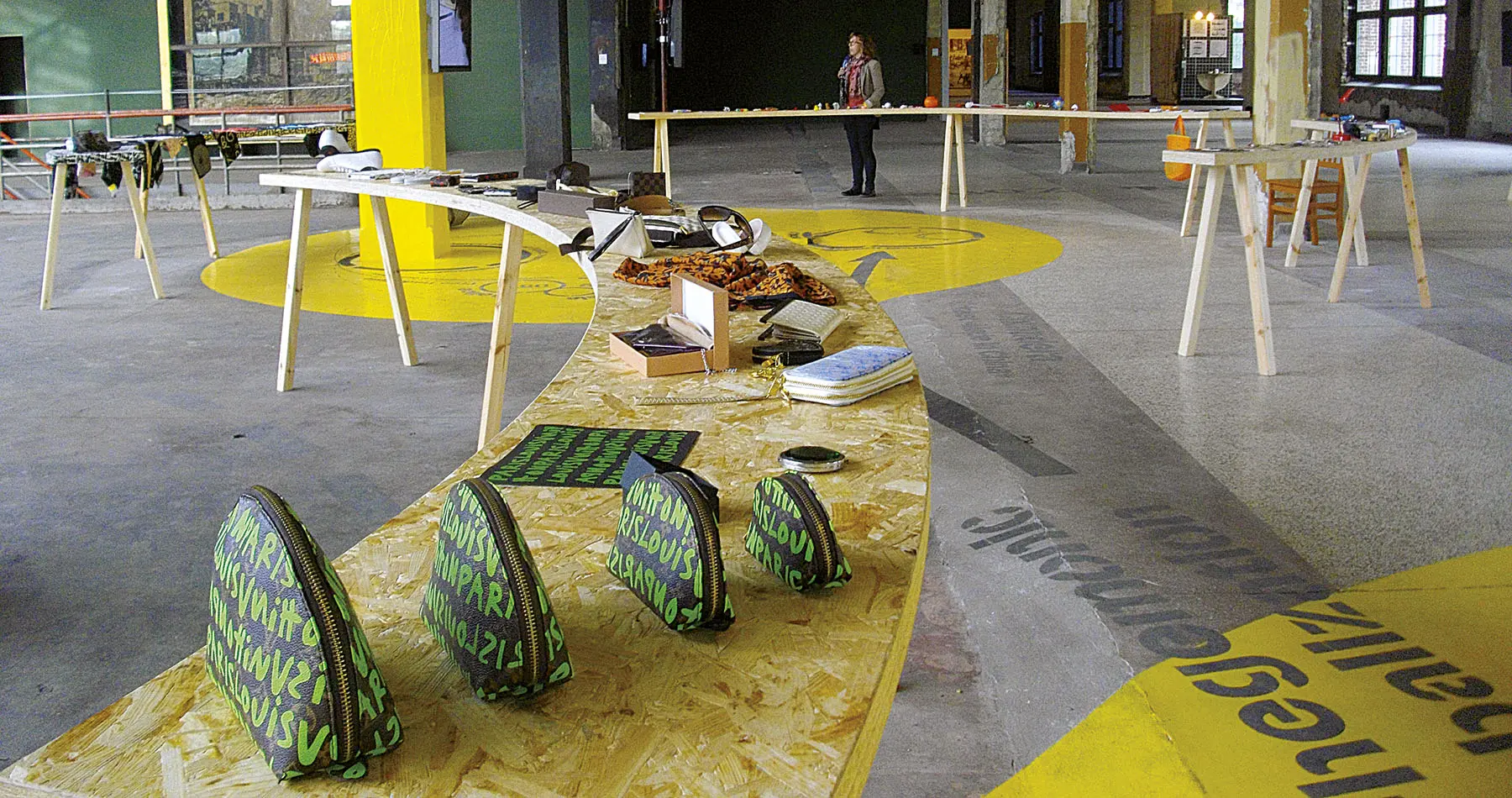
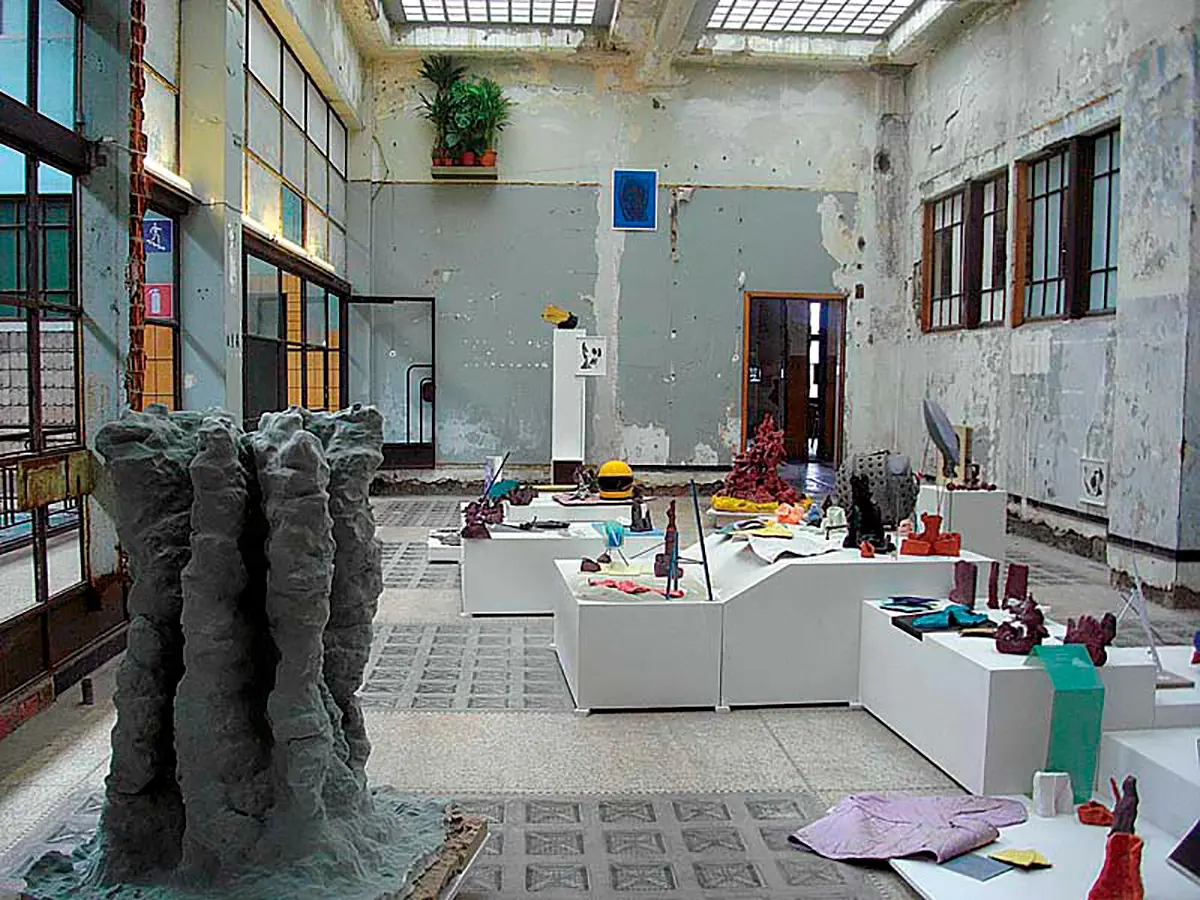
I Poetics of Restructuring included mostly recent works and had artists who are not circulated broadly in the biennial circuit interact and dialog with others who are better known. Arranged on the top floor, in an open space of the industrial building that had been conditioned without major changes or paint to cover the condition of the recently recovered building, this section held installations, videos, drawings, photographs, and paintings. The central topic pointed mainly towards a reflection around the dynamics of capitalism in their new global phase, relationships of production, migration, the interaction of large corporations, the flow of capital in search of cheaper labor in societies that are still in the industrialization stage. These topics were evident in Chinaafrica, a photographic series by Paolo Woods, from the Netherlands. In turn, Capitalismo Amarillo: Special Economic Zone, a multimedia installation by Mexico-based Spanish artist Jota Izquierdo “analyzed” the global phenomenon of the massive invasion of cheap products and fake brands originating in China and flooding the market, the flow of its production, and marketing in the streets and small shops in Mexico and Spain. Appropriating the corporate design of fairs with tables made of cheap materials, typographies, and videos, it showed the merchandise and its “commercialization.” In contrast and in parallel inside the same space, Work in the Dark (2012), by Ben Cain, from England, unfurled mobile devices, perfectly shaped geometric figures, machines that activated panels, an entire industry of fantastic and useless objects that echoed Europe’s post-industrial economic ideal of “clean” development, without detritus or pollution. An anthropological-futuristic interpretation of industrial societies and of the past was offered by the multi-installation A Little Larger than the Entire Universe (2012), by Berlin-based Turkish artist Emre Hùner, an unfolding of modern culture and its archaeological recuperation through fragments, strange sculptural shapes, pieces, detritus of materials from the supposed city founded by Henry Ford in the Amazon rainforest in 1928.
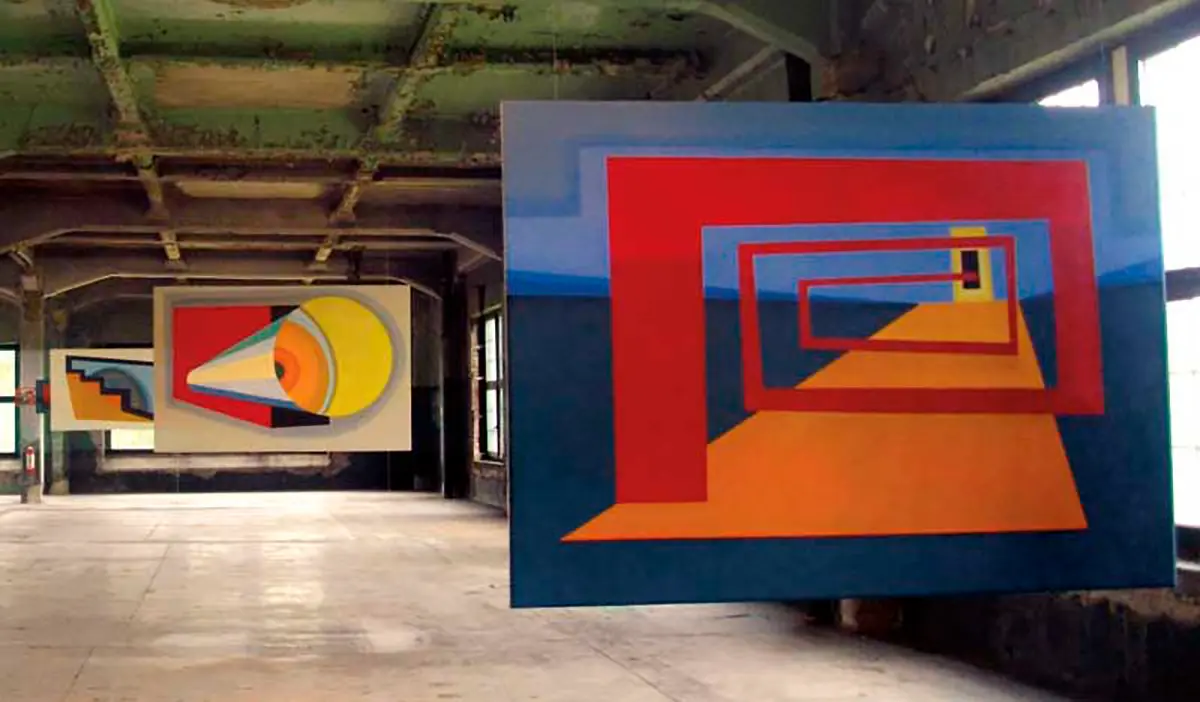
With the Twentieth Century and the epic confrontation of two dominant political-economic systems already behind us, the inclusion of Revolutionary Life (2012), an installation by Argentine artist Magdalena Jitrik, could be interpreted as a need to return to the critical philosophical position that characterized Modernity. Jitrik combined abstract paintings (the modernist ideal of the independence of the work of art and the revolutionary art of the Russian Avant-Garde) with a mural of realist comic- and propaganda-like drawings in a style so much in fashion today, and speculated apocryphally about an epistolary exchange between Belgian writer and activist Victor Serge and Trotsky, about the fate and the role of the working class in Russia after the ideological “earthquake.” Perhaps also about the role of art in today’s ideological debate and the distance between aesthetics and critique? Also to be noted was The Capital of Accumulation (2010), a video by the Raqs Media Collective of New Delhi, who, through an interpretation of Rosa Luxemburg’s work of the same title, created a fictional documentary narrative about the process described by the Polish activist, contextualizing her words in today’s reality and interfering with the Waterschei building and even with the Biennial’s own process of “restructuration” and updating.
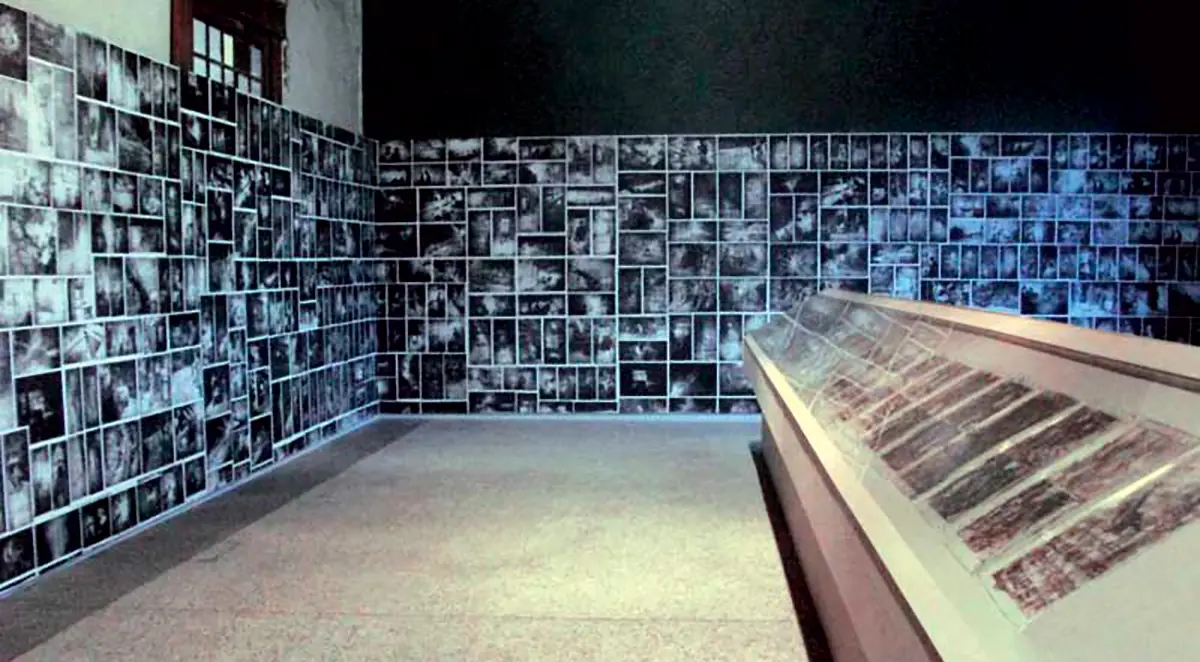
The work of Michael Matthys, from Belgium, was almost like a subtle response to Jitrik about commitment in art. Moloch (1998-2003), 1000 aquatints presented as a whole like an installation, paid tribute to the industrial epic of his native city, Charleroi. Inspired in reproductions of photographs and video fragments recorded in the mines and metallurgy plants, these prints were like a black-and-white reportage on the development of the mining industry. And, for a counterpart, there were the 76 dramatic drawings in cow’s blood on paper, and interpretation of city views, in the series La Ville Rouge (2005-2009). Meanwhile, Venezuelan artist Alexander Apóstol’s video installation Contrato colectivo cromosaturado, in collaboration with Rafael Ortega (2012), revisits the theme of critical reflection and interrogates the utopia of modernity in Caracas’ urban development and the role of the kinetic-art movement in Venezuela. With clear references to Cruz-Diez and his chromo-saturations in the representation of that ideal, he contrasted it with paradoxical images of the city impoverished by economic and political crises.
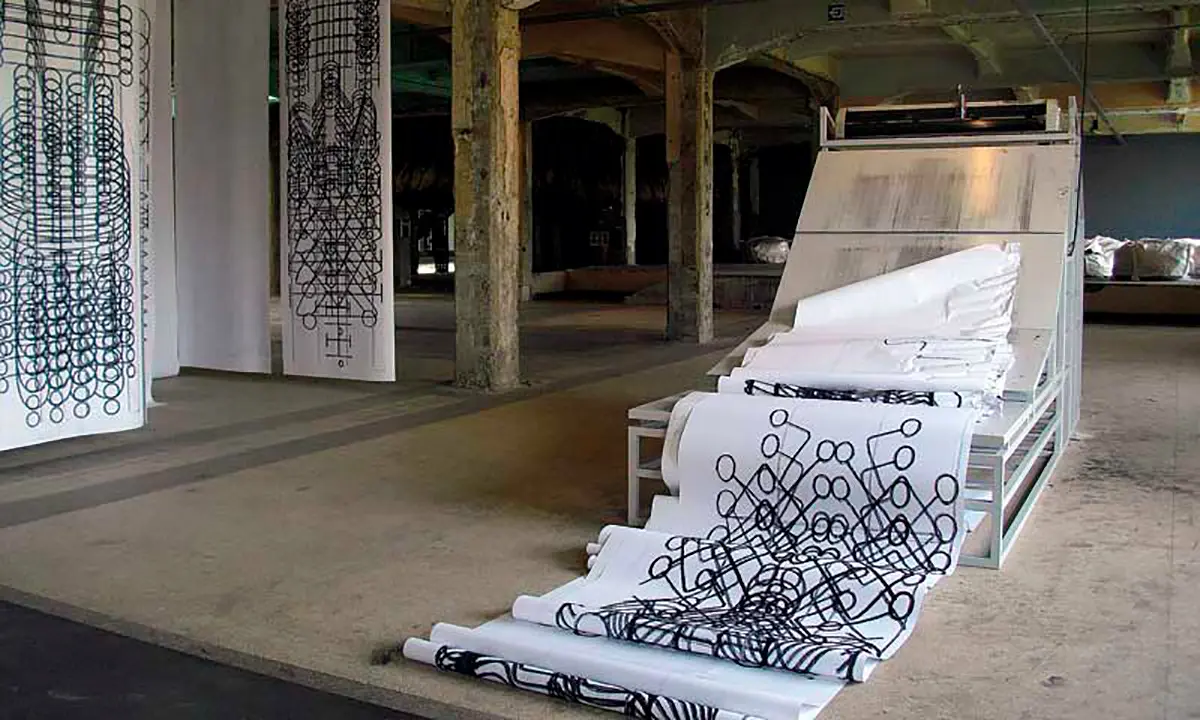
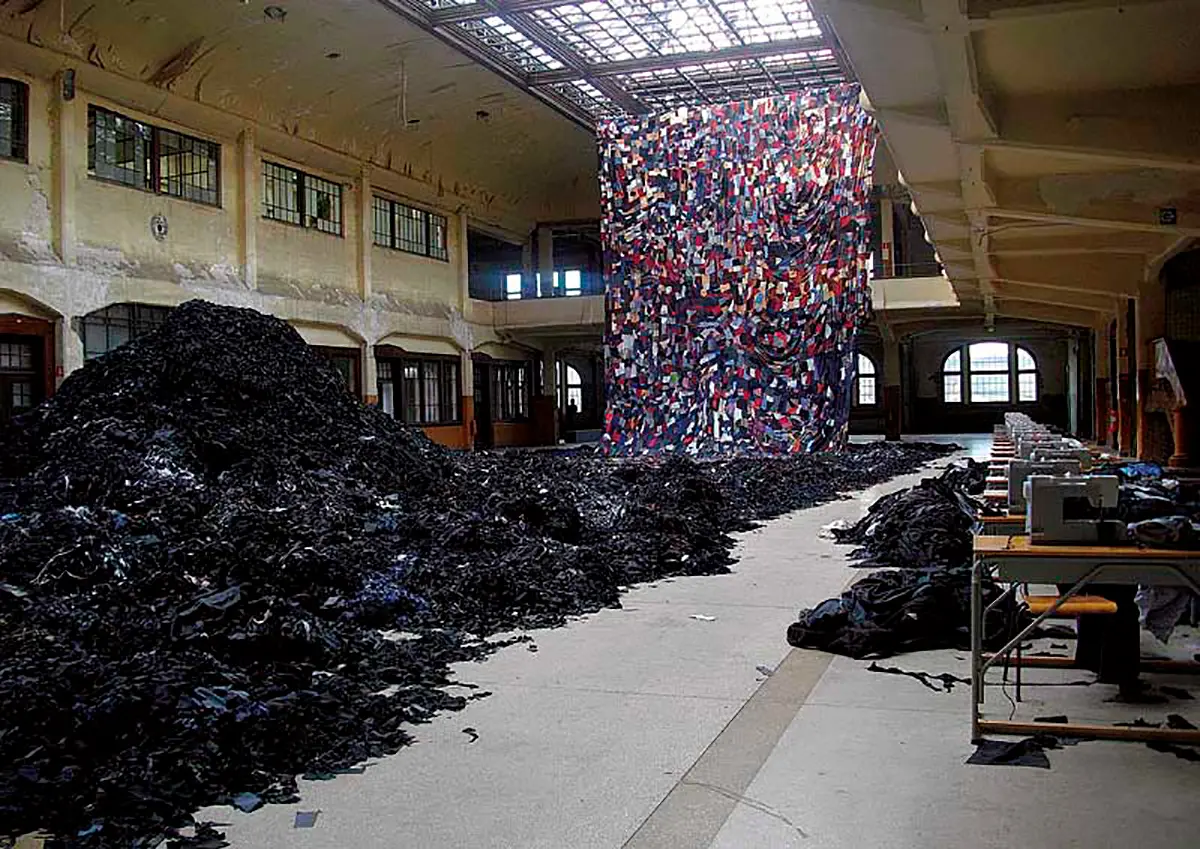
This is not to say that other works coincided perfectly and schematically with their assigned floor and the division of the show into themes. The dialog between the sections flowed through more contemporary and recent installations on the floor immediately below, for their strong visual impact. Carlos Amorales’ large paper sheets with mechanical charcoal drawings made, like a seismographic machine, by a plotter following pre-designed schemes interrupted the flow of the architecture by hanging from the ceiling and creating a labyrinth inside the exhibition space. Following the same dynamic of re-production and dialog between floors, in II The Age of Coal, in a large-scale installation-in-progress by Chinese artist Haifeng Ni, Para-Production (2008-2012), a large mass of fabric fragments fell in a cascade from the upper level, sewn together at the seams. A series of sewing machines were placed in line to one side, to be used by the public and contribute to the unending chain of mass production, in a clear allusion to China’s positioning as the largest manufacturer of textiles and to the mass-production processes that involve so many anonymous hands in an industrial dynamic within the global circulation of merchandise.
To a degree, Haifeng Ni’s installation dialogued with the reference to Marcel Duchamp’s 1938 1200 Coal Sacks made by the coal sacks suspended at the exit of the historical section. Both alluded to industrial production, and both pointed towards the connection between contemporary art and Twentieth-Century Modern art.
The section The Age of Coal was significant in that Medina literally and physically introduced a “museum” in the building. The protagonist here was coal and its archeological history, its economic implications in the development of capitalism and industrialization in Europe, and its influence in cultural production during the Nineteenth and Twentieth Centuries, as both a positive and negative inspiration. Mineral residue, photographs, drawings, and paintings from a variety of collections created a sophisticated curatorial exercise, a tableau of the history and meaning of a mineral as its central theme, with works of relevant artists from the previous century. On the same floor and outside the historical section, we must note Angels with Dirty Faces (2004-2006), photographs, and video by Croatian artist Igor Grubic presenting portraits of miners with wings that alluded to angelic beings.
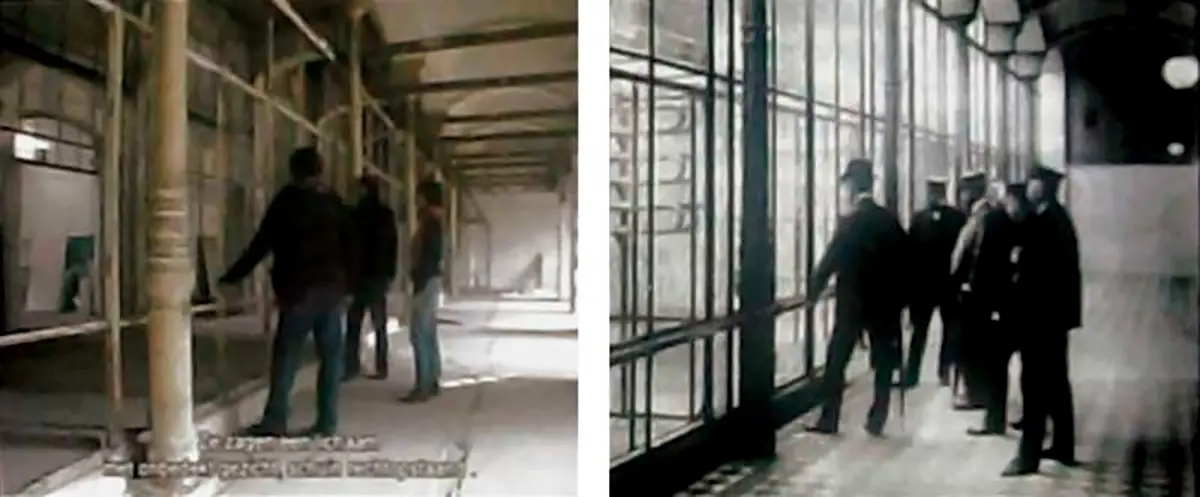
Finally, III 17 Tons, on the first floor, was, of all the sections, the one most evidently dedicated to the city of Genk and the Limburg province. Like the infrastructure of the base that supports the entire socio-cultural construction of a city or region, the space contained multiple historical materials, documents, objects, films, in an attempt to map out the history and the complexity of the region in a broader spectrum. The deployment of all this recovered material, from the building’s original plans, IDs and badges, photographs, police documents, carpets used by the first Turkish immigrants for their prayers, period movies, drawings, and paintings of mineworkers created a “museum” where the private histories, collective struggles, and migratory flows that shaped the region were interwoven. 17 Tons alluded to the title of a popular song dedicated to coal miners, 16 Tons, recorded in 1946 by Merle Travis. At the same time, it referred to Duchamp’s Sixteen Miles of String, from 1942. Both references in the title suggested, in their discrepancy, “the need to take a step beyond the politics and protests of the history of the coal industry in its current state in order to understand the richness of the many levels at which this patrimony produces culture: mind, body, and objects.” 7
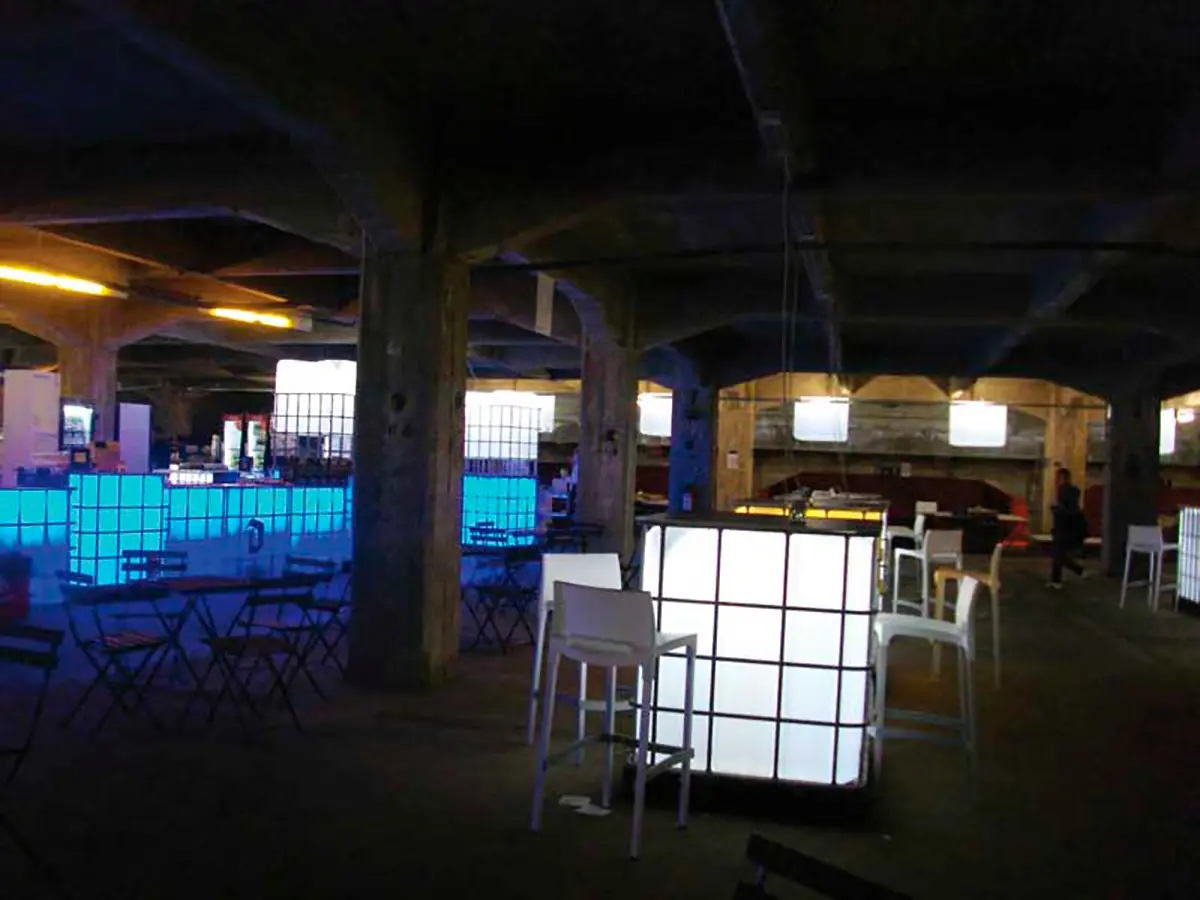
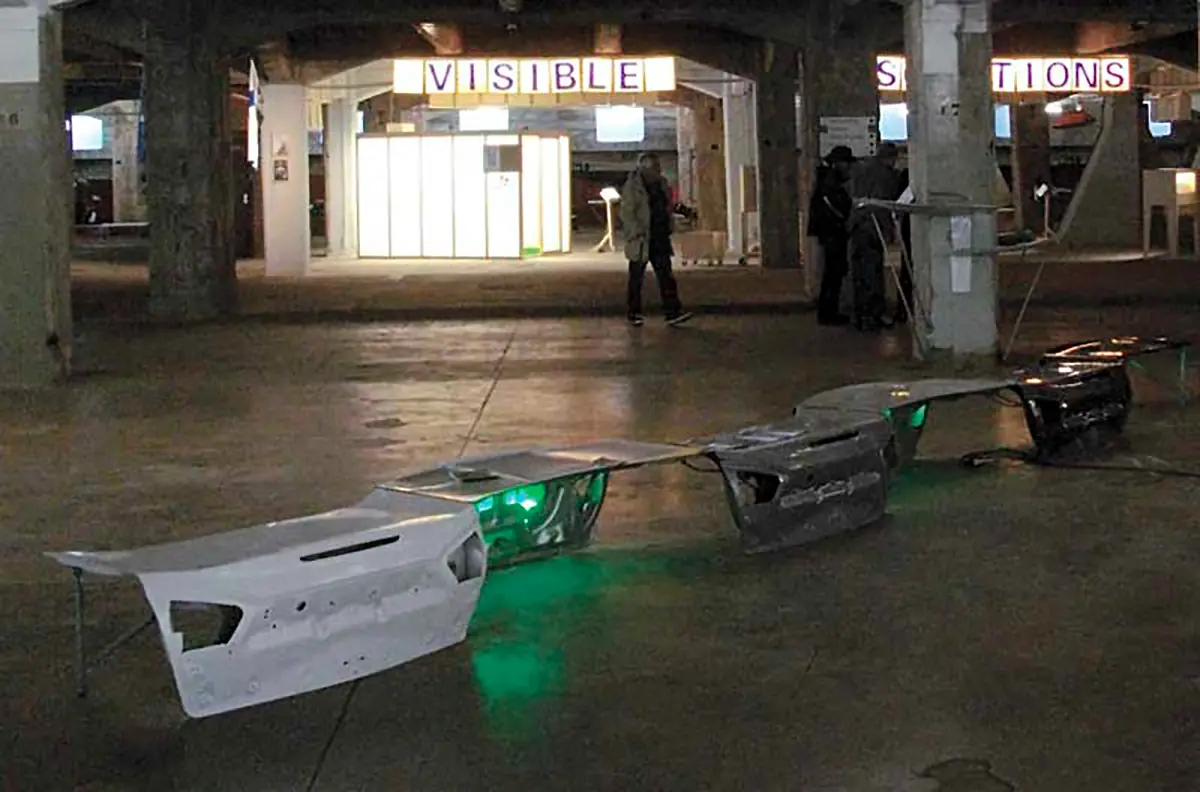
Starting with its main entrance, Manifesta 9 presented a very “cool” look. With the conditioning of the lower vestibule, by the team of architects 2012 Architects & REFUNC, space flowed between independent islands of light and color; environments achieved using discarded materials such as plastic, automotive parts, and coal sacks. The functionality proposed by the architects cohered with the event’s conceptual assumptions, where all actors involved in the production process are part of the creation of material culture and of the functional objects recycled from the “ruin and detritus” left behind by modern industry and capitalism. And in that sense, the art collective Visible Solutions LLC offered also, with a corrosive sense of humor, its dysfunctional designs for our global era. A question then arose, again, about the functionality of art and its place in the “superstructure” of society, and the inescapable pitfall of locating it as part of a critical discourse without overcoming its semantic and formal molds. Is it perhaps that this paradox and this limitation is the only flag left for contemporary art to raise on the recovered ruins of the Waterschei building, in Genk?
Between the two large thematic axes of industrial modernity and post-industrial capitalism/globalization, The Deep of the Modern could be seen as a complex analysis of the present and the production of art from a sociological standpoint. But also as a model of the exhibition where the “work of art” was no longer a mere object of contemplation, open in its meaning, and became part of a wider set that participates in the construction of an era’s cultural capital. By including objects “outside” the realm of art, with historical and sociological value or merely taken from the fields of archaeology and ethnology, and having them share the same space in the exhibition mechanism with works of contemporary art, it perhaps communicated the notion that art is comparable to those other cultural objects, with the particularity of its emerging in response to different semantic and linguistic constructions of knowledge and information in a given epoch and context.
NOTES
1. See "Manifesta 8: La posibilidad del diálogo de fronteras," by Dermis P. León, in ArtNexus.
2. The 7th Berlin Biennale was held April 27th through July 1st and was curated by the controversial Polish artist Artur Zmijewski and Joanna Warsza. Its main site, the KW Institute for Contemporary Art, was occupied by the movements invited by the curator: Occupy Berlin, 15M Movimiento from Barcelona, Occupy Museums (Occupy Wall Street), the Autonoma University, and others joining from many other countries, a well as invited artists, as the biennial progressed.
3. Intervention by an artist not invited to Manifesta 9. (?)
4. Press release, Manifesta 9.
5. Medina, Cuauhtémoc. “Exhibitions ‘Are Material Forces’”, in Manifesta 9, The Deep of the Modern, A Subcyclopaedia. Edited by Cuauhtémoc Medina and Christopher Michael Fraga. Silvana Editoriale, 2012. Pp. 22-32.
6. Artur Zmijewski, in his call for projects for the 7th Biennale, requested that artists stated their political position.
7. Medina, Cuauhtémoc. “Exhibitions ‘Are Material Forces’”, p. 31.
DERMIS P. LEÓN
Curator and independent art critic. The Curatorial Bureau.