
It is more than appropriate that Marc Latamie’s quiet, elegant installation in the Americas Society’s For Rent series takes place in its landmarked McKim, Mead, and White building. Constructed only a few years before the nearly international prohibition of absinthe in 1914, this site could have easily housed, in the words of the artist, a gentile discussion of art with “...a minimum of demonstration and [a] maximum of thinking.” Nevertheless, this sort of salon in the early 20th century New York probably would not have been fueled by la fée verte or absinthe, which serves as the virtual muse for this installation.
Marc Latamie, with curators Christina de Leon and Theodora Doulamis, has constructed, first, an environment that makes physical the complex concepts that bind the Caribbean nation of Martinique to France. Secondly, the juxtaposition of the objects in the installation forces the viewer to explore the idea of Martinican identity, that is, those things that profoundly separate Martinique from France and French history. Perhaps what shouts out most loudly is that while France is part of the history of Martinique, the history of Martinique is not French.
With la fée verte, there are really three feminine muses here: absinthe (which was introduced into Martinique by the French), Lumina Sophie, and Ady Fidelin. The herbaceous cordial is present throughout the installation, appearing in all three galleries; Marie-Philomène Roptus, known as Lumina Sophie, was active during the insurgency of 1870 in Martinique and has become a true national heroine; and, Adrienne “Ady” Fidelin, from Guadeloupe, was the lover, muse, and model of Man Ray, who became a ubiquitous figure in the Parisian art scene. All of these are, perhaps, best summed up in Antillaise from 1941, a seldom-seen pastel by André Masson that represents Martinique in the powerful figure of a woman. Masson visited Martinique in 1941 with André Breton and the island nation made a lasting impression on both men.
The challenge of this exhibition is connecting the seemingly disparate sections and objects and understanding the artist’s point of view and the ultimate object of the show. Without a reasonably sound knowledge of the history of Martinique and its primary relationship as a Départment d’outre-mer, or an Overseas Department, of France, the average gallery hopper will be at a disadvantage. As label copy is scarce, the most effective approach is to read the thorough hand-out/broadside that is available in the galleries, a process that is decidedly worth the effort.
The first gallery “Le Salon (de) Surprise” is dedicated to Lumina Sophie, who was imprisoned and convicted under the name Lumina Sophie Surprise. Here the power of Martinique—and other exoticized French territories—to captivate the minds and convictions of the French becomes clear. A small selection of prints, drawings, and photographs, all from private collections, graphically demonstrates this attraction, one that drove Man Ray to learn Creole and try his hand at portraiture. As no image of Lumina Sophie exists, Latamie has effectively transposed to Ady the representation of a strong, intelligent, and beautiful Caribbean woman.
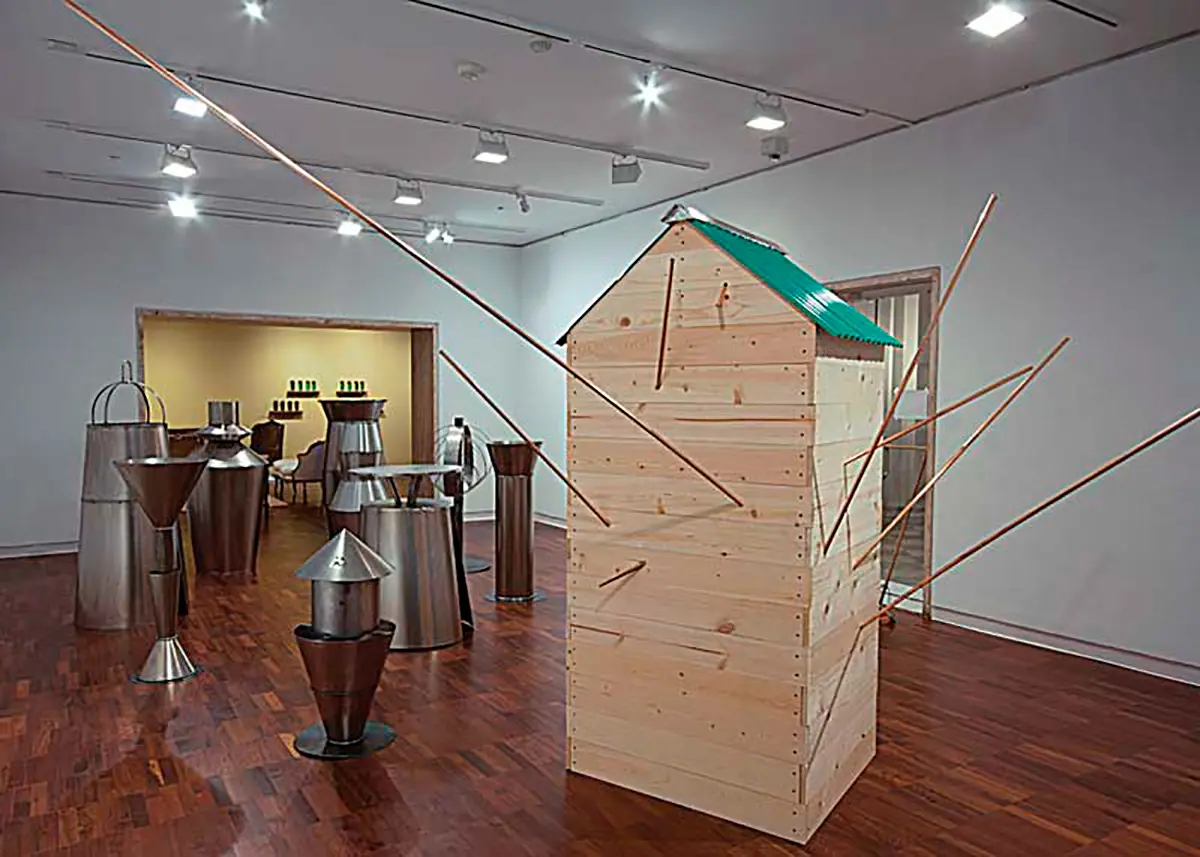
The second and main gallery is by far, at once, the most compelling and confounding. A small allegorical wooden model of an absinthe distillery, which is martyred San Sebastian style with copper pipes, is held in conversation with nine human-sized, stainless steel representations of Duchamp’s malic molds, as seen in his Large Glass. These figures have apparently assembled to furtively gaze upon the essence of absinthe that twirls within the distillery and supports the very idea of the secret of life in a stylized tree-of-life. Embodied in this central gallery is one of Latamie’s aesthetic tenets, as expressed in the brochure: “Obviously I had Marcel Duchamp in the back of my mind, which happens quite frequently when I look at art. Not only when considering my own pieces, but usually the way I approach art is with 'the minimum of demonstration and the maximum of thinking.'” The idea of desire fills the room.
That aesthetic thinking is something that could take place in the third gallery, the Absinthe Lounge. Here, in a pastiche of a 19th-century parlor, the artist asks viewers to sit and consider the content of the first two galleries. To aid in that process, Latamie has included here two earlier works, in wood, silver, and glass. Each of these boxes (coffrets) can be seen as a sort of absinthe user kit. But, in fact, beautifully designed and executed, these boxes take on the form of a reliquary, holding the remains of the idea of the French in Martinique.
CLAYTON KIRKING