
Minerva Cuevas’ (Mexico City, 1975) retrospective at the Museo de la Ciudad de México, which brings together some thirty works in video, graphic arts, wall painting, and installation, is the artist’s most complete exhibition so far.
Curated by Patrick Charpenel, the show makes room for works that are representative of Cuevas’ trajectory over the past fifteen years, enabling a holistic view of artistic production that, as it is made evident here, has remained solidly anchored to a critical perspective on social reality.
Thus, the exhibition begins with Ángel (2012,) centered on the fallen and broken head of the emblematic winged figure that crowns Mexico’s memorial monument to its war of independence, followed by the traditional little street-vendor cart traditionally seen at national celebrations peddling small flags, transformed into a scaffold filled with red-and-black flags that contrast with the tri-color image of Mexico’s official symbol and a truck in the Zócalo, the country’s main civic square (24 de enero, México, 2007.)
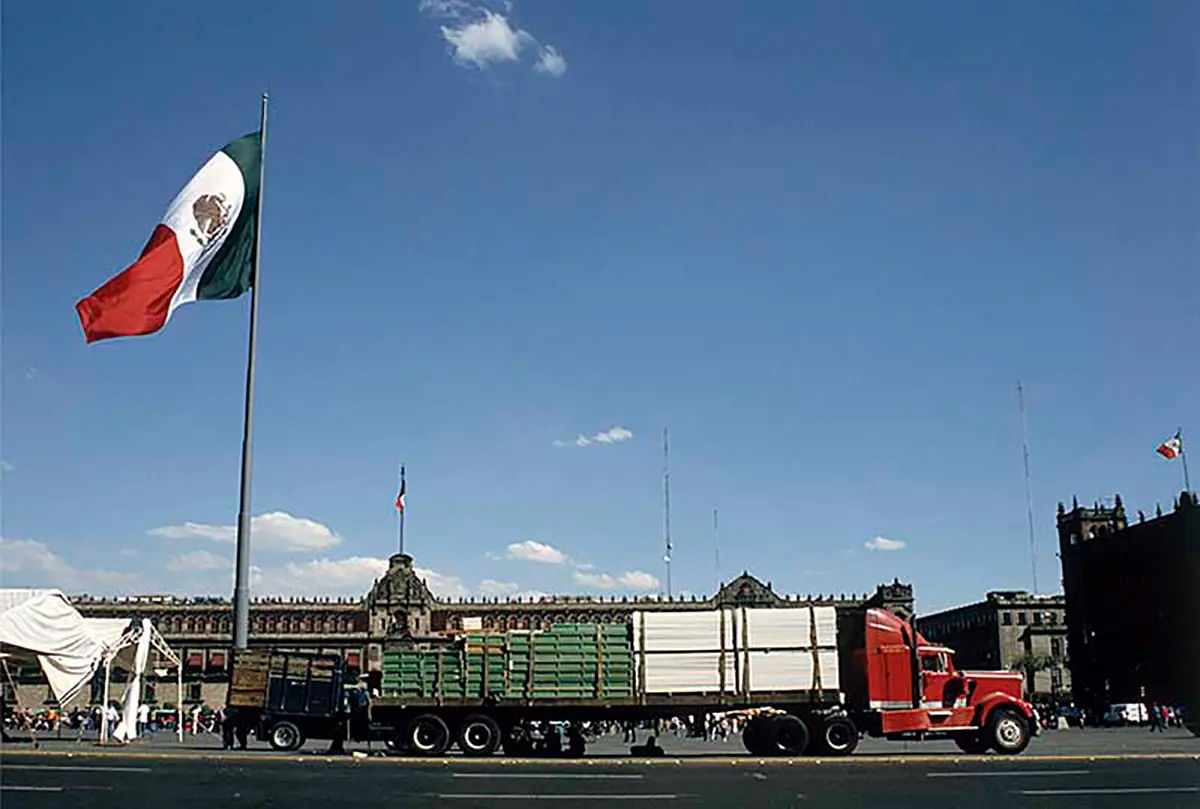
The problematization that both installations introduce into the topic of nationalistic beliefs reappears a few galleries later, in Patria (2000), a video also set in the capital’s Zócalo and accompanied by posters printed with the effigy of a young chicken that, at the antipodes of the imposing foundational eagle depicted in the Mexican seal, appears in a text: “Para qué infierno, si tenemos la Patria” (“Why Hell, if we have the Fatherland”).
On the other hand, Cuevas claims a concrete, everyday territory of identity in Tepito (2009,) a film that captures the hive-like assortment of stalls in Mexico City’s infamous “rough neighborhood,” where all kinds of objects, mostly pirated, are offered for sale, projected on walls tattooed with “little devils,” the popular two-wheeled load carriers here loaded with words: “Contra lo prohibido, las calles de lo posible” (“Against the forbidden, the streets of the possible”).
In the same vein, as part of her exploration of ideological doctrines, the animation Créelo y ocurrirá. Believe and It Will Happen (2000) is intended to detonate reactions, in the manner of Jenny Holzer’s Truisms, in viewers bombarded with dollar signs, crosses, the Star of David, and other symbols of world-wide codification.
And it is precisely here, in the global realm where powerful economic concerns operate, where Cuevas concentrates her artistic strategies understood as means for investigation and denunciation of the ills of our era, starting with her critique of consumerism and fast food in Donald McRonald, Francia (2003,) a video that captures a performance of the famous clown, given here a voracious vampiric aspect and duplicated in the show by means of a display containing his iconic costume.
Similarly, Seascape (2007) focuses on a critique of the environmental contamination generated by the oil industry through the depiction of the arrival of the black tide; so does Hidrocarburos (2007), an installation that gathers overflowing barrels and tin drums labeled Esso, Mobil, and Quaker state, photographs of drilling platforms, press clippings informing of spills, and a series of toys covered with sludge. The same topic functions as the connecting thread between an insecticide bulb attached to the center of a bulls-eye target (Target, Shell, 2007) and the intervened street-fair cart (Dodgem, Esso, 2000.)
Cuevas appropriates logos and slogans of transnational companies in order to subvert them into a testimonial exercise of historical memory. For example, in Del Montte (2003,) the paint on the wall transfigures this canned produce trademark by inserting the double “t” in the surname of Guatemalan president Efraín Ríos Montt, referring to the relationship between certain government administrations and the impoverishment of Central American farmers at the hands of that food company, as explained in the adjacent pile of relabeled tomato cans.
Another appropriation of advertising codes is Cuevas’s installation of plastic bottles titled Egalité (2004), which recontextualizes the image of a renowned company dedicated to the commercialization of purified water to set in motion an ethical sense towards current spaces of multiculturalism and growing inequality.
Inscribed in the same quest for more egalitarian social relations, Mejor Vida Corp. (1997-2012) documents Cuevas’ activism through her own corporation, which, from a position of resistance to the logic of neoliberal capitalism, distributes some goods for free: barcodes for reduced prices, recommendation letters, student credentials that can be used for discounts, and, as an experimental proposal, the free use of a telephone placed in the street, outside the museum, for long-distance calls, all of which allows the artist to cross borders not only between art and politics but also between art and the museum space.
ARGELIA CASTILLO