
The most recent exhibition by Nadín Ospina titled Oniria (2007-2012) is presented at the Museo de Artes Visuales of the UJTL in Bogota. The exhibition incorporates much of the elements Ospina’s used in his earlier artistic production, where he cleverly combined ludic elements with the universe of children, anachronisms, collective and individual memories, popular elements, delirious expressions, and the world of dreams. Oniria is a multimedia installation in which objects, sound, and video create a stage for viewers to be immersed in oneiric adventures to “fight oblivion and growing up,” affirms the artist. Thus, according to this proposal, the loss of memory and adulthood works hand in hand against a realm defined and energized by dreams: the world of children.
As we first enter the completely dark exhibition area, we barely perceive two zenith illumination points that reveal several brightly colored figures. These figures rest on small round tables almost flush with the floor and equally colorful that are reminiscent of those serially produced old plastic toys that we once held in our hands: the walking woman, a Buddha sitting on a bison, a race car judge with a starting flag, a caliph, or the unmistakable redskin American Indian with the bare torso, severe gaze, and weapon in hand and ready to be played with by children in a game of cowboys and Indians.
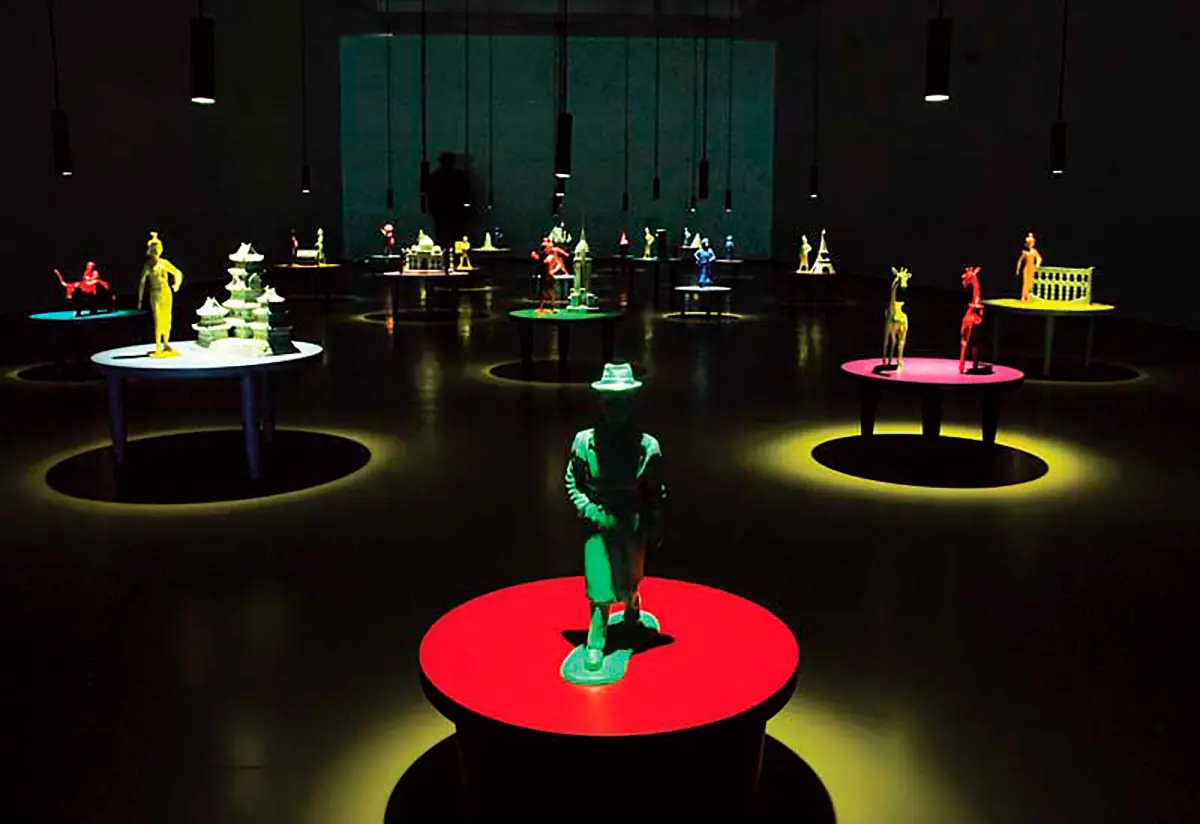
As we observe these figures we realize that they are actually oversize versions of the original and that most of them are accompanied by mockups of some of the largest constructions around the world—the Eiffel Tower, the Big Ben, the Taj Mahal, an Aztec Pyramid, the Roman Coliseum, among others. These pieces accentuate the dream world in which history and reality promiscuously merge in our minds. Although they appear to be created with plastic—as they are seemingly part toy set—viewers are surprised to find that they are actually made of bronze that has been painted. Ospina succeeds in updating bronze sculpture by placing it in a place where popular culture plays an important role.
This experience is not only visual: across the entire exhibition area, we can listen to sound environments in which water, and some metallic sounds, can be perceived, as these are blended with the sounds of birds. After walking through the exhibition, we realize that the sounds actually emanate from a video that initially shows bubbles floating in a water environment. Suddenly the rotating figure of the redskin Indian appears, followed by the also rotating yellow female figure. Other figures that were already in the room and that make reference to the sculptural and architectural monuments earlier described. In Ospina’s own words, Oniria is:
“A validation of the collective memory, where each character demands a place in the context of resignification of contemporary art. An element that contextualizes the work, Oniria is the image and signification of the mythic Ouroboros, the serpent or dragon that eats its own tail. This sign contains concepts like the eternal return, the cyclical, the immutable, reiteration, useless effort, the condemnation to repetition (Sisyphus), and fate, among others. As an appeal to memory, to remembering, to longing, this exhibition very much remains a contemporary proposal that surveys many moments from the past. Oniria represents an immersion into a personal universe of dreams and memories, as a way to resist the disappearance of singularity and individuality. Oniria is an invitation to the practice of dreaming in the face of the prevailing pathos of everyday life and the sordidness of the status quo.”
Indeed, just as Nadín Ospina explains, this work contains several mythical referents that are linked with our dreams, nostalgia, and memory. Each element becomes a trigger that allows viewers to be immersed in a state of deep contemplation and fantasy. This work is closely connected to an earlier production, in which Ospina had already approached the themes of dreaming and fantasy: Soñadores (Dreamers), 1991, Éxtasis (Ecstasy), 1991, and Delirio, (Delirium), 1992; as well as the theme of toys: Karakatoa, 1987 and Colombialand , 2004.
With this installation, Nadín Ospina succeeds in challenging us to remember that the dream world is still connected to reality. It is impossible to leave our dreams behind, as they are, in many ways, the vehicle of our existence. This world of dreams—which is also the world of playing—is where faraway places become within easy grasp, and where the characters that populated our childhood appear to regain their meaningfulness. By accepting this, we are able to insist—like the Calderón de la Barca did—that, indeed, life is a permanent dream, a frenzy, “an illusion, a shadow, a fiction, and the greatest profit is small; for all of life is a dream, and dreams, are nothing but dreams.”
RICARDO ARCOS-PALMA