
The exhibition of works by Natalia Arias at Nohra Haime Gallery draws inspiration from a poem that the artist also added to the corpus of work as a photograph illustrating the poem. The first two lines read, “No permanent, no perpetual/No comfort from constant” and are taken up in the works exhibited where we witness the artist struggle with issues of representation, transformation, and self-identity, as well as outright metamorphosis.
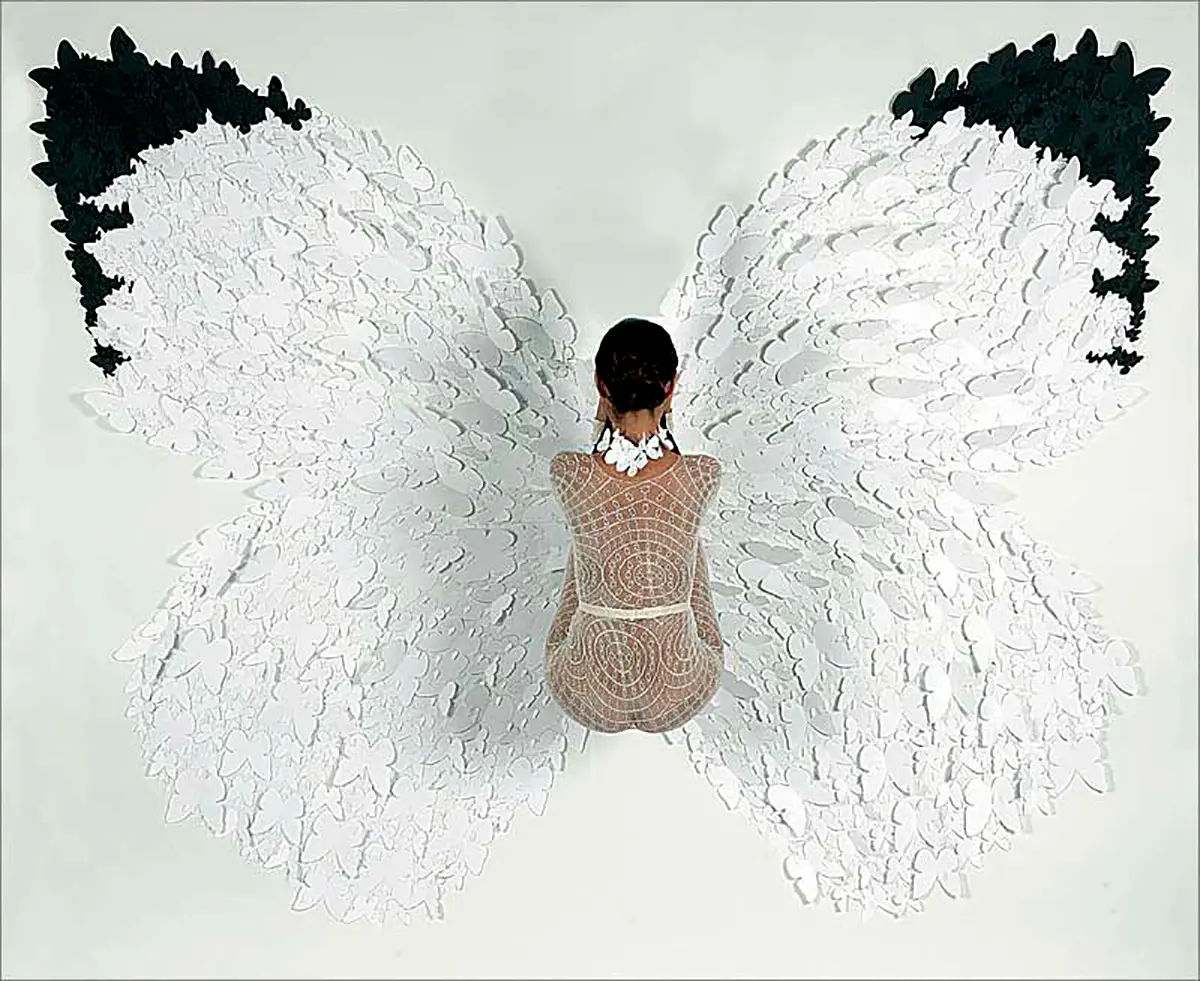
The central and pivotal work represents a red ball in the midst of a giant butterfly made up of smaller butterflies on paper that extend into the huge wings. On the catalog cover, we see the same image with the artist herself curled up in the central part of the butterfly, replacing the ball that represents the pin, which both secures and kills real butterflies in collectors’ frames. The issue of entrapment is hinted at by the pin which looks like the black endings of the wings and some spots in the center that point to what looks like an inconclusive color mutation between a night moth and a black butterfly specimen.
Another photo shows what looks like the cocoon before the metamorphosis where the larva will transform from a worm into the winged presence of the butterfly. There is something disturbing about confronting this vulnerable chrysalis, even if we are separated by the flatness of photography. As the enlarged image is almost life-sized, we feel in approaching as if we were too close to an unknown biological process. The same applies to another work, closely related to this one in composition, where a nude body is trapped inside a netted bag and suspended with an industrial cable. The ambiguity of the isolated and netted figure does not inform us whether this is a natural process or an artificially induced one, but there is an uneasy feeling of forced paralysis that can be interpreted as a form of transformation/evolution. The head of the figure is ominously covered with a red bag that looks surgically protective as if to induce hatching or to protect a surgical intervention, and large gray and white butterflies have settled on the outside of the net in groups as if recognizing a fellow member in the making inside the net. Arias has expressed issues of entrapment and transformation that are very present in the language of contemporary women artists as they struggle to redefine the image of a post-modern, post liberated contemporary woman that has abandoned traditional poses and symbols of ancestral femininity but have not yet developed new ones to effectively replace the old with an entirely new field of recognizable material that is as automatically referenced in the archive of images we all share as part of our cultural baggage.
Another image, the most thought-provoking in the series, shows a portrait of the artist with her face half-covered by what look like black eggs from an insect’s nest. Inevitable associations with reproductive insect ‘queens’ such as bees come to mind as does the idea that this is an unfinished process—whether a new being is evolving from the nest or whether the nest itself is part of the process in the creation of a new being that will not be a woman at all is possible, but either a combination of the two or something altogether different is an unknown/unresolved prospect. There is also a reflection that is captured in the dark foreground that projects this strangely masked face into the bottom visual plane of the photograph, providing a continuum of the disturbing image in reverse.
Alight is the title of another image in which a crouching nude female is shown with an attachment made up of what looks like paper cut-outs of white butterflies that again turn to very big wings. There is nothing in this image that reminds us of angels, instead, we think of a genetic experiment in the making, and alteration whether surgical or gene-induced that has produced a new species, not necessarily entirely human.
Whether transforming or illustrative of evolutionary states of mind, the compositions of these works question issues of image representation and identity and are as interesting for what is left unsaid as much as by what we see, and think we understand. They question our perception of reality by opening the door to possibilities of body alteration and transformation that we often think about within the context of science, and particularly how those scientific images are manipulated in the process of representation. Ultimately, the treatment of the subjects is not clear enough to indicate a relationship with progress or evolution; it just points in the direction of permanent inquiry and questions the validity of our own reliance on visual information.
ALBERTO BARRAL