
There are many ways to write the history of the Americas. One could begin, for instance, with their Renaissance-era “discovery,” or focus on the wars of independence from European domination. The art of Paulo Nazareth seems to emerge from a reflection about these different narratives. His first solo exhibition, at Mendes Wood gallery in São Paulo, is titled Noticias de America. It is important to note that this is not solely a news item; the narratives here do not just come from the Americas but are about the continent.
Leaving his native city of Santa Lucía, in Minas Gerais, a state in the Brazilian interior, in 2011, the artist followed a trajectory that had New York City as its final destination. A poetic swallowed was substituted for the usual airplanes; wearing flip-flops (already a stereotype of Brazilianness), Nazareth traversed the cultural diversity of the Americas on foot, by bus, and by boat, gathering materials and producing the videos and photographs shown in this exhibition.
In an inner courtyard at the gallery, among trees and plants, we find some hanging hammocks. Sloth, a resistance to the hurry of the world, is what welcomes visitors. Inside the exhibition space, we see a number of tables arranged in an irregular fashion, comprised of an assemblage of wood and cardboard of diverse origin. The artist presents the public with a kind of museum of appropriations. Walking, we must be careful: there are objects around the floor and we could, unwittingly, step on contemporary art.
On the tables, we find, for example, piles of coins, soap, plastic animals, flags, and newspaper clippings. These objects are set side to side and underscore their various geographic origins. One of these supports stands out for presenting a large amount of superimposed water bottle labels. The similitude to the words grabs our attention: “fresh”, “crystal”, “oasis”, and “natural” are names that appear more than once in the labels. In this way, Nazareth organizes a metaphorical atlas that refuses to divide the Americas in the conventional way, which is to say, into North, Central, and South. The map built by the artist is the result of his encounter with the unexpected that emerged during his walk. Thus, the dust of Latin America is carried and thrown into North American rivers, re-codifying in a poetic, ephemeral way the cultural and socio-economic differences across the American continent.
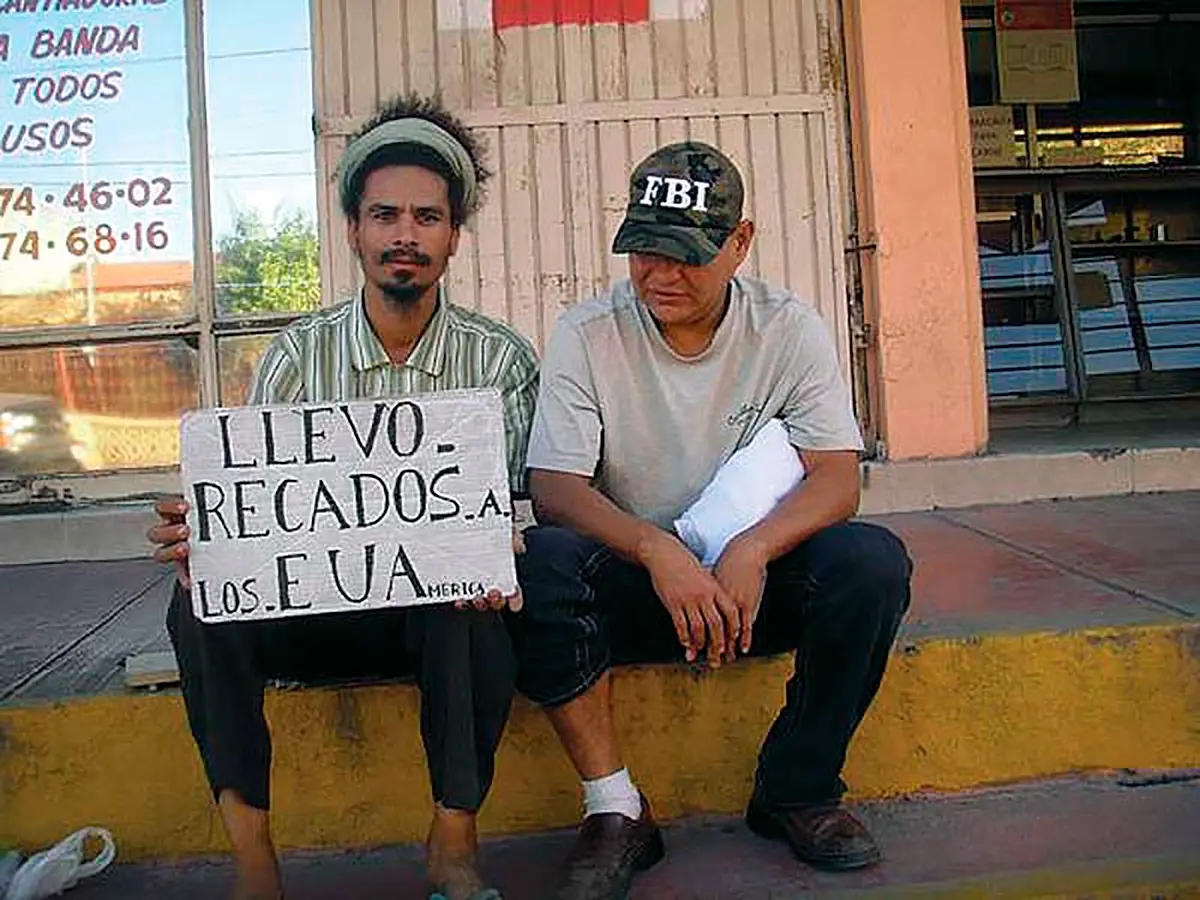
On the gallery walls are some photographic self-portraits, as well as posters collected by the artist, that endorse the ethnographic experience of his journey. In the self-portraits, Nazareth poses towards the camera and displays plaques with texts that resemble advertisements. “I clean your bathroom for a just price,” reads one of them; in the background, we see the US flag. In another photograph, sitting net to a man that hides his eyes under a beret with the logo of the FBI, Nazareth writes: “I carry messages to the US America.” Printed in small formats, these images come from the same rhetoric of self-exoticism that percolates through the entire exhibition. Instead of denying the bloody past of Spanish and Portuguese colonization in the Americas, Nazareth seems to always remember it through the use of those sentences, which are the summary of an acidic, ironic view of the present that nevertheless remains coherent with the well-known northbound migratory flow.
The most complex objects on exhibit, however, are the videos shown in monitors that, amidst the great number of objects strewn about the space, lose some of their visual impact. In them, the quest for cultural identity is carried forth in a less obvious way—we know they are records created during the experience of Nazareth’s artistic walk— these images are more existential in character. In When There Is Food in My Hands, some birds attempt to grab bread crumbs thrown by the artist’s hands. The timidity of the animals gives place, promptly, to a cloud of birds that avidly seeks food; the artist approaches the status of the demiurge.
Instead of training his camera of the infamous men of the Americas, Nazareth creates narratives around his own approach to nature. It is not a question of domesticating Man or landscape by means of photography, text, or a small cabinet of curiosities, but, as the title of the show announces, to create “news” (fable-like annotations) that have the Americas and their diversity as their trigger. Fictitious Americas in the real one.
RAPHAEL FONSECA