
Venezuelan artist Pedro Fermín (Carúpano, 1950) created ten metal works specifically for space at Galería La Cuadra. These were exhibited from March 18 to May 27 in a solo exhibition that ended the sculptor’s three-year hiatus from the exhibition circuit.
Winner of the most recent edition of the Salon Arturo Michelena Biennial, Pedro Fermín was formed in the rigor of geometry, which he nonetheless approaches from a ludic and poetic perspective through something we could call an illusion of flexibility. Following the refined technique of the abstract-geometric sculptors, his works are created in monochromatically painted iron or aluminum. But metal in Fermín’s work loses its rigidity and becomes elastic matter. The artist is interested in the creation of works that appear to be “shaped by the wind,” as he bends the sheets of metal to create flexible volumes that appear to flow in the space with sensual movements.
In fact, the important explorations by this artist center on visual and expressive elements that are activated during the process of transforming flat forms into three-dimensional ones. As he himself has indicated, his “works are surfaces that stop being two-dimensional [… and] took over space, assumed it, and energized it.”
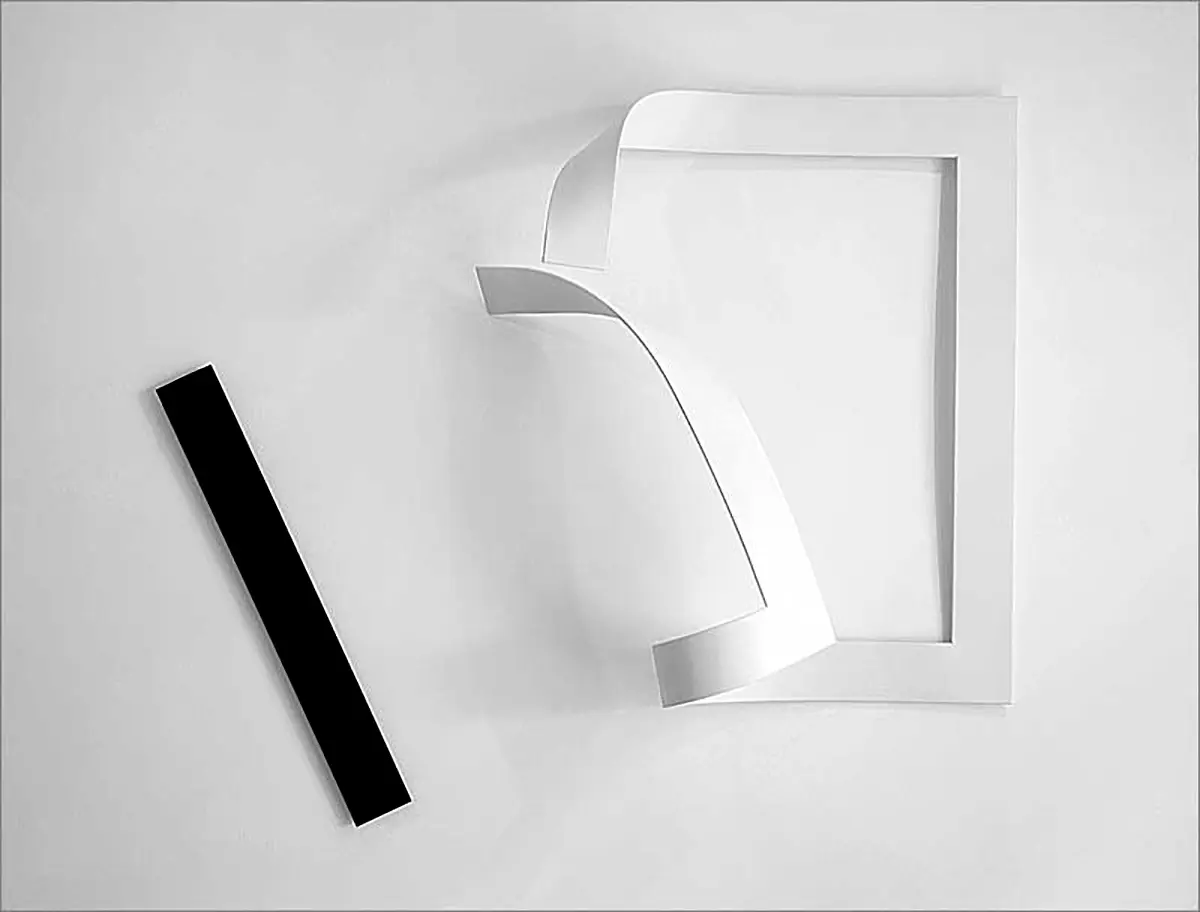
Pedro Fermín’s endeavor stands out for being consistently, unwaveringly, and firmly exploratory in nature. His language owes much to great masters from abstractionism, like Kasimir Malevich, Piet Mondrian, and Josef Albers. The square being the unit in which most of his work is structured, the influence of Malevich is also a tribute to the Russian painter. The reiteration in the use of primary colors, white and black, brings Fermín close to Mondrian and the simplification of the visual vocabulary and also connects the Venezuelan to Albers.
Pedro Fermín subverts the traditional perception of constructive pieces. His visual games offer the sensation of constant movement, of a fluidity that is very different from the aesthetic of classical geometrism, as his approach emphasizes the idea of the process. Indeed, many of his pieces appear to describe the transformation of a geometric form, while viewers are encouraged to create visual fantasies that appear to narrate the origin and destination of constantly changing forms. In this sense, his work becomes ludic since it is emphatically visual, haptic, but also ambiguous. Thus, the spirit of experimentation of the 1960s and also of minimalism can also be perceived in his work.
Not satisfied with the coldness of constructivism, Fermín introduces a sensual element in his work that is filled with curves and that, in some instances, it almost completely erases the orthogonal vestiges of his pieces.
The so-called “Möbius strip” has been at the core of many of his explorations surrounding the permutation of flatforms across space. In fact, a great part of his sculptural works have been created with metal sheets or strips that can be twisted in the manner of the model created by the German mathematician, which is constructed with a rectangular strip that is twisted before their extremes are united.
The work Plano Continuo 04042011 (Continuous Plane 04042011) is a triptych made with black painted iron displayed on the wall. The three forms were shaped by the artist to accentuate the ductile character of a material that, because of the quality achieved, could pass as cardboard or paper. Curves, twists, and undulations enable Fermín to describe forms close to the square, or that resemble squares that have been transformed by the wind or by another subtle exterior agent. The monochromic nature of the piece accentuates a sensation of permutability, instability, and even fragility of a work whose appearance promises further transformations.
A similar sensation is present in the works Relativo (Relative) and Relativo 31072010 (Relative 31072010). In the first piece, painted white, the artist deforms the square to the point of making it twist in itself. Fermín introduces a grey segment next to the piece to punctuate a narrative about the process of deformation or deterioration of the perfect form: the original vestige that has now left the piece. In the second piece, painted in cobalt blue, Fermín elaborates a “transformed square.” In the lower-left corner, he places a segment painted in orange. The dynamic contrast achieved by this point of color within the blue surrounding stresses the dynamic element and introduces a sort of ludic commentary in the piece.
This exhibition served to confirm the consistent quality of the work by this Venezuelan artist who, well versed in formal tradition and geometric technique, is able to renovate his artistic language from the possibilities that offer the grammar of contemporary art.
KATHERINE CHACÓN