
The freedom that Cubans long for: to transit freely between Havana and Miami and many other destinations around the world became a tangible element in Bridges: Between Completed Faraway and Nearby Journeys, a solo exhibition by Sandra Ramos presented at the Cuban Art Building of the Museo Nacional de Bellas Artes, in Havana. Part of the group of artists invited to show their proposals in the 11th Havana Biennial, Ramos participated with her work in the central exhibition of the mega event announced under the theme Artistic Practices and Social Imaginaries.
Her installation consisted of a bridge that connected the two highly meaningful points of the historic conflict between the politically opposed geographic places of Cuba and the United States. The possibility of such transit made the piece titled 90 Millas (90 Miles), and the exhibition as a whole, the heterotopic place in a time when the Caribbean island continues to wait for a migratory reform.
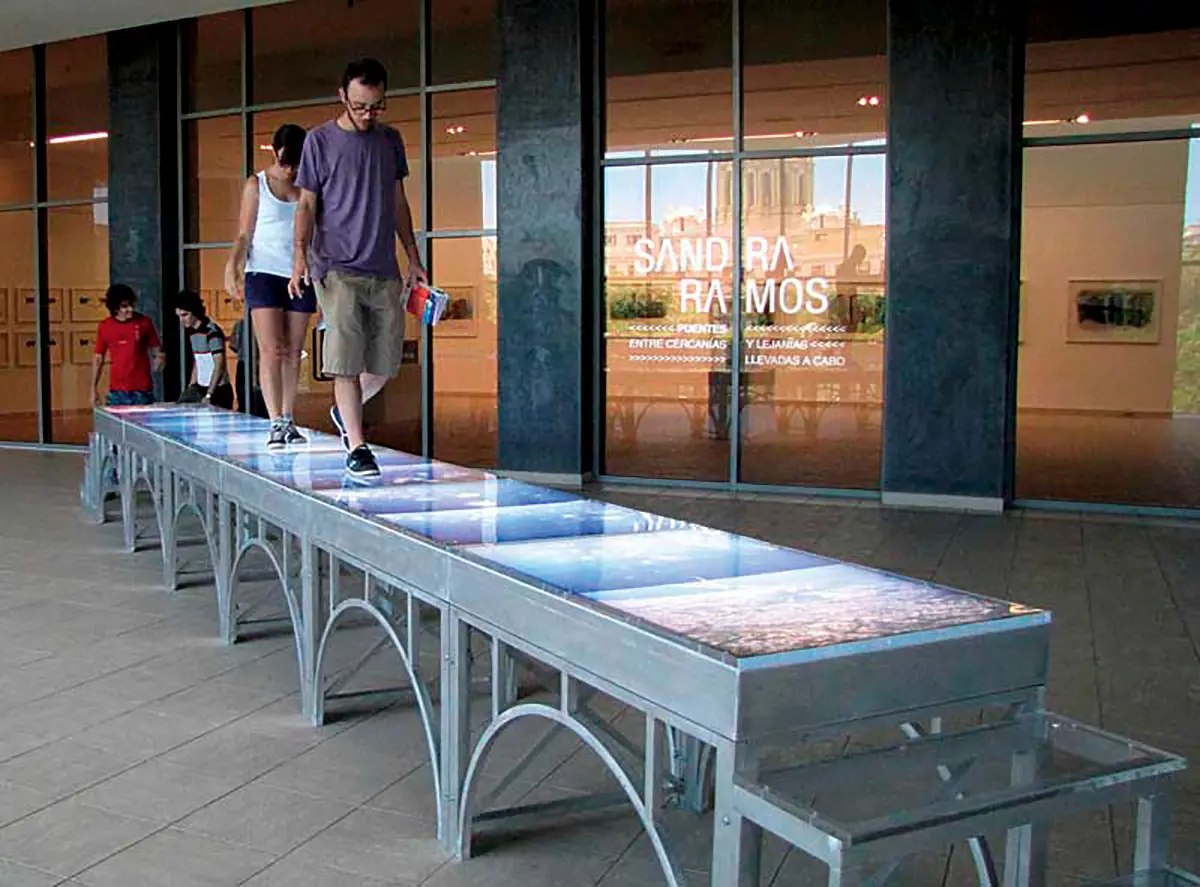
To walk through this dimension of lights inspired by the aerial views of Havana and Miami, as well as of the ocean area that divides the two places known as the Straits of Florida—based on photographs taken by the artist as she flew over the area—meant to enter into a new segment of one of the central themes in Sandra Ramos’s work: traveling. Her engravings La Maldita Circunstancia del Agua por Todas Partes (The Damned Circumstance of Water Everywhere) and Cuando Todos se han Ido Queda la Soledad (When Everybody is Gone Solitude Stays), presented in 1993 as part of the show titled Ways of Killing Solitudes; as well as as a wide-ranging group of installations, like Air Mall: Mirages (2002-2003), El Camino de la Incertidumbre (The Path of Uncertainty, 2004), and Naufragios (Shipwrecks, 2004); illustrate several sides of an argument that Ramos continues developing to this day, as she builds a chronicle about the conflicts and movements in Cuban society for the last two decades. These transits are associated with the history of the Cuban nation, with political and social reasons; the island’s insularity, migrations, people’s dreams, alienation, loss, and sacrifice. Individual and collective destinies are revealed in Ramos’ multifaceted artistic production.
Real or tropological movements infused the exhibition with a singular type of energy. The group of works consisted of sculptural installations—with lightboxes or video projections included—book-objects, and collages based on serigraphs and digital prints. Among the icons that embodied the singular movement were: the sculpture in the shape of the buoy placed in Key West since 1983. Like Ramos did with her museum version of the sculpture, the Key West sculpture includes the following inscription: “Southernmost Point Continental U.S.A,” and “90 Miles to Cuba.” To this inscription from Florida and the matter-of-fact number it contained—a distance etched in the memory of many people—Ramos added another inscription: El más cercano–lejano punto (The Nearest–Furthermost Point); and in doing so, she incorporated the perspective of those leaving Cuban soil in search of the North. From this double perspective associated with the place of origin, viewers became participants as they were offered two visions from two coasts (Key West/Hicacos Peninsula) that were projected on both sides of the artifact.
During the inauguration of Bridges: Between Completed Faraway and Nearby Journeys, the public received a symbolic gift: the printed catalog of the exhibition designed to look like Cuba’s passport. The singular replica was then stamped with a sort of visa created by the artist. This procedure was a wink and a nod at the value of the current document in the island, its central role in the achievement of the connections addressed by the exhibition; and, I must note, at the relevant role the passport has in some pieces of the show that are full of dramatic gravitas and narrative developments, like Horizonte I (Horizon I) y Horizonte II (Horizon II). In the first work, the passport pages appear as if they could have been stamped with the ocean or with tears, happiness, or suffering—all ways of defining the existential tribulations that have burdened the transit of Cubans and the landscapes. Ramos complemented the works with words punctured in cardboards—nostalgia, thirst, dead, hope, success, faraway, and nearby. For the body of her books in Horizontes II, Ramos relied on images sent by friends of the passports they used to leave Cuba for the first time. These images were combined with the cities where they ended up living—New York, Mexico City, and Puebla, among others.
The witness of the aforementioned circumstances, Sandra Ramos’ gaze became a translation of marks conveyed in 14 intervened serigraphs in the work titled Miedo Secreto (Secret Fear). There, the artist defined some of the marks that migration laws and the restrictions to enter and leave Cuba have left in people—ruptures with families and friends, loneliness, separation, displacement, frustration, etc. Ramos’ gaze, and Bridges: Between Completed Faraway and Nearby Journeys as a whole, succeeded in connecting and communicating subjective spaces and personal experiences with the spaces among the citizenry that those conflicts occupy in the collective imaginary.
CARIDAD BLANCO DE LA CRUZ