
The history of Colombian art has many chapters yet to be written. One such chapter concerns Taller 4 Rojo, a group formed during the 1970s by Nirma Zárate, Diego Arango, Umberto Giangrandi, Carlos Granada—all of these artists who already had important trajectories—and by two students from the Art Department of the Universidad Nacional: Jorge Mora and Fabio Rodríguez. The group played an important role in the Colombian art scene, especially in the field of graphic art and in the development of photoserigraphy. The members of the group participated in the 36th Venice Biennale, in salons and graphic art events in Puerto Rico, Havana, Bogota, and Cali, among other places. Likewise, they actively supported the social struggles of syndicalists, farmers, and indigenous groups; as well as editorial projects that supported those struggles.
The Transhistoria Group—formed by Camilo Ordoñez and María Sol Barón—has taken an important step toward the writing of a chapter that contains some valuable references from the history of Colombian art.1 They began their research several years ago attracted by some images produced at the Taller 4 Rojo and by what they thought was a brand of activism concurrent with contemporary artistic proposals. They carried out several interviews, researched, and collected archival material—most of it never before published and poorly organized. In 2009, the Trasnhistoria Group was invited by Uruguayan curator Gabriel Peluffo to participate in the Third Triennial of Chile. Estado de Sitio was an event that emphasized “art characterized by avant-garde attitudes aligned with political actions that left a distinctive mark through several localized—and yet geographically disperse—experiences, registered in the continent since the end of the 1960s,” all characteristics that clearly define the position adopted by Taller 4 Rojo. In 2010, this research project won the Fourth Historic Curatorship Prize of the Fundación Gilberto Alzate Avedaño—the reason why this archive was exhibited in the foundation, which constitutes a great challenge if we take into account that the spatial characteristics of the colonial house make it very difficult to present an exhibition or the creation of coherent walkthroughs.
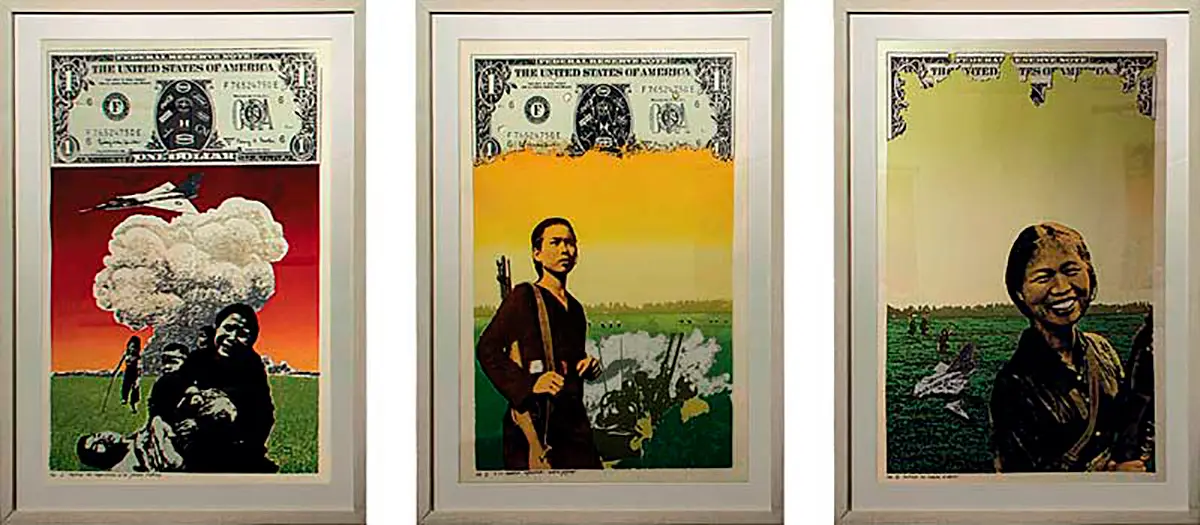
The material was organized by taking into account three moments: the group’s background, the graphic work created by the members of the workshop before they became members; and the works created during the workshop’s existence, including artistic proposals, political and social propaganda posters, and editorial material; and third of all, works created during the same period by artists and workshops popular in Colombia and Latin America were also shown. Conferences and roundtables with the workshop member were also organized concurrently with the exhibition.
The walk through the exhibit initially presented a dilemma for me that was resolved by what Elkin Rubiano said about arte≠vida, an exhibition that included excellent artistic archives from Latin America, the Caribbean, and the US: “(…) visitors to this exhibition will find, more than an artistic experience, a documentary base of names and backgrounds that requires—if the objective is to be informed—many more visits than just one.” On the other hand, Peluffo’s view regarding his own exhibition, stress the importance of understanding that an archive must be approached like a “testimonial stratum of a dynamic memory that is open to several readings.” In other words, this exhibition must be approached as the staging of an archive structured through thorough and judicious research that sheds light on themes that were previously very confusing.
From the many readings that can be drawn from this archive, it becomes clear that they continue to be paradigmatic images, some of them already shown, like La Agresión del Imperialismo (The Aggression of imperialism) by Nirma Zárate and Diego Arango; a revealing drawing by Umberto Giangrandi, sold at an auction to benefit the Consejo de Paz (Peace Council), which readdresses the Vietnam theme; and a poster created by the group in opposition to the official artists' salons—where it is possible to observe that their criticisms to “institution-art,” still relevant today, had an important role during the 1970s when the Taller decided to privilege actions over artistic works. Some texts stand out for the revealing commentaries they contain, concerning the strategies of the group that favors the “elaboration of projects that would privilege wide-ranging promotion and distribution; the implementation of processes of appropriation of visual and informative sources; and a predisposition toward collective creation that supersedes individual credits.” And in terms of artistic production, “they share a visual and narrative proposal that is similar to photomontage and the configuration of narrative planes (…).”
This inquiry does not solely shed light into an important chapter in the history of art, it is also invaluable to help us understand the social and political context of the 1970s in Colombia when the alternative left-wing magazine Alternativa—in which the members of Taller 4 Rojo actively participated—began circulation. We will wait for the catalog, in which the text that accompanies the exhibition will be easier to read. This research reveals that Taller 4 Rojo transformed from an open group to an interdisciplinary collective that relied on several channels of action and promotion.
NOTE
1. Germán Rubiano, La Historia del Arte Colombiano (The History of Colombian Art) Salvat editores, volume 11, Bogota, 1983. Ivonne Pini, Gráfica testimonial (Testimonial Graphic), Arte en Colombia, N. 33, 1987. María Elvira Iriarte in Historia de la Serigrafía en Colombia (History of Serigraphy in Colombia), ediciones Universidad Nacional de Colombia, 1986. Álvaro Medina in Procesos del Arte Colombiano (Processes of Colombian Art), Biblioteca Básica Colombiana de Colcultura, Bogota 1978.
MARTA RODRÍGUEZ