
The world fits inside a shell. This is revealed by the production of Rio artist Anna Bella Geiger, as emblematically expressed in one of her most moving works: a small seashell showing a world map, engraved in metal. This work, titled Sobre Nácar (2003), is among Geiger’s most representative ones; she often uses the cartographic representation to express concepts of place, territory, border, and globalism.
It is impossible not to associate the shell recreated by the artist with the ideas of French philosopher
Gaston Bachelard, for whom a shell is a nest, the space of solitude, a home. While the planet Earth, planned out in the rational systematization of a map, is made to fit inside the intimate immensity of a sea shell, Geiger’s art is imbued not only with political meaning. Her work is viscerally human. When it comes explicitly across as ideological, through the representation of maps that question the notions of center and periphery, she touches each viewer in their most private subjectivity: she forces us to wonder who we are and what is our place as individuals in the frantic interplay of a globalized geopolitical power. Hers is the point of view of a Latin American artist.
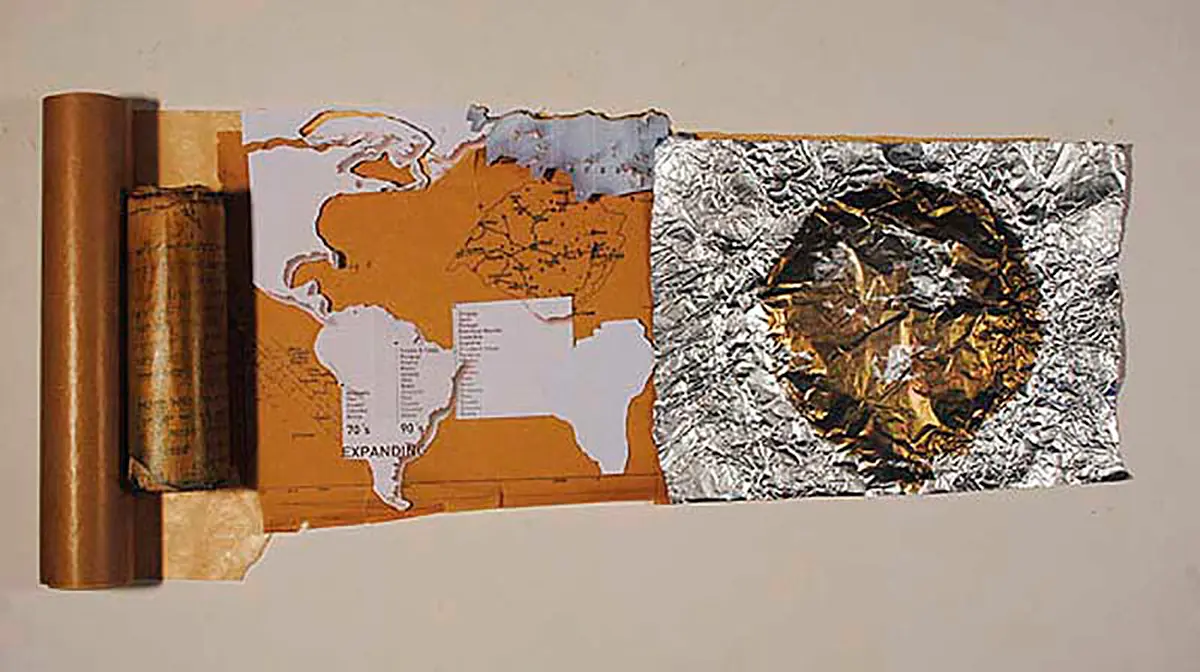
Some of these works were seen recently in Neither More Nor Less, an exhibition of Geiger works at Artur Fidalgo gallery in Rio de Janeiro, curated by Fernando Cocchiarale. Geiger, who is 80 years old, was a participant in several art-historical landmarks: the end of Modernism, postwar Abstract Art, Pop. She reached the Twenty-First Century with fidelity to her poetic, or, rather, “geo-poetic” project, focused on the variety of techniques and supports. Her maturity reveals the fact that neither art nor life can be subjected to Cartesian-evolutionist analysis. The “back and forth” of creativity is a mysterious time, supported by its "constellar" shape, as explained by Cocchiarale in connection with the curatorial concept that connected paintings, photo-compositions, videos, papyri, and maps.
The artist’s entire trajectory is coherently connected, as was also demonstrated at a large retrospective last year in Rio de Janeiro, titled Circa. That show, curated by the artist herself, resulted from the SESC Rio de Janeiro Award for the Promotion of Culture. There, the shifts and turns of her career appeared always as consonant with the explorations that characterized each era and Geiger’s own idiosyncrasies as an artist and a thinker. It is possible to find, in works of previous periods (for instance, those from the 1960s, prints or paintings), the notion of “visceral art” as defined by critic Mario Pedrosa.
In the 1970s, such organicity translated into representations of the human body used also as a map, its entrails representing the rivers and borders of a symbolic world. The body understood as a body politic appears in her performances of the 1970s, such as the work recorded in photographs showing the mold left by a body on the sand. The topic of the “ideologized” body also appears in her constant representation of ears, such as those that watch over maps or globes.
Geiger defends art as an archetype; this is to say, a symbolic representation of the collective unconscious. She proved this even as she produces points of breakage through the use of new technologies, like video, photography, and photocopying. Her own theories support a poetic production; Geiger is in possession of a well-rounded theoretical education (a degree in German and English language and literature, Art History with Hannah Levy at the Metropolitan Museum of Art, and Sociology of Art at the University of New York.) She understands the experimental position as the only possible path for aesthetic creation. This conception drove her to perceive, for example, the profound exhaustion of abstract art, whose codes became mere stylistic dogmas. The artist also explains that, in order to comprehend the reasons for this exhaustion and the loss of meaning in rules or methods previously considered valid, it is necessary to understand art as an “idea.”
Geiger’s important theoretical veneer also appears in the constant presence of words in her visual works. Next to her figurative representations, the phrases, loose words, and terms represent highly objective realities: the war between world powers and the cultural subjugation of marginal countries. Some of her works also use the humorous mold of Latin American pop art, as expressed in the series bearing the words: About Art—Repeat With Us: Bureaucracy.
Geiger, however, moves beyond Latin American situationism in order to show that geopolitical domination is an archetype repeated throughout the process of secularization of culture. As proof, the phrase The Center is Here, one of her leitmotifs. It is the title of a photo-engraving from 1974 depicting a road that advances into infinity and nothingness. That unending road is the representation of Geiger’s most important theory: “to speak of the world is an abstraction,” as she explained once. It is from that point of view that the world can fit inside a seashell.
ALESSANDRA SIMÕES