
The Galería D’Museo at the Centro de Arte Los Galpones presented the exhibition titled Steel Thorns by Carlos Zerpa. Twenty-eight works, among them paintings, installations, and assemblages, reveal a prolific, creative, and coherent artistic endeavor within the Venezuelan contemporary art landscape.
This coherence is expressed through elements that have been a constant in Zerpa’s work throughout the years. A convergence of references and iconic images from Western art interact in a playful and ironic manner with elements from popular culture: martial arts, especially characters that are part of the world of Mexican wrestling—or lucha libre—popular religious imagery, TV characters, and rock and roll.
It is particularly in rock and roll—in the rebellious and challenging attitude that once characterized this musical genre—where the spirit and general tone of the exhibition get its inspiration. Not solely because the nomenclature of some of the pieces make direct references to important musicians or emblematic bands from the 1960s and 1970s, like in the case of the piece titled Tower Records (Simpático para la Banda Pink Floyd) (Tower Records [Simpatico for the Pink Floyd Band])—a tower created with vinyl records collected by Zerpa through a public call in which he exchanged autographed drawings for 33 rpm albums—or like in the large paintings Tubular Bells (Simpatico for Mike Oldfield) and Velvet Underground (Simpatico for Andy Warhol) from the Metallica Series, in which Zerpa transforms into graphic elements the famous jackets from the Oldfield and Velvet Underground records.
More than a mischievous act from an enfant terrible of art, this adopted attitude comes from a decision to critically confront reality and the very artistic endeavor. It is a proposal that through the questioning of the status quo, and with the use of humor, has opted to reject any of the ever-changing fashionable trends or themes.
In Steel Thorns the general sense of the exhibition from the get-go offers a statement that reflects what this exhibition would eventually become: direct images that, as a result of their dimensions and visual impact, generate curiosity and fascination.
First of all, the canvases from the Metallica Series—8 large paintings hanging halfway on a double-height wall—allowed viewers to appreciate, even from the distance, the referential characters or objects that in each piece would pay tribute to a specific artist, musician, or film: the flying head from the film Zardoz; the bed from Apolinère Enameled by Duchamp; the tire from the sculptures by Jean-Michel Basquiat; a toy robot that alludes to the novel I Robot by Isaac Asimov; the iconic sunflowers by Van Gogh; and the banana painted by Andy Warhol for the jacket of the album by the Velvet Underground; among others.
These referential elements from art and popular culture are transformed into white figures outlined in black that float over a metallic grey background; and a minimalist palette—unlike the colorful paints used in Zerpa’s earlier works—that in its rejection of any narrative intention is able to maximize its evocative power. It is not an object transformed into an icon, as it occurred in Andy Warhol’s work; it is the definition of an icon transformed into a graphic sign that is capable of self-recognition.
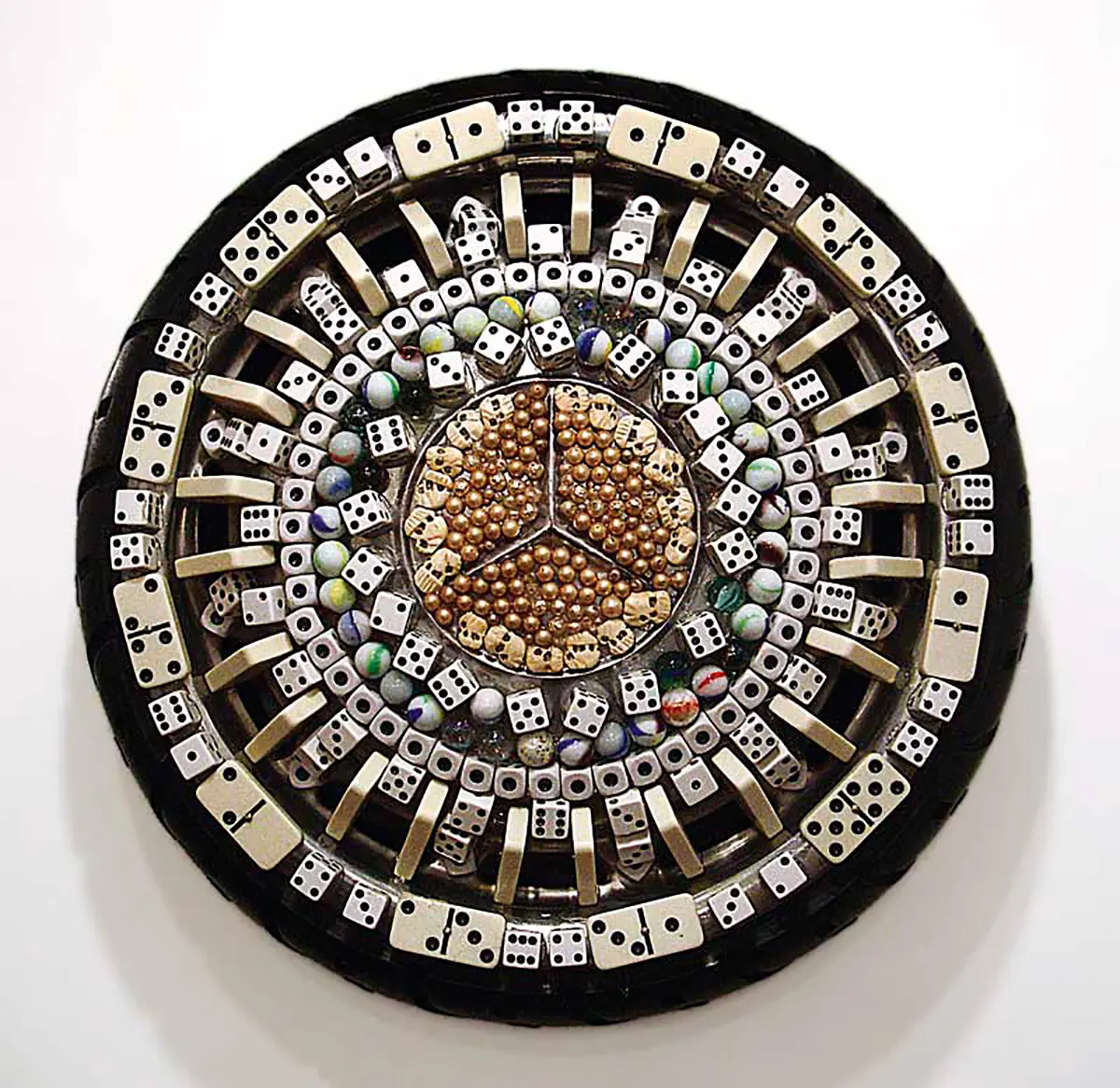
Second of all, the installations and assemblages transform recycled objects—such as keys, chains, costume medals, baby Jesus figurines, as well as plastic animals, dices, marbles, and golden fangs—into baroque surfaces mounted on various supports. Formerly neglected and devalued by the everyday gaze, these objects acquire a new non-function: mannequin heads transformed into brilliant and impossible pieces of jewelry (see the Antijewels Series); tires transmuted into wheels of fortune (see the Roulette Series); domino pieces that cover wood strips and crosses to form wordless crossword puzzles (see the Dominoes Series); or small figurines and skulls covered by the horror vacui, which are transmuted into powerful new cult symbols (from the Mutant Saints Series and the Skulls Series).
Lastly, in the work titled El Señor Conejo y el Señor Trastorno (Mister Rabbit and Mister Disorder), the fuzzy image of the white rabbit taken from children stories, is unsettlingly reconstructed into an installation in which the characters—and oversized white rabbit and the manikin of a masked child bodyguard—are shown each solemnly holding a hatchet.
Either through provocation or through the use of humor—and also through the recognition in the other of that which is also part of us—the pieces in this current exhibition—all-steel spines—convey the rock and roll spirit of Carlos Zerpa. It is a posthumous aesthetic that, far from calming down, became stronger after forty years of creative activity.
COSTANZA DE ROGATIS