
On the occasion of the fiftieth anniversary of the contemporary glass art movement known as “Studio Glass Art”, several U.S. institutions have organized exhibitions in honor of artists who have made an important contribution in this medium. The Museum of Art/Fort Lauderdale Nova Southeastern University in Florida presented an impressive show titled Primordial: Paintings and Sculptures by Isabel De Obaldía with more than 70 works produced by this Panamanian artist between 1985 and 2010.
De Obaldía’s retrospective exhibition was elegantly installed in several spacious, adjacent rooms on the Museum’s first floor. Her drawings, paintings, and sculptures were displayed in various groups based on thematic or technical connections, making up a general vision that left no doubt of this artist’s mastery in handling both two-dimensional as well as three-dimensional space. The choice of works on paper and paintings on canvas showed her stylistic connections to neo figurative art and neo-expressionism, and her preference for painting dramatic narrative content related to her personal biography and her country’s political history. There were some outstanding paintings such as Exiled of 1989 and Lifeboat of 1990, as well as a work from 2010 titled Jaguar in the Jungle. In addition, it was also possible to see drawings such as Body Bags and Torture chamber from the Mani Obras (Maneuvers) series of the late eighties, which depict the circumstances and the horrors of Panama's dictatorship.
In this combined vision, De Obaldía’s drawings and paintings offered an interesting contrast with her sculptures, allowing specific comparisons regarding some of her preferred themes and characters. Man was present, as always in De Obaldía’s oeuvre, whether in his complete form or represented by some anatomical part, mainly torsos and heads, but also dismembered arms and legs. The animal world and this artist’s fascination with the tropics and its dangers were represented in the forms of monkeys, sharks, jaguars, crocodiles, and iguanas. If in her oils these characters tend to form part of complicated stories, in her three-dimensional works, due to their volume and presence, they command respect. Without a doubt, during the past years, her creations in one medium have enriched her work in the other: the iconography of her paintings reappears in her sculptures and her explorations in color through glass have had an effect on the intensity and transparency of her oils.
Another feature of De Obaldía’s works is the artist’s references to pre-Columbian art, which are present both in her canvasses and her monumental pieces, in which she often reproduces the emblematic shape of ancient “metates” (or “monumental thrones”), as well as the heads of warriors or animals. The Fort Lauderdale exhibition was particularly enriching due to the inclusion of several original pre-Columbian pieces (mostly) from Costa Rica and Panama, which clearly illustrate the visual and esthetic links with De Obaldía’s contemporary artworks.
As this exhibition proves, over the years, De Obaldía has produced an important body of work in glass sculpture, which she generally develops in series. Her initial experiments in the 1990s, when she took her first courses in glass at the Pilchuck School in Washington state (U.S.A.), after which she established her own glass workshop in Panama. Over the years, she has continued her training in the United States and in Europe, establishing connections with glass artists from other parts of the world.
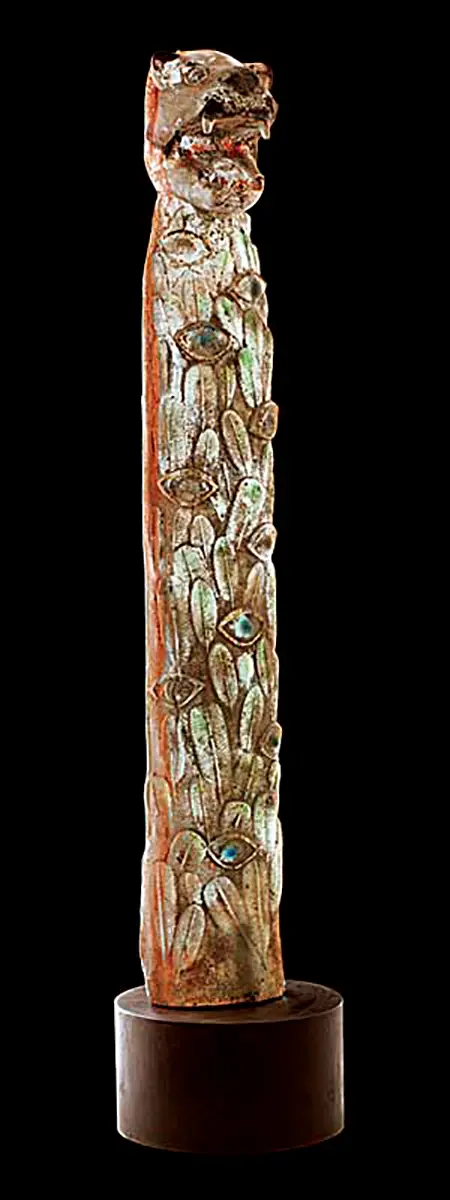
More than glassblowing, the technique that has motivated De Obaldía to create increasingly imposing glass sculptures has been glass casting, working with sand or plaster molds, into which she inserts broken or molten glass. Through the years, she has progressed in her experiments, as much in terms of the diversity of materials and techniques she employs, as well as with regard to the sheer volume of her pieces. Her largest sculptures have been the result of her work since 2006 at the Wheaton Arts Center in New Jersey, a workshop that offers her the possibility of working with large amounts of molten glass and of finishing her works in huge kilns. There, she produced the largest sculptures in the exhibition, pieces over six feet in height, such as Jaguar King, a majestic glass obelisk covered with engraved leaves and eyes, and crowned by an aggressive feline head.
In addition to this exhibition of historic and esthetic value, the Museum of Art /Fort Lauderdale published a substantial catalog about Isabel De Obaldía’s oeuvre, with color reproductions of the works in the show, and analytical essays about different aspects of this artist’s work by Susan L. Aberth, Edward J. Sullivan, and the present writer. Both the exhibition and the catalog bear witness to the importance of Isabel De Obaldía’s work, and to the position she has earned among glass sculptors today.
MONICA KUPFER