
With twelve solo exhibitions already under his belt—three of these presented abroad—Juan Pastorelli presents his thirteenth show titled Urban Landscape, at La Galería, in Lima. He named the exhibition Urban Landscape because he wanted to demonstrate that “amid the organization and chaos that coexist in the skin of a city like Lima, it is still visually possible to find aesthetic elements.”1 This is the task of any artist, to find beauty where there appears to be none, or where for some reason is not perceptible to others. Pastorelli graduated from the Universidad Nacional de Ingeniería in Lima. There he has to complete required courses in painting, watercolor, and contemporary art theory. So his transition to becoming a visual artist occurred quite naturally.
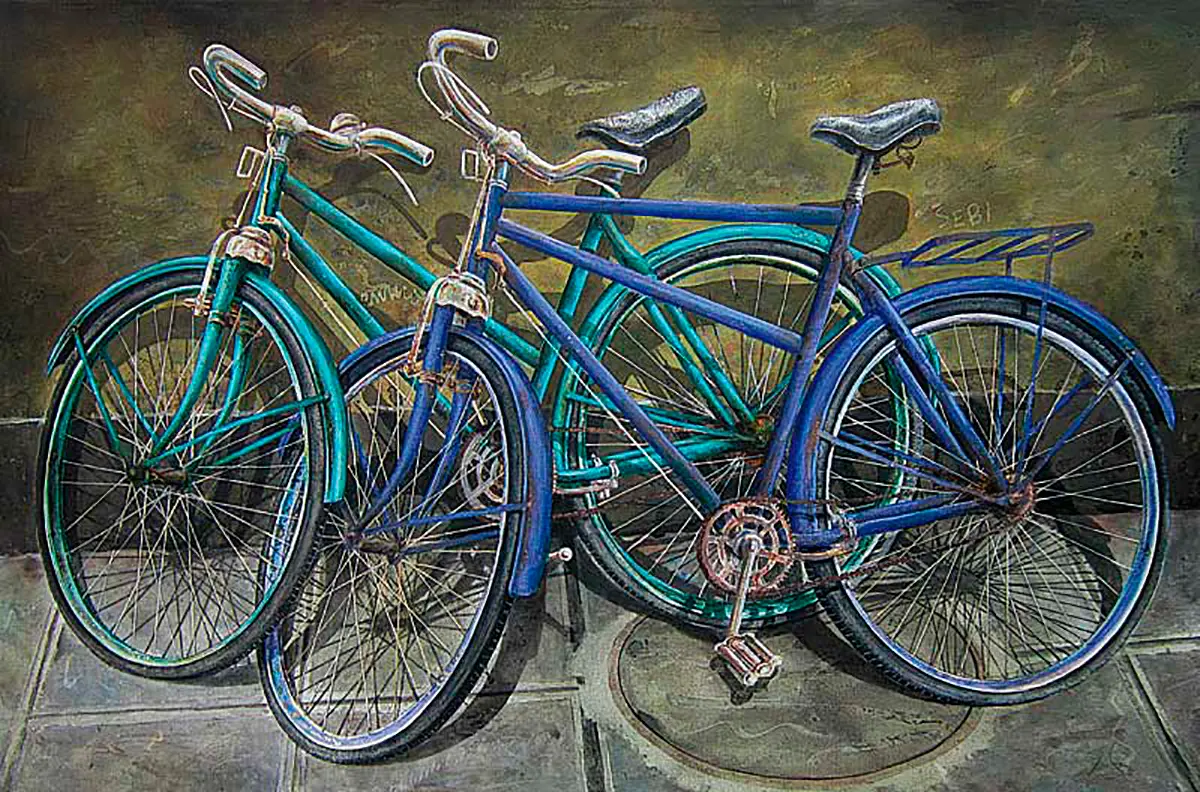
His work could be mistaken with those by commercial artists, as some of his subjects are popular leitmotivs like boats, beach tents, and bicycles. About this, Pastorelli says: “I simply concentrate on the composition, the formal arrangement on two planes, and on the urban iconography at the service of perspective, light, and color.” 2 And this is precisely the difference between commercial art and visual art; the use of light and shadows, forms and volume, color and depth, along with creativity.
In the work titled La Sagrada Familia (The Holy Family), the artist depicts three bicycles, a pink bike for a woman—because of the lowered top part of the frame—a blue bike for a man and a brown and orange bike for a child. Thus the name of the painting. The bicycles are not chained, but instead, they rest on a blue wall decorated with graffiti. This detail—the fact that the bikes are not chained—informs us that the family must be nearby. It is a sunny day, as the hard shadows projected on the pavement reveal. It is wonderful the manner in which Pastorelli renders the bicycle wheels and their spokes, as the latter multiply into hundreds of spokes and their shadows on the pavement. It is interesting the manner in which the rendering of an image can tell the story of that particular image.
When I asked Pastorelli why he chose the theme of the bicycles, he said, “after the bicycle was invented, it eventually became just a novelty toy for the elite. Then, in other latitudes—like a public pair of shoes—it became a depersonalized vehicle for mass transportation, to the point that anyone could grab the closest bike to go anywhere, while everyone else could do the same the following day, as in China. In my personal experience, the bicycle became the best toy to play with on the streets during my childhood.”3
But not all works by Pastorelli center on the bicycle. There are 4 pieces that only depict urban landscapes. Like the painting entitled Atahualpa con la Diagonal (Atahualpa with the Diagonal) that focuses on two streets in Miraflores, an upper- class neighborhood in Lima. The painting shows the street corners, the street, and the sidewalk, the white and yellow painted on the street to allow people to cross; the special wheelchair accessible entrance, the light posts, the stop sign, and the bus stop sign; in short, an urban landscape. Once again, viewers can observe the hard shadows—created by the posts and the building located on one side—that confer depth to the urban landscape. The work is rendered in a very exquisite manner. There are no people in any part of the image, as the entire emphasis of the work centers on the city and its view: one that has been transformed in the last 20 years, since the streets did not use to be painted in this manner. In the work 28 de Julio con la Paz (28 de Julio and La Paz), there we observe a blue bicycle for men that rests on a light post in a street corner. The yellow and white paint from the street signage is also partially visible. Even the last letter from the stop sign can be seen.
When I asked him what kind of things he painted with watercolor, he told me, “Dürer painted the image of a rabbit in watercolor; British painter, William Turner, was the founder of this genre; US artists, Homer, Hopper, Wyatt, and O’Keeffe also used watercolor; Paul Klee did the same to create his abstractions. So, as far as I am concerned, it will always be treated as a serious matter.”4 It is interesting that Pastorelli uses watercolor when it is so rare to find artists who still use it.
NOTES
1. Interview with the artist, June 2012.
2.Idem.
3.Idem.
4.Idem.
AUGUSTO CHIMPEN