
Born in Milan (1924), Linda Kohen left Italy and settled in Montevideo; later she moved to Buenos Aires, São Paulo, Europe, and the US, before returning to the Uruguayan capital. A pilgrimage forced, first, by the dawn of the Holocaust, which she fled with her parents, and later by the military dictatorship in Uruguay, from which she escaped with her husband and children.
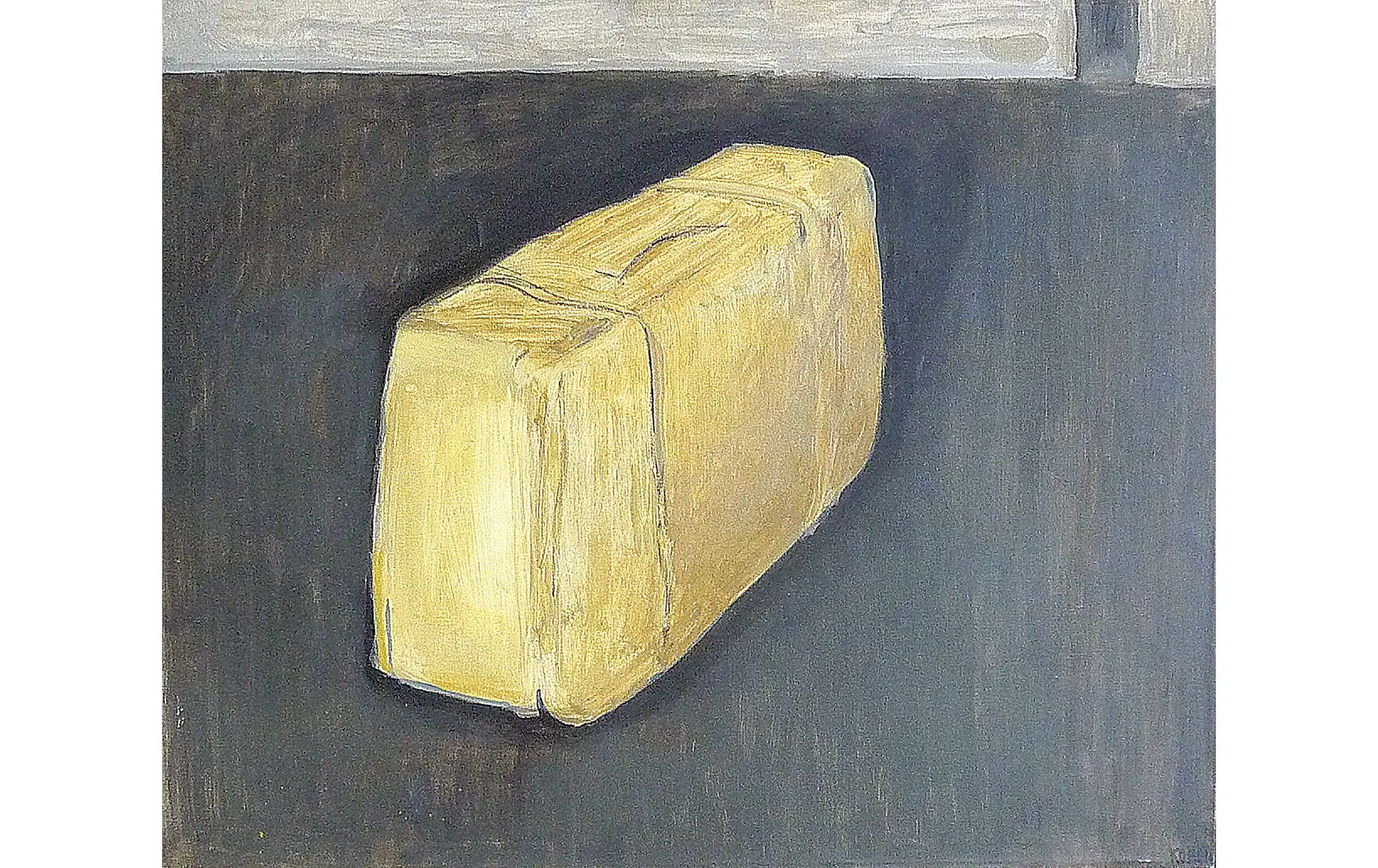
Over the years, the artist’s nomadic condition has revealed itself central to her iconographic repertoire: her permanent displacement, picking up tents, and safeguarding her past (which she must resign, even against her will) under precarious covers, setting up and settling down time and again. It is not surprising that boxes and luggage are among the prominent topics of her painting.
In short, Linda Kohen’s art accompanied her nomadic days—an issue whose relevance cannot be escaped in this era of globalization.
A Female Gaze
Boxes, luggage, beds. Through these themes, Kohen’s paintings communicate a qualitatively feminine dimension of her permanent uprootedness. Profound and anguished, her paintings display the angst of expressionism tempered by the years spent as a member of the Torres García Workshop, where she studied with Gurvich, Alpuy, and Augusto Torres.
An artist who keeps her distance from any spectacular inclination, she works with a limited but precise set of visual resources. Her work unfolds in the life spaces she encountered and the everyday objects that surround her. Most of her paintings are austere in their use of color: a low-key palette of ochre, gray, white. In most of her work, color is a single hue traversing the entirety of the canvas (she does not hold on to objects because they are a temptation to become sedentary). Similarly, and despite being a child of the informalist generation—which, privileging the organic world covered the surface of the canvas with densely impastoed brushstrokes, creating a kind of matteric topography—Kohen sees the matter in an abstract key and uses textures only minimally. Her low, austere palette and the absence of texture connect with Morandi’s painting. And, as was the case for the Bologna artist, for Kohen, “less is more.”
“Painting is a Thing of the Mind”
In this way, bareness and essentialism define Kohen’s art. She seeks to create visual shapes freed from any contingency; hers is a mental painting. Linda Kohen always painted from memory in order to arrive at the configuration of the shapes and objects being represented. She is not concerned with verisimilitude, but with pictorial values such as color, composition, and construction. Here we note how, along with Amalia Nieto and Elsa Andrada, Kohen represents the female side of the Torres García Workshop.
It is thus that almost all of Kohen’s objects are abstractions, as she subtracts from them anything anecdotic, all that is not constitutive of their form, and transforms them into the pure image. Had he been Kohen’s contemporary, De Chirico would have defined them—as he did for Morandi—as “the metaphysics of the commonest objects,” with the artist seeing (and showing us) that which we perceive as dead “in its eternal aspect.” However, objects are the protagonists of Morandi’s still lifes; for Kohen, objects are volatile.
A mainstay of her long career is her invitation to traverse a world that appears as intimate and private. Hallways, doors—closed or ajar—windows, staircases, plaques—all from houses she has inhabited; interior spaces and familiar furniture: an unmade bed, a couch, a table all set and ready, but alone; valises filled with old letters or family photographs, empty recliners, and boxes, many boxes, those mysterious cabinets. In sum, the organization of space inside a home. The realm of women, characterized by its intimate tone. (But file cabinets can also present the enigmatic traces of the public space as it interferes with the home, especially in repressive societies, where they symbolize an intrusion in the private sphere as they contain documents relative to lives that are under surveillance.)
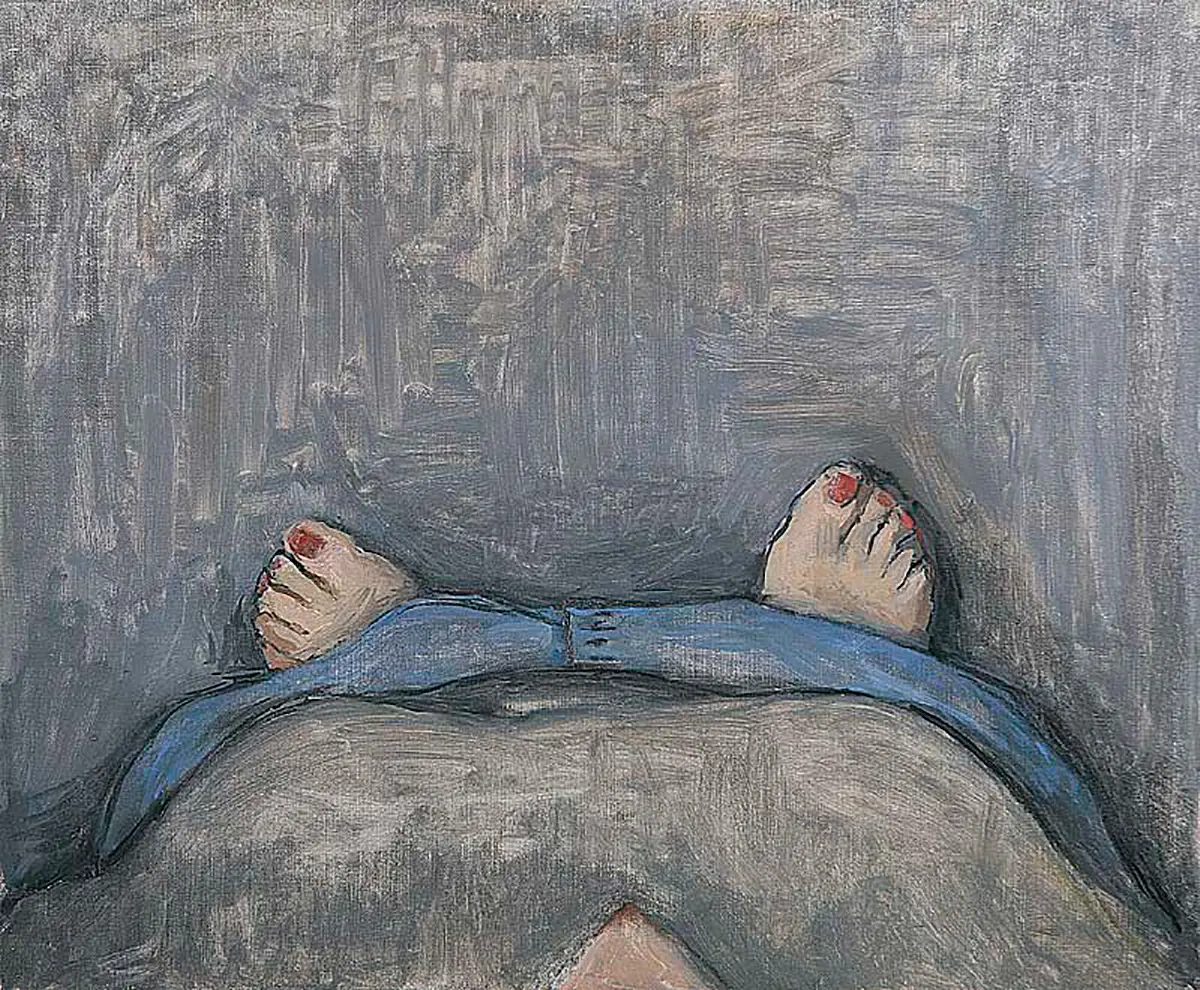
Because of this, Kohen’s exploration of intimate spaces can be confused with subjectivism, especially since, in some of her works, the artist seems to be looking at herself laying down (De pie is one of her most notable paintings), eating, painting, or working. However, neither her portraits nor her self-portraits point towards an introspective psychological quest; rather, they are a pretext for her exploration of pictorial values. Kohen shows objects, but she hides as a subject.
The Forge of the Fragment
When Man was represented for the first time, as in the Neolithic caves of the Sahara, the body appeared in full and with a kinesthetic projection. In that era, one’s fate was dependent on the agility of the legs and the skill of the hands, the functioning of one’s sexual organs, and our kinship with animals. In turn, Linda Kohen represents the body of her characters—be it in her portraits or her self-portraits—in a fragmentary manner, inscribing her work in the aesthetic of the fragment that emerged in the history of art as a consequence of the fragmentation of society and values, as well as in a fragmentary concept of the individual, characteristic of the Modernist period and philosophy.
This fragmentation is photographic in nature. Before photography, portraits strove to capture the unity of a person’s different moments. Photography, on the contrary, captures a moment and a concrete framing of the real. Kohen’s portraits carry something of that instantaneous photographic sensibility. And they perhaps have a point of reference in Rodin’s sculptures and the paintings of Schiele and Philip Guston.
While Vuillard trains his gaze on the private life of his characters, Kohen proposes stages for absent characters. She shows the world behind closed doors, the private world we inhabit but are not presented with as viewers/ Kohen’s domestic scenes are impregnated with a perhaps unsettling atmosphere, reflection of the uncertainties that mark the Twenty-First century.
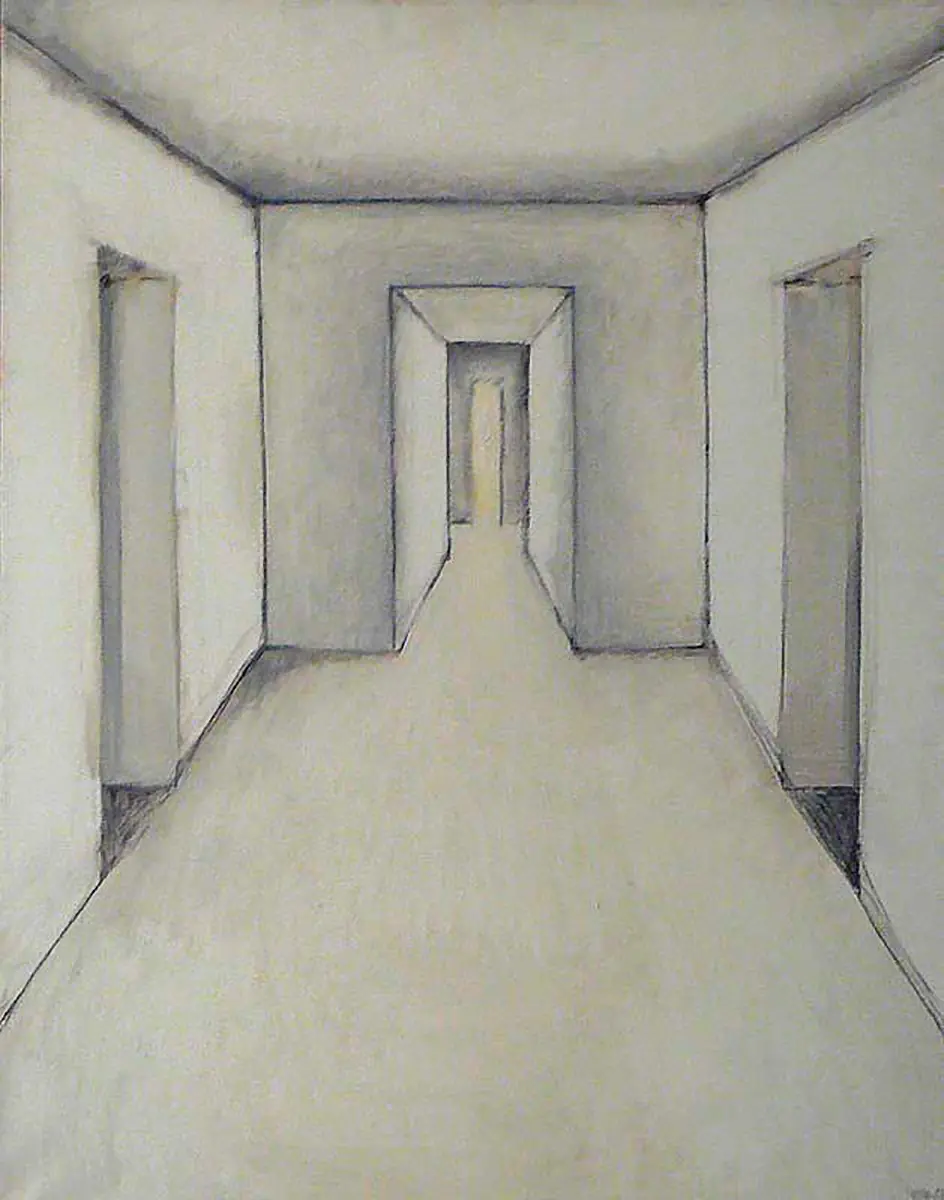
Linda Kohen paints the space around her body, as well as doors and windows, those diaphragms of space. And when she appeals to perspective, in Corredor simetría (1998), she deploys perspective of an accelerated manner, similar to Munch’s The Scream. Here, Kohen fully achieves minimalist expressionism.
Forking Paths
The artist wrote: “I paint in series; I have painted the hours of my days (…) my person, my home, portraits, people, the loneliness of man (…)” these series articulate her world under names such as Soledades, Cajas, El Peñasco, La Valija que contiene cartas de familia, Interiores, La Cama, etc.
The Valijas series (1985). Open or closed, they speak of roots and uprootedness. Luggage brought from Italy, by her and her parents, like many immigrants/migrants of the past and today. They name the need to adapt their more salient characteristics (culture, religion, language); yet, the spaces are generic and minimalistic. In Uruguayan art it is necessary to establish a parallel between Hilda López’s approach to the topic, with a more tragic, more socially marked kind of painting, and Linda Kohen’s, whose work, while referring to family circumstances, once again emphasizes the pictorial, reaching unusual degrees of mastery.
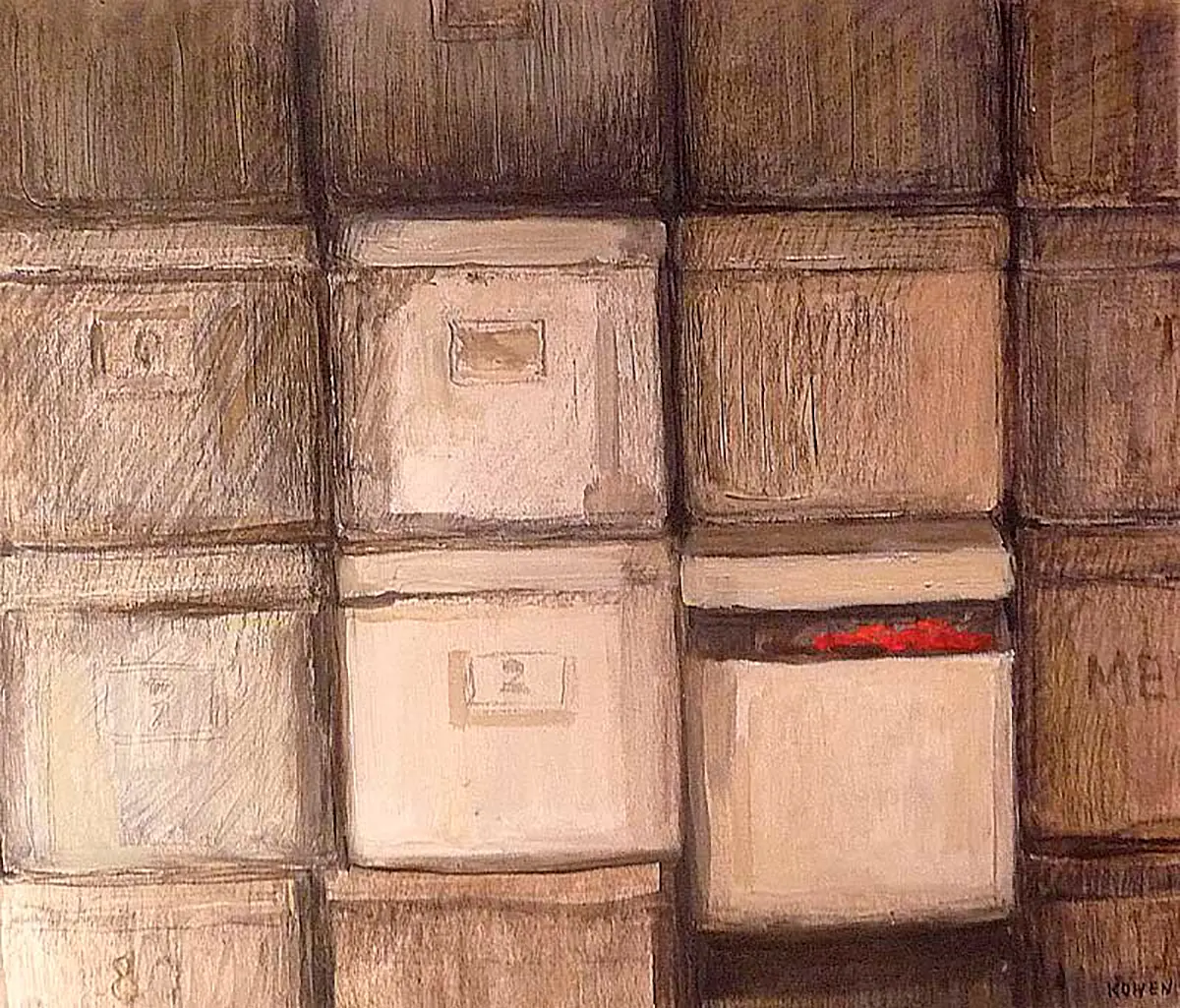
The Cajas series (1987). Boxes in a tradition that, in Uruguay, harks back to Torres García. Kohen paints these everyday objects of consumer society. Cardboard boxes, archive boxes, packing boxes; piled-up or in disarray; open or closed; whole or in fragments (due to the photographic close-ups of her compositions); clean of labels, they cultivate the consistent mystery of an archive of forgotten chronicles, faded photographs, letters, press clips, hotel bills, documents. The past at the ready.
Of Towers and Sky Scrappers
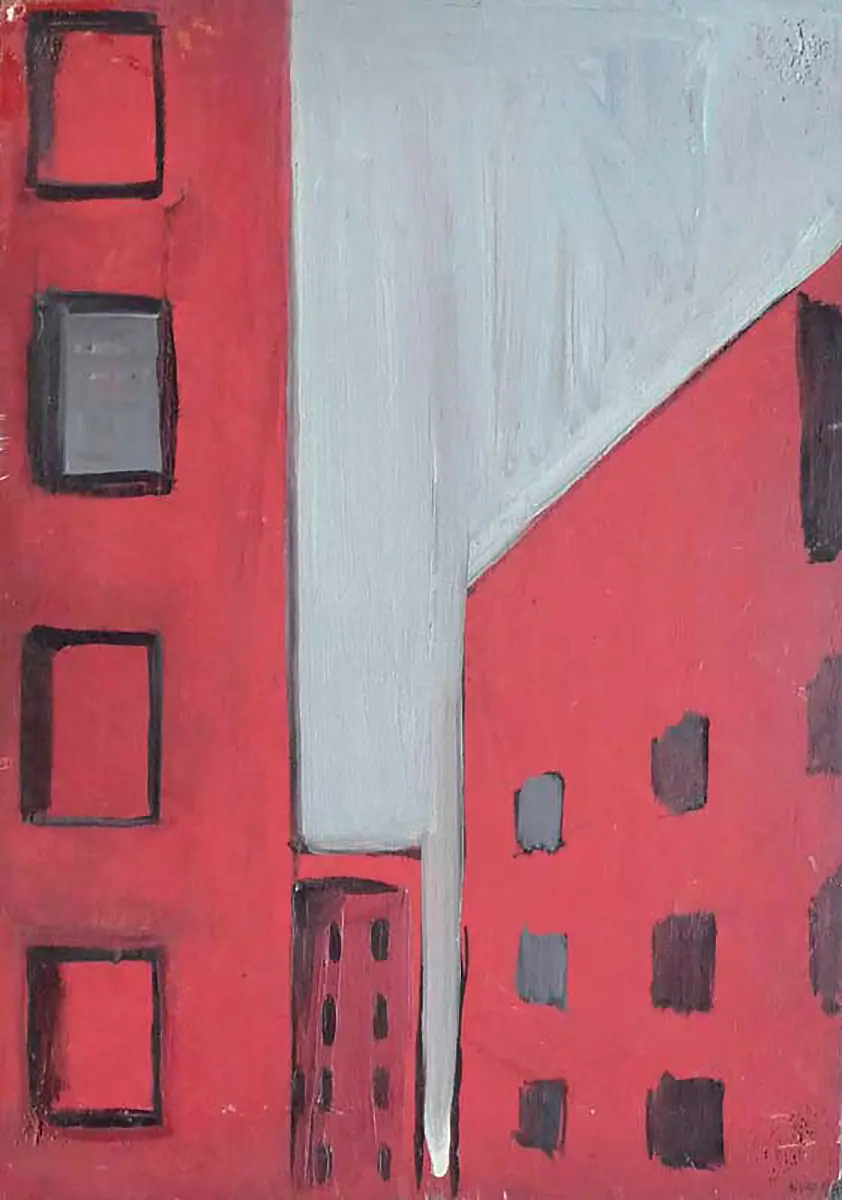
The El Peñasco series (1991) brings to mind the walls and windows of her house in Punta del Este. “A house,” says Bachelard, “is primarily an object of strong geometry (…) It is made of well-carved solids (…) Dominated by straight lines (…) such a geometric object should be able to resist metaphors that encompass the human body, the human soul…” But El Peñasco is a house with elements of a tower, and it is known that towers—medieval or modern sky scrappers in São Paulo or New York are emblems of power, family-based in the past, monopolistic today. These paintings by Linda Kohen count the solid figures in her walls, geometric in structure, reduced to essential planes and painted with a high, crackling palette, devoid of human figures, with a minimal landscape around them in which we find resonances of Giotto (in fact, one of the canvases in this series is explicitly titled Giotto).
A tower rises above other constructions, and this facilitates surveillance. From the heights of El Peñasco it is possible to survey the neighboring city of San Carlos, orphaned of trees, and that is the view Kohen has of the streets and houses she paints in her San Carlos series (1991) Linda Kohen found in that place an equivalent to what Horta del Ebro was for the earliest cubist paintings by Braque and Picasso. There is but one step from cubism to minimalism.
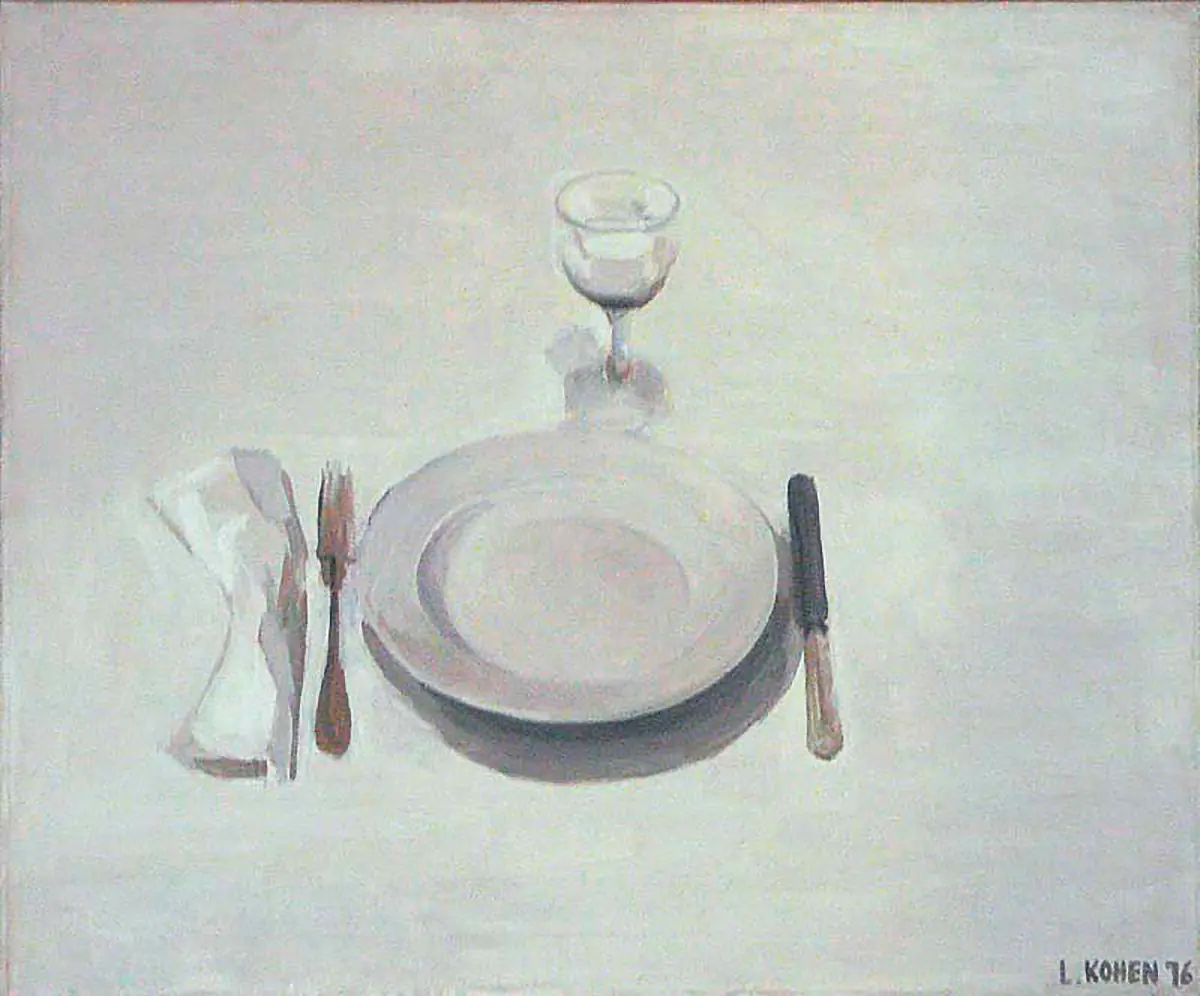
The houses have a familiar connotation, and their character and their place in society are defined by furniture. The table where she eats, for instance: La mesa está puesta depicts a table (she has painted them square and rectangular) without people, lonely; there is a plate and a goblet on a big, dazzlingly white tablecloth. An allusion to the family table, as well as to table manners, ways of cooking, and eating?
Cities with Names
In the series El hombre en la ciudad, Linda Kohen trains her gaze on the modern megalopolis: São Paulo or New York, it matters little; she looks at architecture and men.
These paintings can refer us back to the nostalgia of Roman cities explored by Italo Calvino in his Invisible Cities; they perhaps anticipate Rem Koolhas’ extraordinary The Generic City, where we read that “The Generic City is the only thing that remains of what used to be the city. The Generic City is the post-city in preparation for the establishment of the ex-city.”
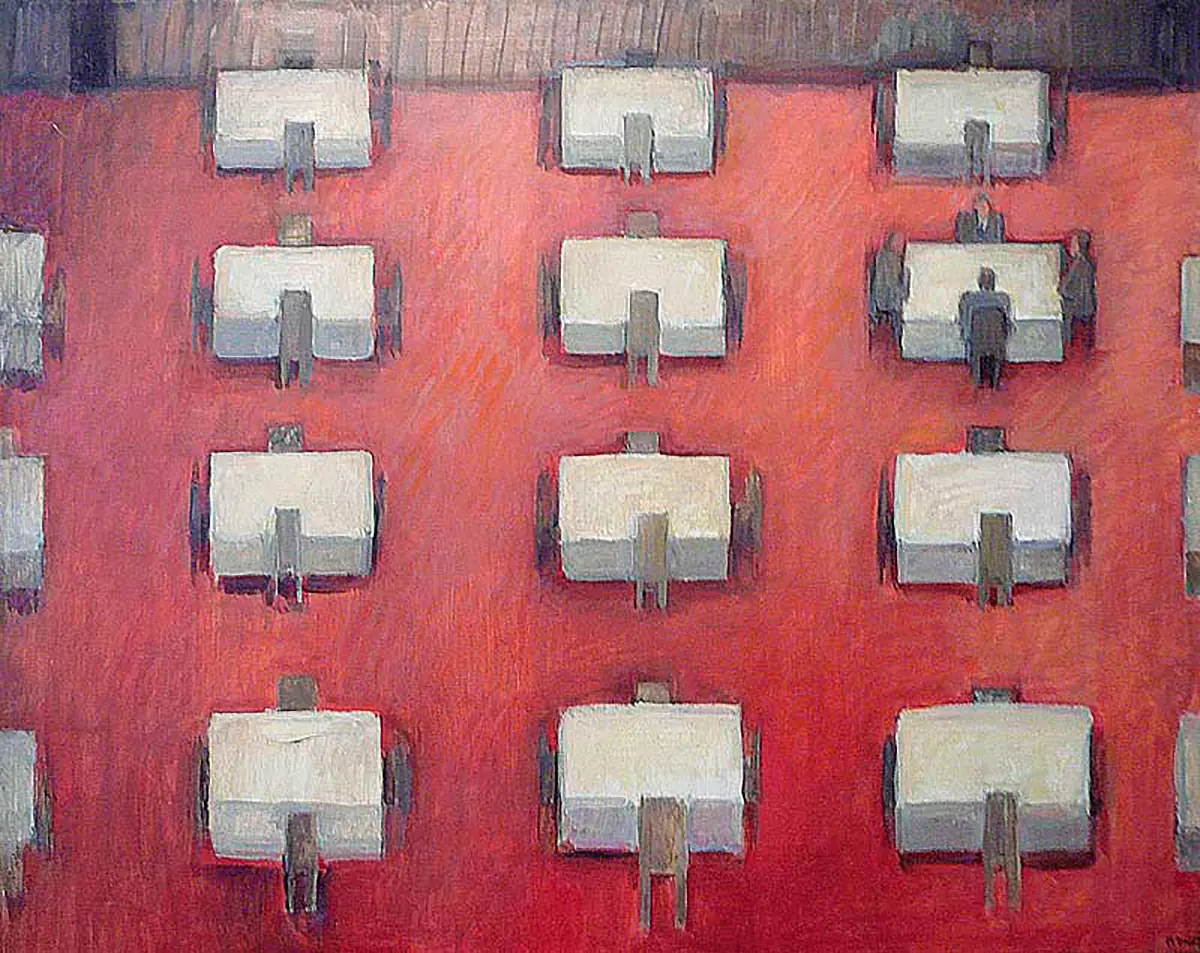
The series Los ejecutivos proposes scenes with executives and functionaries, perhaps working for multinational concerns, the new nomenklatura; for example, a dinner at a deserted restaurant (in consonance with the situation in the US and Europe today, with an economy in crisis and close to default), with many empty chairs. The abstract game of capitalist finance. The ominous presence of an eloquent absence.
A Pictorial Autobiography
As a whole, Linda Kohen’s work has something of the logbook, where she has recorded her memories, the matter from which art is made in order to infuse life into oblivion. “What region of oblivion returns now?” one could wonder. The shock of a complete salvage of the past could be so destructive, as Walter Benjamin wrote, that we would at once stop understanding our nostalgia.
The recovery of the object is the topic and title of Torres García’s last book. Kohen follows in the Master’s steps: she recovers objects, transformed into traces, vestiges, skid marks from the passage of time, “because it is impossible to escape the fatefulness of memory.”
Kohen’s artistic language, self-sufficient and closed in itself, is realistic in nature, but of a kind of realism pregnant with metaphysical intimations emerging from the (seeming) minimalistic quietism of her paintings. Her work doesn’t offer up anything more, or less than presence as a visual reality. Nevertheless, her paintings hide more than they show. “Mystery is what moves my painting. In other words, I want and it is important to me,” the artist confesses, “for my painting to speak especially of what isn’t there, what one imagines, intuits, or senses, what unsettles us and we strive to understand: the mystery of our lives, of the universe… of life itself.” Attempting to discover the bottom of her mystery is the challenge Linda Kohen posits for her viewers.
ÁNGEL KALENBERG
Art critic. A member of the IVAM Directing Council. Director of the Museo Nacional de Bellas Artes, Montevideo, 1969-2007.