
Magdalena Fernández presents the exhibition titled Greys at NC-Arte in Bogota. It is a project that once again reminds us of abstraction and of the legacy of the great masters that transformed this artistic manifestation into a symbol of modernity; a manifestation whose influence can be felt across all realms of contemporary artistic production.
Two fractured and suspended steel columns—Fernández placed each next to one of the two concrete columns that support the building—welcome us as we enter the NC-arte space. This monumental gesture shakes the notion of stability that the building usually inspires. The two hollow cylinders created by the artist hang from the ceiling suggesting the pause before the imminent fall, the break of the line, of the axis. The tension between the weight and lightness is central and is precisely generated by the confrontation between the real and the contrived. Thus, the questioning of the structure becomes the preamble to the exhibition.
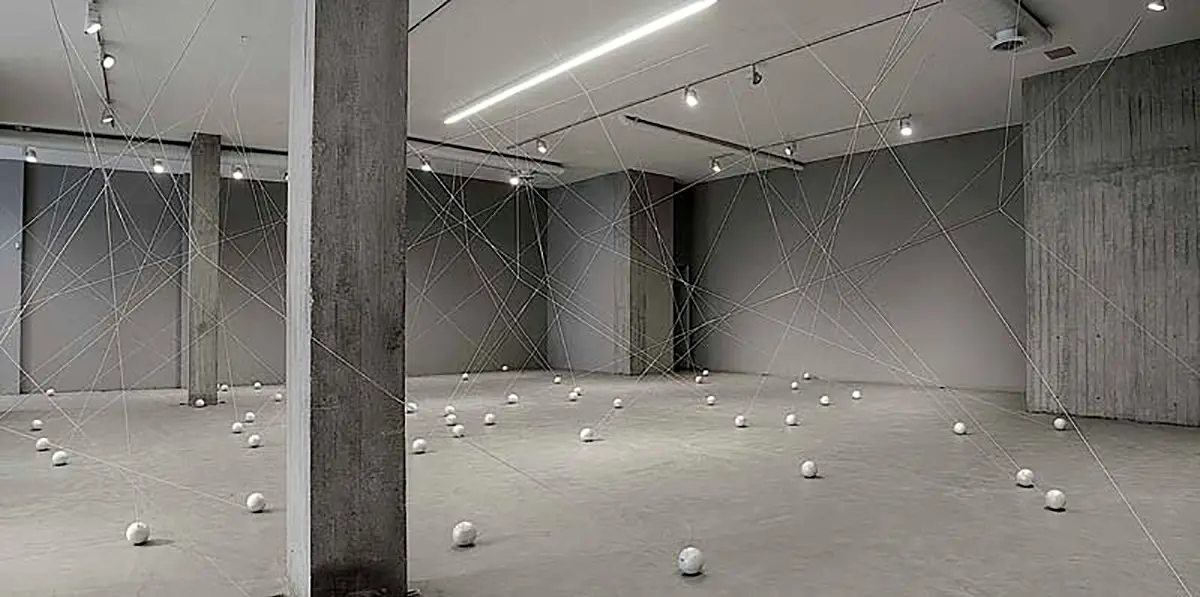
The creation that appears next in a rear plane is a lattice created with white elastic cords. Emerging from white painted steel spheres that simulate Styrofoam balls and that remain completely still on the floor, the flexible cords are diagonally projected across space and fastened to the ceiling. The intersections they generate create a three-dimensional drawing in which line and point play central roles. It is a landscape made of primary forms in which the geometrical realm is pretty much alive. It could be perceived as the essential structure of a forest, in the same manner, Piet Mondrian created his dissertations with the figure of a tree, as part of his research process focused on abstraction.
Viewers are encouraged to move across this flexible web, to adjust the cords, and to negotiate their way through the structure, in the same manner, they would do it if they were walking through a forest; in an act that opens access to the landscape in order to continue on the path. It is an interpretation closely associated with the type of landscape found in Venezuela that the artist has observed with a keen gaze. The shadows projected by the diagonals experience constant mutations as a result of the light changes and the movements by those who dare to interact with the installation.
On the second level of the NC-arte building, Magdalena Fernández presents pieces that reaffirm her interest in exploring new visual languages and their potential to expand. Here, she presents one of her mobile paintings titled Layers, in which sound and the projection of light are synchronized to render a landscape, to construct an image where the intensity of the sounds elements have a central role in the proposal. It is a video installation in which the interaction with viewers is encouraged, as their shadows interfere with the projection immediately upon their entrance into space. The rectangle is the basic form Fernández uses to construct this piece. Containing sources of light, the rectangles overlap each other in a visual event that makes the image projected on the wall increasingly more complex and powerful—also with the help of the sound elements that perfectly synchronize with the piece. It is an audio-visual proposal generated through the use of two central elements: visual exploration and the use of sound.
Also hanging on the walls are two series of drawings and one series of three videos that could be categorized as timely “footnotes” that offer complementary information about the artist’s work, as they nonetheless manage to be coherent with the most representative works of the exhibition. The small format three-video series addresses the unstable nature of the line Fernández has decided to explore—and subvert through several strategies; it is a line with a life of its own that seduces and questions at the same time.
The two and three-dimensional constructs that form the exhibition oscillate between white and black. Greys becomes an exercise in abstraction that reveals the essential structure of nature. It confronts us with the influences that have been defining in Fernández’s work—Gego, Jesús Soto, Piet Mondrian, Kazimir Malevich, and Joaquín Torres García, among others. With industrial materials and other less tangible elements—like lights and shadows—Magdalena Fernández assembles simple forms and materializes ideas that maintain an intimate relationship with her knowledge about design and architecture.
ERIKA MARTÍNEZ