
We are lucky to belong to a genealogy of symbolic production where we rarely have to witness the most (im)plausible descents of art into the generalized anemic state that appears to rule a good part of the discourse of contemporary culture. It is pure luck, I must insist, that the new Latin American art is willing to bet in favor of a critical sociological perspective that is eager to discuss and debate some of the formulations of the contemporary model, including the very art system and its mechanisms of validation and consecration of its usage.
This is precisely the theme of the new photographic series by young Argentinean artist Mariela Apollonio, currently being exhibited at the Kir Royal Gallery in Valencia, Spain. It consists of an ironic and daring photographic narrative that addresses two central phenomena in connection to the internal mobilization and ideology of the artistic field: “institutional criticism” and “the institutionalization of the work of art, insofar as a fetish of consumption. What are the legalization and valorization mechanisms and under which instruments do they operate? Who is responsible for arbitrating the value judgment that selects what belongs in the institution-art space—in this instance, the museum? What or which criteria are set in motion in such operative, insofar as an exercise of consecration/legitimization/prestige? What is the actual power of critics, curators, or museum institutions when it comes to determining the value of a proposal and, thus, its immediate incorporation into the history of contemporary art? These are some of the questions formulated in Mariela Apollonio’s new photographic work.
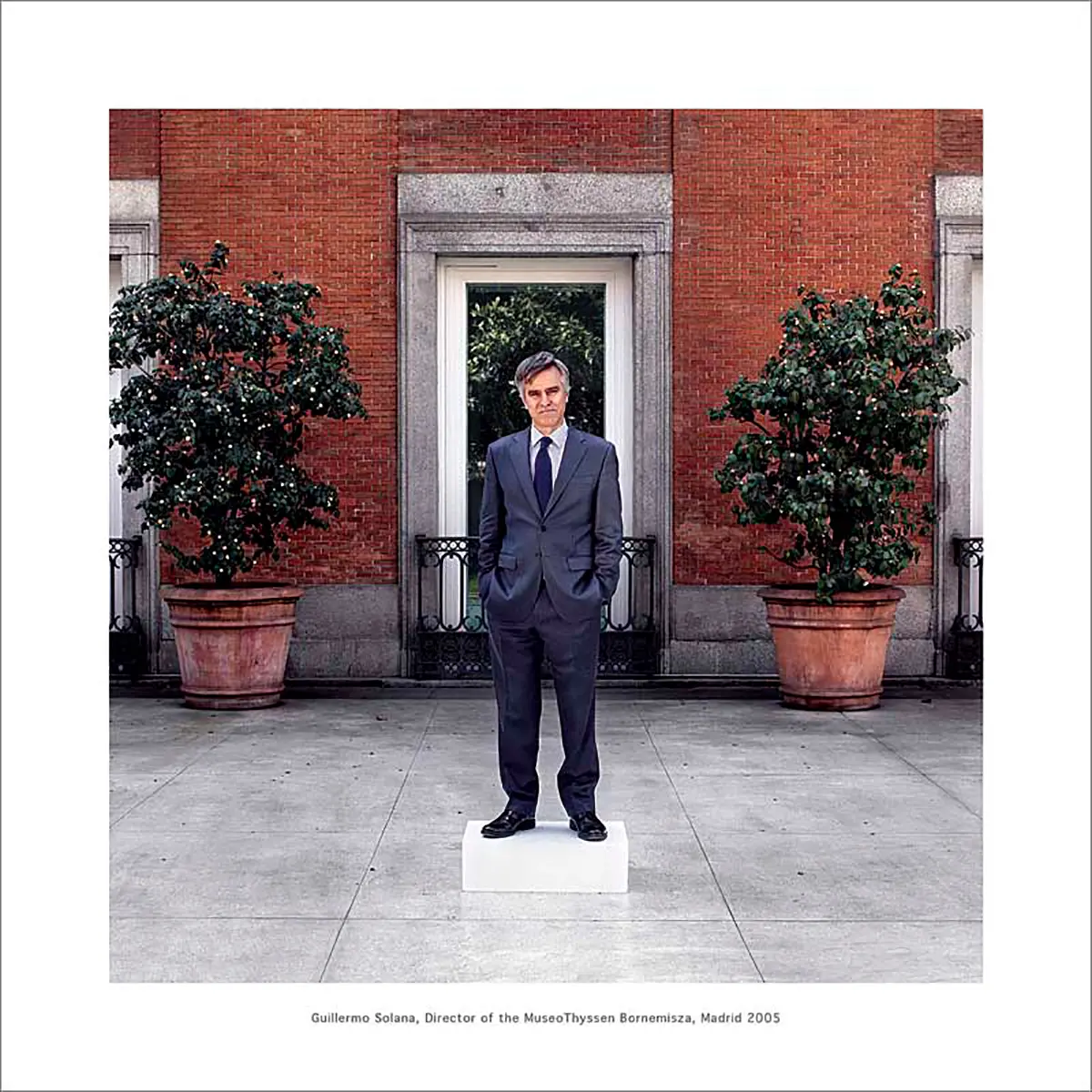
The exhibition consists of a group of wonderful snapshots that depict a “select” group of directors of some of the most important museums around the world, shown immersed in conversation with a pedestal—provided by Apollonio as a prop. With it, the characters establish infinite relationships that reveal an entire set of gestures and poses with ideological overtones. These gestures warn us of the acceptance or rejection of their authoritarian postures or distaste toward the democratic process.
It is an overtly perverse and parodic take on the authority—real or fictional—of this “character” within the institutional environment of art, and of its entire system of persuasive reactions that barely subvert the establishment in favor of new and ingenious emancipatory and countercultural impulses. It is here where part of the appeal, the lucidity, and intelligence of this project resides: on the one hand, it understands—in my opinion—that art must encourage critical commentary toward the very ontology and operational configuration of the field; on the other, it understands art’s inability to transform these structures and destroy their hegemony; although it is able to reduce their authority from the realm of the discourse.
I have no doubt that this approach is part of the ideological core of many projects by young Latin American artists to whom reality is nothing but a cultural text threaded by an infinite number of paradoxical and complex relationships of power that alternate with the masquerade. On one hand, they undermine the authority of certain hegemonic structures, as they attempt to subvert as their discursive efficacy as much as possible; while, on the other hand, they are completely aware of which tools are necessary and the reach art has to generate from within the real transformation of such structures.
The fact that it is a pedestal and not any other artifact from everyday life, in itself, imposes or predetermines a certain degree of logic to the algebra being used. While Apollonio does not intervene in determining the manner in which the “model” will relate to this base, the artifact itself allows a maneuver of usage that, in principle, appears not to leave much chance for democratic improvisation. This maximizes—even more so if it fits—the destabilizing and ironic nature of the proposal. It may be relevant here to consider the cultural—and conceptual—tradition that surrounds the object of the pedestal and even the very figure of a director, now turned into a sort of contemporary effigy, hero, conqueror, or saint. There are many interpretative possibilities and winks established in this mise-en-scène. A triad of rampant complicity and perversion appears to announce the final destination reserved for this figure that apparently enjoys a hegemonic position within the field: the reified director, reduced to one more object and, thus, invalidated, like most works that freeze and stay in a time that taste like death; the director that has turned himself into a “work,” insofar as exquisite corpse extolled by the anthropology of art; the reclusion and freezing of the activity of legitimization of a “closed field” that “does not expand,” while it strives to recover the most orthodoxies and traditional typologies of a sculpture that does not scape the margins of its perimeter.
The most brilliant example—or at the very least the most unsettling—within this new theology of authority, is embodied in a snapshot of Vicente Todolí—former director of Tate Modern, in London. Unlike the rest of his colleagues, who are shown posing inside the sacred realm of the museum, he appears in the shadow of a garden. For the occasion, he transformed his pedestal into a jardinière full of ornamental plants. I think that Todolí’s case, notwithstanding his amusing gestures or the possible strategies of acceptance or rejection of his own authority, is symptomatic to the degree he acts as co-creator—the doer—of Apollonio’s work, as he orchestrates his own performance and takes it almost surpassing the limits of suitability, legitimacy, and pertinence established by the artist’s proposal.
In any rate, between some and others, amid the most unsettling and most expected—perhaps even suspected—there is a story about the authority of canon, the legitimizing functions, and mechanisms, always intricate, of consecration that establishes the differences between men and the gods.
ANDRÉS ISAAC SANTANA