
With its ethical and political content, Proyecto ADN, an exhibition by Máximo Corvalán-Pincheira (1973) is primarily an immersive experience that plays with visual impact and beauty. The strategy is intentional: to give the installation powers of seduction that can compete with the dimension of the spectacle. And what one finds after immersion is, indeed, a fictitious and provocative experience that is also close to the experience of horror.
As we walk in the Santiago Metro’s Quinta Normal station, next to the ticket booths, the sound of water guides us towards a gallery that presents a scene filled with luminous sculptural objects suspended over a large pool. Space connects the underground train’s terrace with the Museo de la Memoria y Los Derechos Humanos, which rises across Matucana Street. Under a subtle buzzing, the intervention suddenly resembles a twisting insect hive, dragonflies, or molecules floating in the air, representation of DNA, or artifices of a science-fiction experiment. They are bodies, with incessant threads of water coursing through their veins. They are bones tied by cables, traversed by fluorescent tubes and electrical circuits; assemblages of animal or human remains. The skeletons are reflected in the water; the shapes are replicated, like ghosts.
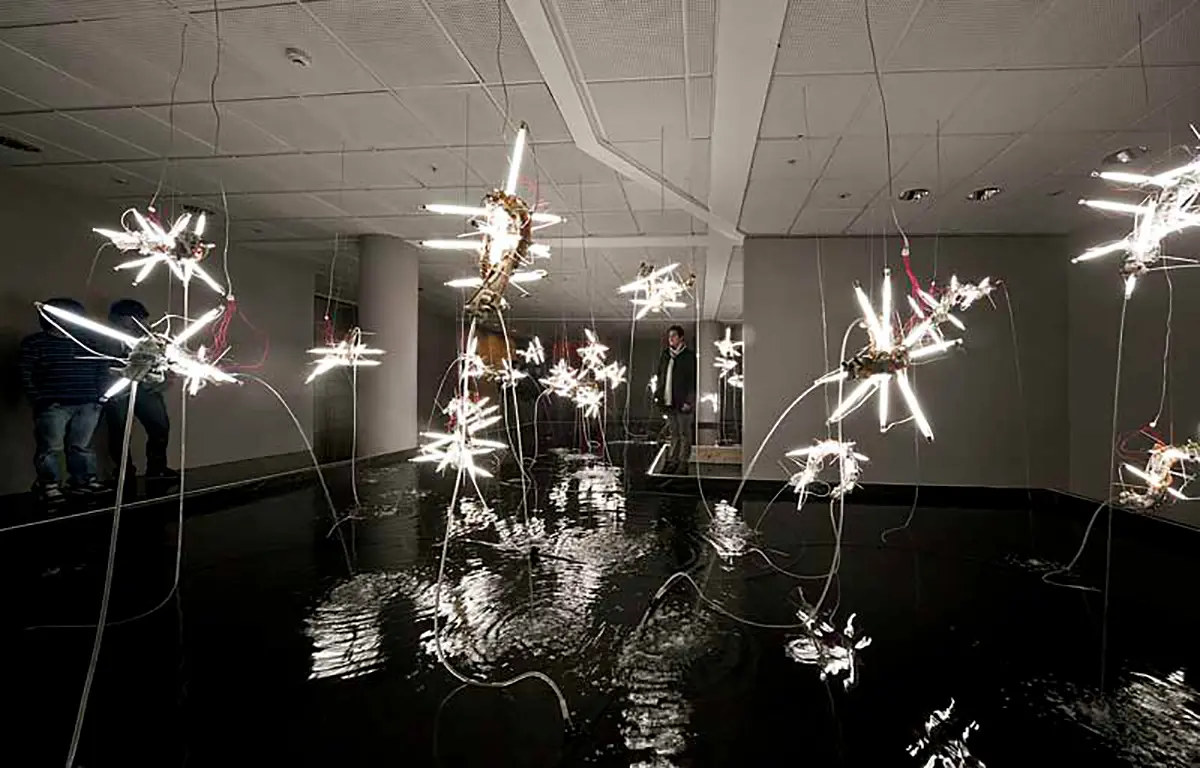
The artist’s craft plays with a low-tech aesthetic and with effects that generate constant tension. Water and electricity, the organic with the technological, light, and shadow, a sensation of peacefulness and at the same time of imminent danger. This also works with precariousness and the spectacle, the beautiful and the sinister. Proyecto ADN takes us to a territory in suspension, where different narratives are woven on the basis of the image of the DNA and the consequences of the latest discoveries for science, contemporary visuality, our experience of the real, or the construction of history.
It suffices to recall how key nuclear DNA analysis has become in the identification of bodies after great, highly symbolic disasters such as the attack against the Twin Towers in New York City (2001) or the accident of Chile’s Casa 212 in the Juan Fernández archipelago, which killed its 21 passengers, among them TV personalities, cultural figures, and local politicians. In Chile, these advances have been at the vanguard, but pointing towards another brutal fact, which Corvalán-Pincheira connects with history itself: the death and disappearance of political prisoners during dictatorial regimes. The artist is the son of Ricardo Pincheira, a medical doctor and an adviser to Salvador Allende who was arrested inside Santiago’s presidential palace, La Moneda, during the September 11, 1973, military coup. In 1994 he was notified that his father’s remains had been identified in Yard 29 of Santiago’s General Cemetery, yet some accounts asserted that Dr. Pincheira had been killed by firing squad and his body blown up with dynamite at the hands of the Tacna regiment. Only in 2006, and thanks to the DNA analysis of some fragments found in a common grave, was it possible to confirm his identity. The paradox is that these analyses require the destruction of the fragment. Disappearance is now definitive.
Corvalán-Pincheira’s work has always developed in the process, in connection with Chile’s recent history, with autobiography, and the spaces in which it rises. In the Museo de la Memoria, it acquires a solemn, haunting presence, perhaps related to the path we follow through a collection of photographs, documents, videos, and objects devoted to the history of human rights violations during the dictatorship and the struggle for its defense. Just a few days before the exhibition’s opening in July, the museum was very much in the news. Magdalena Krebs, from the DIBAM (the Chilean government’s Libraries, Archives, and Museum’s agency), questioned the institution’s pedagogical effectiveness for its exclusion of the context in which those events unfolded. In Krebs’ view, the systematic actions of disappearance and extermination are rendered relative by the fact that all was a consequence of the country’s processes. Several voices were raised in that juncture; Corvalán-Pincheira’s work was, unwittingly, a response from the other side of the divide.
Proyecto ADN may be speaking to us about situations of disaster, of torture, of dictatorship in Chile, of the need to rethink history and question the power of those who write it. But if we pay attention to its surface, to its fierce poetry, the mise-en-scene can be a memorial to the disappeared father, a reconstitution of bodies or suspended molecules, a monument to the human genome. In its apparatus, fiction confronts us precisely with the real, with what is about to happen: a short-circuit in this perfect chain or a loss of the body, which is not the same as silence, absence, or the loss of memory.