
During the month of April 2012, the Fototeca de Cuba presented an exhibition titled Historia de un Gusano, by Nadal Antelmo (Cuba, 1968,) comprised of 25 color photographs in digital print on paper (60 x 50 cm), framed and hung on the wall; a larger photograph (3 x 0.60 m) placed directly on the floor; and a flexible object hanging from the ceiling (elongated polyester travel bag used for carrying personal items—1.40 x 0.40 x 0.40 m—in substitution of heavier luggage, known in Cuba as a gusano, or worm) in the middle of the main exhibition gallery. But gusano has also been, for the past 50 years, the term used in official discourse to designate those opposed to the revolution and to socialism, people that often took the path of exile but who, with time and the “positive shifts” in the ideological treatment they received—once it was possible to visit the island to reunite with family and friends—local wits rechristened as “butterflies” in a clear allusion to the “zoological metamorphosis” undergone by the political animal in question due to the new circumstances in the country, not always well received by the institutions of power.
Now the gusano is a different one: its very nature has changed substantially even to his or her own eyes and those of its social space, since, whatever they believe, however energetically they dissent or not, exile is no longer a primary concern; rather, the desire is to travel regularly and return with one or more gusano bags in tow, filled with everyday objects and personal items for their family and friends, and to sell them in Cuba for a profit that will allow them to forge a new way of life in accordance to the recent small-scale economic reforms that allow, after so many years of prohibitions, to set up private businesses of a variety of kinds.
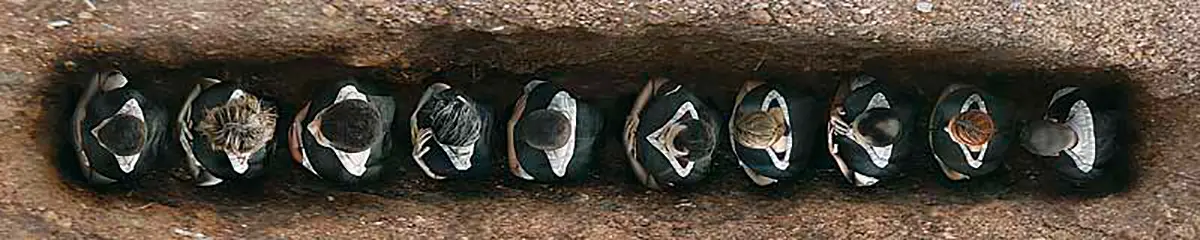
Now the gusano is an entrepreneur, a practical, tolerant, skillful, even successful person capable of participating in unexpected activities while abroad, attempting to understand different realities and contrasting with those of his or her immediate surroundings, unaligned with any cause different from his own and his family’s well being. A new entity, not a New Man, the result of local elements and their intelligent intertwining with the global, who moves at will in a complex world filled with customs and migratory controls, commercial regulations, taxes and duties, restrictions to movement: a post-modern version of Quevedo’s Don Pablos, the well-known hustler who will not be deterred by any obstacles.
It is this reality that Nadal builds, first with his camera and then with the use of software in a dry home lab. After photographing himself inside one of those gusano bags, in a vertical position, he constructs photo-montages posing as the central axis, as the protagonist, based on photographs he has taken in a variety of contemporary spaces: a waiting room in a German airport; the indignados rally in Madrid; a blighted Havana street; the complex, violent periphery of a Brazilian mega-city; a giant warehouse for recycled materials; the inside of a Parisian Metro coach; a political rally for May Day; the luxurious interior of an executive office… All of them revealed through this new contemporary character’s gift for ubiquity; he appears to be one of the most effective survivors ever, in economic terms, in periods of such turbulence as ours.
Nadal Antelmo is not concerned with the legitimated, sacrosanct “decisive instant,” nor with the interweaving of light and shadows that characterized a photographic tradition that is over 150 years old: his works are a strange mixture of landscape and portraiture, built on the basis of personal experiences and others that are taken from the surrounding reality and amplified to the point of overvaluation in today’s Cuba. With the excuse of consumption, the artist plucks the social and political strings that vibrate in the most dissimilar contemporary scenes since such consumerist mentality extends across the entire planet and makes no distinctions: in some cases it even generates addiction, as with cellular phones.
Digital photography thus becomes a pretext for setting up a discourse with powerful foundations in sociology and anthropology, more than any other contemporary humanistic or aesthetic discipline. And an intense autobiographical component, because his own experience is filled on a daily basis with situations that are not imaginary in the least but violently real, however, one looks at them. Nadal has struggled in life like so many other, and perhaps still does… albeit with a modest quotient of refinement and elegance, education, and culture, but a “striver” in the end, in times so critical and unsettling for any human group or society as this dawn of a century whose resolution no one dares imagine.
The cynicism that permeates a discreet zone of contemporary Cuban art is, in the case of the images on exhibit here, sly, latent, semi-hidden, veiled behind a light mist of realism and naturalism that no other artist has assumed in such a way as the topic or issue of his discourse. Nadal is not interested in making it explicit, in making it exceedingly visible to anyone’s eyes: we all know what these images are about, and they require no further explanation. The composition or framing device don’t exhaust his aesthetic expectations, because Nadal is more concerned with what he says and not as much with how he says it, although it is easy to note the form and the resources deployed.
This once again launches the concept of democratization of the image, so often appealed to by experts from all over. Nadal seems to be saying that we can build these images ourselves in the comfort of our own home, with no other instrument than a PC or a laptop computer, after wielding with skill a simple digital camera: the key is to let ourselves be swayed by the seduction of an idea, negotiating effectively the articulation of the real and mental processes that constantly outline and remold our lives.
This show included the participation of friends in the construction of that chapter of the social imaginary now hovering over Cuban reality like never before: they acted as models with their gusano bags or in group images. The latter, to return to the exhibition’s central nucleus, are the fruit of a highly specific moment, the result of a rational cut in the cartography of a mutating society. They do have many elements of the reportage, only not in the traditional way to which we are accustomed: thus their testimonial character, a documentary in the extreme, which can surprise those who deal with the genealogy of their terms.
The paradoxical testimonial content of Nadal’s constructed images is unique in contemporary Cuban photography: it is another kind of testimony, one set apart from any epic sense and from the verisimilitude to which we have been used for years, of the effect if trite objective record. It is the truth of lies that Vargas Llosa has so magnificently explored in his literary essays: fiction as an exemplary document for the understanding of history, of what we have been, of what we are.
In this way, these photographs turn down barriers that for years had seemed impossible to cross, overflows its own territories and those of other expressions in the conceptual plane, eliminates obstacles for a critique of the photographic from photography itself, even if this wasn’t the central purpose of the Historia de un Gusano series. Nadal inscribes his work here within the spaces and constraints of visual journalism, which he had already in a way visited with his series Estética x genética and TV Play (2009) or Mi propia historia (2003), even if they included the manual intervention of each photograph to place texts or other marks. At the same time, following this line of discourse from early on in his career, Nadal has discovered and constructed a language of his own, where codes, morphemes, and syntagmas acquire diverse meanings as components of a larger system.
NELSON HERRERA YSLA