
The work by artist Rafael Lozano-Hemmer is widely recognized across many latitudes. In Mexico, he has participated in monumental art projects like Vectorial Elevation, presented at the Zócalo in downtown Mexico City, as part of the millennium celebrations.
His work is sometimes regarded as electronic art or as experimental art. Nonetheless, labels aside, he always succeeds in achieving an interaction between the work and the viewers that is closer to performance.
On this occasion, the Galería OMR presents seven important works by this artist. Some of these have already been exhibited in other international galleries, while other pieces are of recent creation. Thus, the exhibition becomes a perfect opportunity to approach Lozano-Hemmer’s vision and to have a close look at the interesting proposals of an artist who by transiting between the virtual and the real, is able to generate pieces that—in his own words—have a life of their own. On the other hand, his works are of the kind that can only be truly completed and become more meaningful through the spectators’ participation.
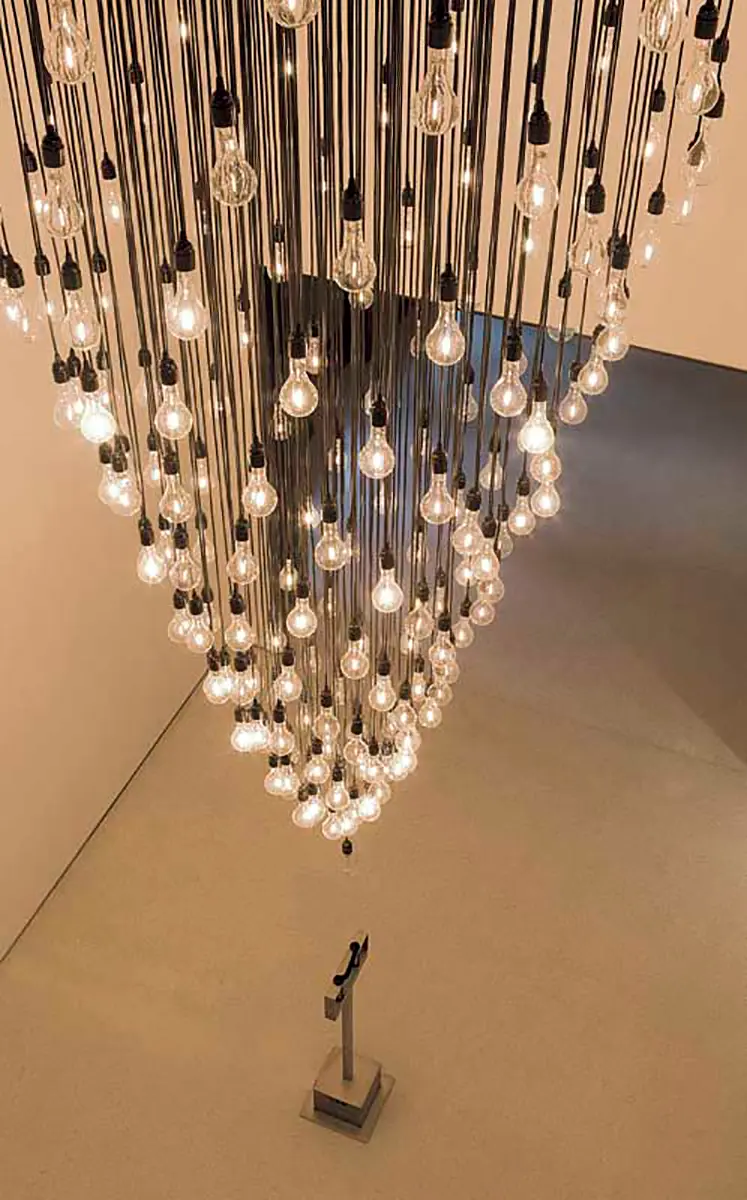
Lozano-Hemmer’s works center on the theme of memory and the relationship between absence and presence, insofar as participation supposes a presence that in this case inhabits the work. Such is the case of Pulse Spiral (2008), a work that consists of 400 light bulbs placed along a paraboloid spiral that hangs from the ceiling arranged according to the equation by Fermat. This equation is associated with the spiral placement of leaves in the stems of some plants or in certain roots. Below these light bulbs, there is a sensor that viewers can hold to take their heart rates as the last light bulb turns on with each pulsation. As the number of participating spectators increases the heart rates registered move up on the spiral.
There is no record of the participants, but there are 400 absences coexisting on a single point that changes with each new presence. Here is where memory persists, even if in a subtle manner, even if the presence is palpable by not being there. The most vital part of existence, the heart rate, is the only thing that remains.
Rafael Lozano-Hemmer believes that his work is not visual but that is rather a “performing art.” There is little doubt that he is right when each one of his works is based on the participation of viewers, their interaction with a given environment that—through electronic media, algorithms, equations, and several contraptions—ensures that the work is continuously changing and developing.
Another highly poetical work that centers on the same absence/presence relationship is Last Breath (2012). A mechanism was designed for this installation to store in a plastic bag the breath of a person forever. The mechanism lets the person’s breath circulate through a hose, like an artificial breathing machine—ventilator—used in hospitals. The device is activated 10,000 times per day, which is the typical respiratory rate of an adult when resting. The mechanism even factors in 158 sighs. Each “breath” is recorded and the mechanism is able to last for the equivalent length of life of the person whose breath it contains, or even forever if periodically maintained. When inflated or deflated the paper bag emits a rhythmic sound that becomes part of the exhibition.
Although absent, there is here a permanent presence that is absent at the same time. A breath of life that has been registered and that will remain as long as the apparatus functions and air continues to flow. The work continuously evokes the presence of someone who is not there but who at the same time is present and lives through the echoes of each one of his breaths.
The works do not overwhelm us with the use of technology. Nonetheless, it is the medium of experimentation and presentation of discourse that, although seemingly contradictory, relies on works closely related to architecture and entirely elaborated with electronic and media elements, for very large spaces—like public squares. Nonetheless, X is not a New Y is a very intimate exhibition that develops a complicit relationship with the spaces of the big house from the turn of the Twentieth century—located in Mexico City’s Colonia Roma—that houses the gallery.
Each of the works by Rafael Lozano-Hemmer achieves the union of aesthetic, architectural, theatrical, mathematical, philosophic, and poetic elements that allow for the works to be in a continuous process of transformation. Such transformation also reaches the viewers, as they not only play the role of usual witnesses but are involved and even pulled toward the pieces; thus, one begins as an observer and ends as an accomplice.
ISAURA RUIZ