
Although hundreds of years ago Sappho wrote verses dedicated to women and their beauty in the island of Lesbos, and notwithstanding the irresistible presence of Cleopatra in Egypt, or Sister Juana Inés de la Cruz’s poems—that in the Sixteenth Century called men “stubborn”—and O’Keefe or Frida Kahlo—both dispellers of the bias against women painters—it was not until the feminist movement during the 1970s that significant changes began to take in the ways women see themselves. It also represented the beginning of “us,” the public in general, looking at women in a different manner in the political and economic world, as well as in the field of the visual arts.
Before this, women in the art world had been defined by the Greeks and the Romans, by Michelangelo, Raffaello, and Leonardo; by Rodin and the Impressionists; by Picasso and Modigliani, De Kooning, Hopper, Warhol, and Lucian Freud. Nonetheless, today the number of women artists who have taken the responsibility of “portraying” themselves, of capturing and sharing who they are—in all their elemental and complex, pure and obscured, truths and realities—is enormous. We clearly see this in exhibitions, art fairs, as well as in local and international Biennials.
We saw this change in Puerto Rico in the works of some vanguardist female painters—Luisa Ordólez and María Penne—in a country that was very conservative during the 1930s, 1940s, and 1950s. And then we had important artists like Zilia Sánchez, Susana Herrero, Toña Ordóñez, Mari Mater-O’Neill, Rosa Irigoyen, and, of course, the master of the female/feminist nude: Myrna Báez—with her spectacular paintings, in the style of Lucian Freud, of plump but extraordinarily beautiful women.
The 1990s saw the emergence of artists like Edra Soto, Ada Bobonis, and Linda Sánchez Pintor, among many others. But it was not until the beginning of the new century when we find, not solely a response to the challenges of the always-changing postmodern artistic world, but also new certainties, equalities, respects, and acceptances. In Puerto Rico this is evidenced in the work of Allora & Calzadilla—male and female artists respectively—and most importantly, in one of Puerto Rico’s most complete and successful urban artists: Sofía Maldonado.
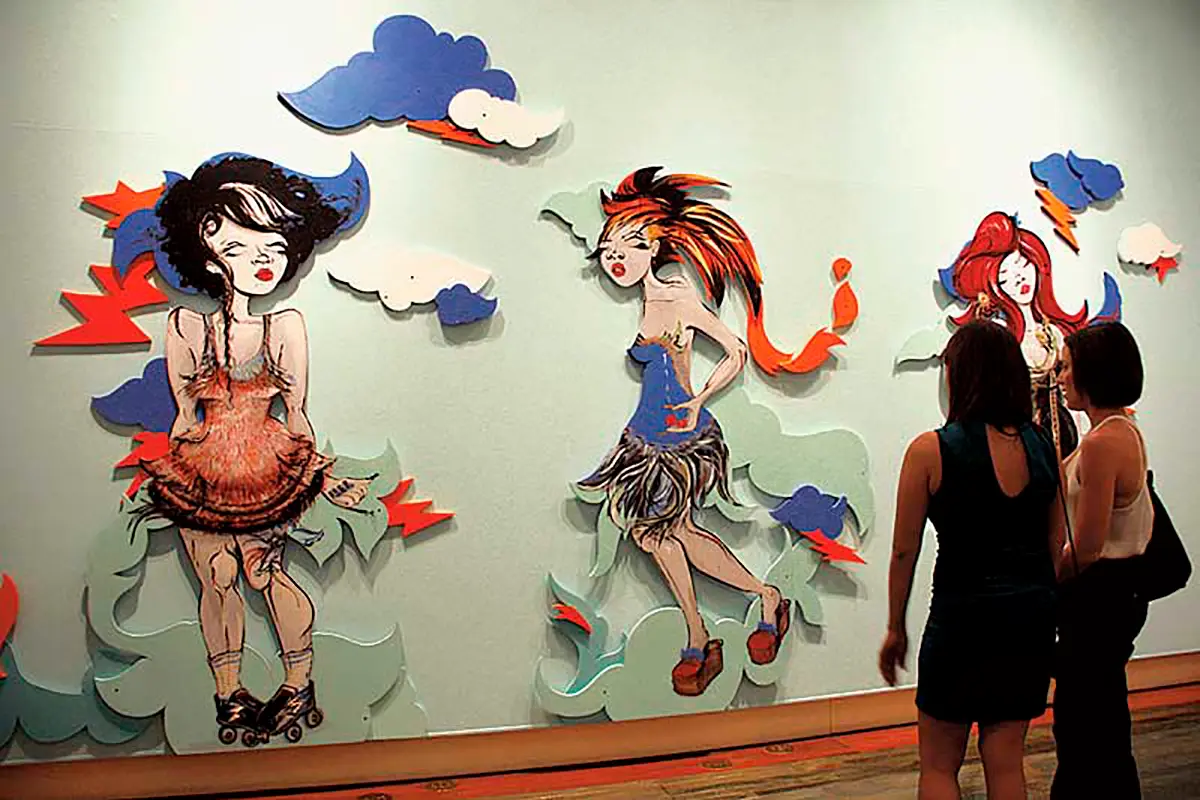
Sofía Maldonado was born in 1984 in San Juan, Puerto Rico. She comes from a Cuban-Puerto Rican family and grew up in a real urban environment, both in Puerto Rico and then in New York—with its rules, aesthetic and ethic canons. After practicing her craft as a street artist, Maldonado completed undergraduate studies at the Escuela de Artes Plásticas (EAP) in San Juan, and then earned an MFA in Painting from Pratt Institute, in New York. She fell in love with the art of skateboarding, as she also became a young master of the existential/feminist/urban gaze. A gaze that sometimes is controversial in her exposure of Latin American women from certain social classes—from Puerto Rico, the Caribbean, and many other regions—and their aesthetic and ethic canons: bodies, clothes, sensualities, gestures, hairstyles, etc., that are as valid as any other.
Maldonado, who began her artistic career as a graffiti artist and painting on old skateboards, was soon recognized by many—I did not at the time—as an important artist. Without abandoning the public spaces—murals, poor communities—she leaped into the world of galleries and art fairs, just as Basquiat and Harina—followed by the majority of talented graffiti artists that remained—did before her. Her biting and almost friendly “portrayal” of certain types of women—rendered with a combination of stylized lines reminiscent of both Pop Art and the Psychedelic Movement—resulted in highly creative proposals that began to greatly expand her popularity.
In order to understand Maldonado’s work, it is important to take into account that: 1. Although her work is exhibited in galleries, important collections, and museums—and despite her unwise decision to design cans for famous soda brands—Sofía was, is, and will continue to be an urban artist; a street artist with a gaze that looks from the “inside” or from the “outside”—however one wants to dissect it—an anti-establishment artist, defender of alternative lifestyles, and honest; 2. She is an innate feminist, intelligent, and daring. It is enough to remember the way she defended her controversial mural in New York in which she portrayed some women from El Barrio as she addressed their defining characteristics—María vs. Anita in West Side Story. In that work, Maldonado was able to capture and to classify a group of women that have a way of presenting themselves, of living, enjoying, and suffering, which is very much their own: women who pursue the image of “the queen” of the building, of the neighborhoods, or even of the Bronx; women that must show “skin” to seduce and who, in the eyes of some, dress in a vulgar, tacky, and extravagant manner; 3. Sofía is an excellent chronicler of her historic moment. She succeeds in portraying the visual and psychological information that makes us who we are—from our DNA and memories to the sensual aspects that set us apart from other people. In each of her faces, figures, and poses, there is a surprise that finds its meaning in the contemporaneity of certain Latin American women.
Fever: Tropical Nostalgias and Urban Anxieties in Sofía Maldonado is a powerful experience that allows us to observe a variety of proposals that range from Maldonado’s first small drawings on paper to some of her most significant drawings, as well as some of her large paintings of powerless, intense, sexual, or powerful women, depicted in works like: Baile, Botella, y Baraja (Dance, Bottle, and Card Deck, 2011), 1954 (2011), Conk-Gurl (2007), Pasarela de Grama (Grass Runway, 2006), Concrete Jungle Divas, Triptych: Lady Gaga, Mia, and Rihanna (2002). Despite liking Fever…, I do not believe that there is much sense—and the repetitive nature of the exhibition could actually harm Maldonado—in organizing and presenting a retrospective by an artist who is not 30 years old yet. Nonetheless, from a didactic point of view, I believe that the exhibition is relevant, given that Sofía Maldonado feeds from the complexities, confusion, and beauty of her identity to offer an original world that is also very contemporary. Many of our women will be amazed and proud to see themselves reflected in this exhibition.
MANUEL ÁLVAREZ LEZAMA